
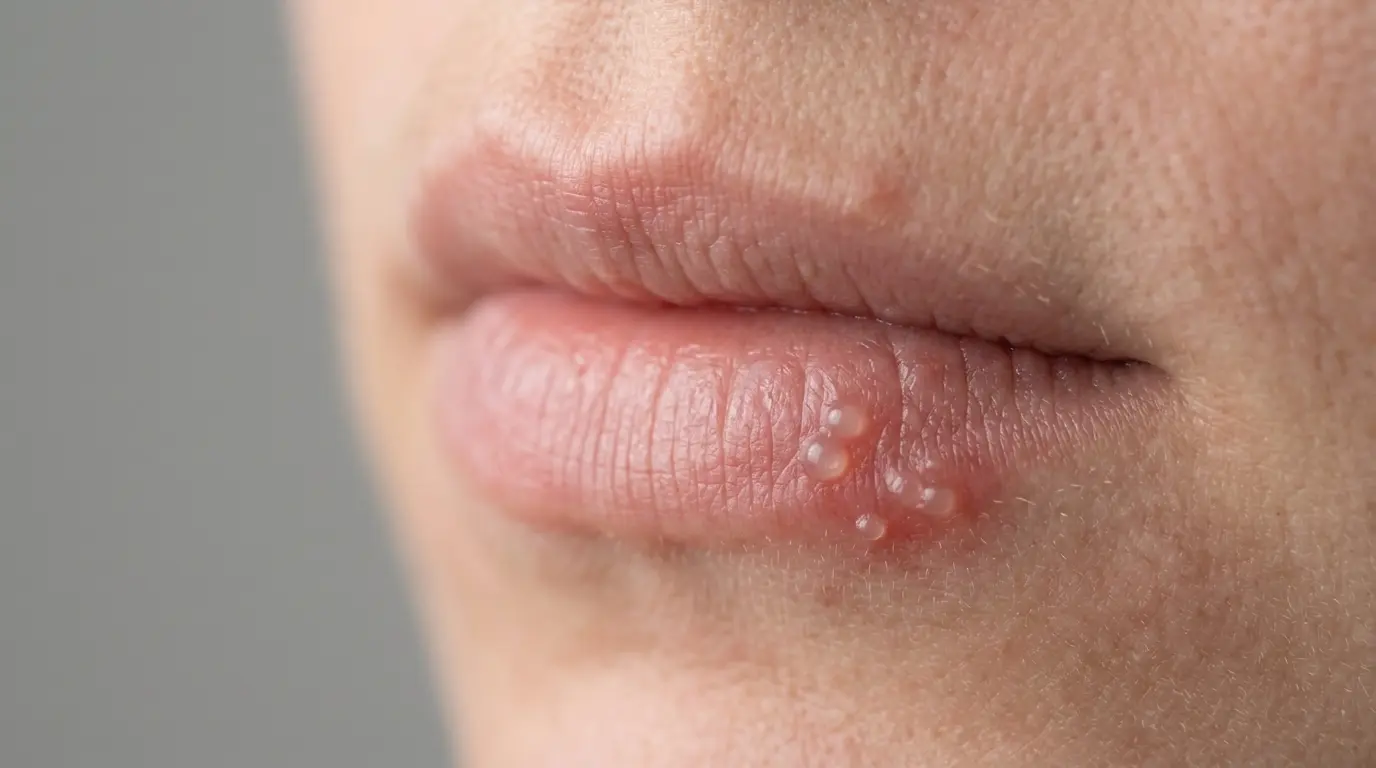
Cold sore on the lip in brief
- Cold sores are caused by herpes simplex virus, most commonly HSV-1. After the first infection, the virus remains in the body and can become active again later.
- An outbreak often begins with tingling, itching, tightness or burning before any visible blisters appear.
- Typical signs are small grouped blisters that may burst, followed by a sore and crust. Most recurrent outbreaks heal within about one to two weeks.
- Cold sores are contagious from the first warning symptoms until the area has completely healed. The risk of transmission is particularly high while active blisters are present.
- Early action, good hand hygiene and avoiding direct contact with the sore are important. Extra caution is needed around newborn babies, with lesions near the eye and in people with a severely weakened immune system.
Table of contents
What does a cold sore look like and how does it start?
A cold sore often begins before anything is visible on the skin. Tingling, itching, tightness, tenderness or burning may develop in a small localised area. Typical blisters may then appear within the following hours or by the next day.
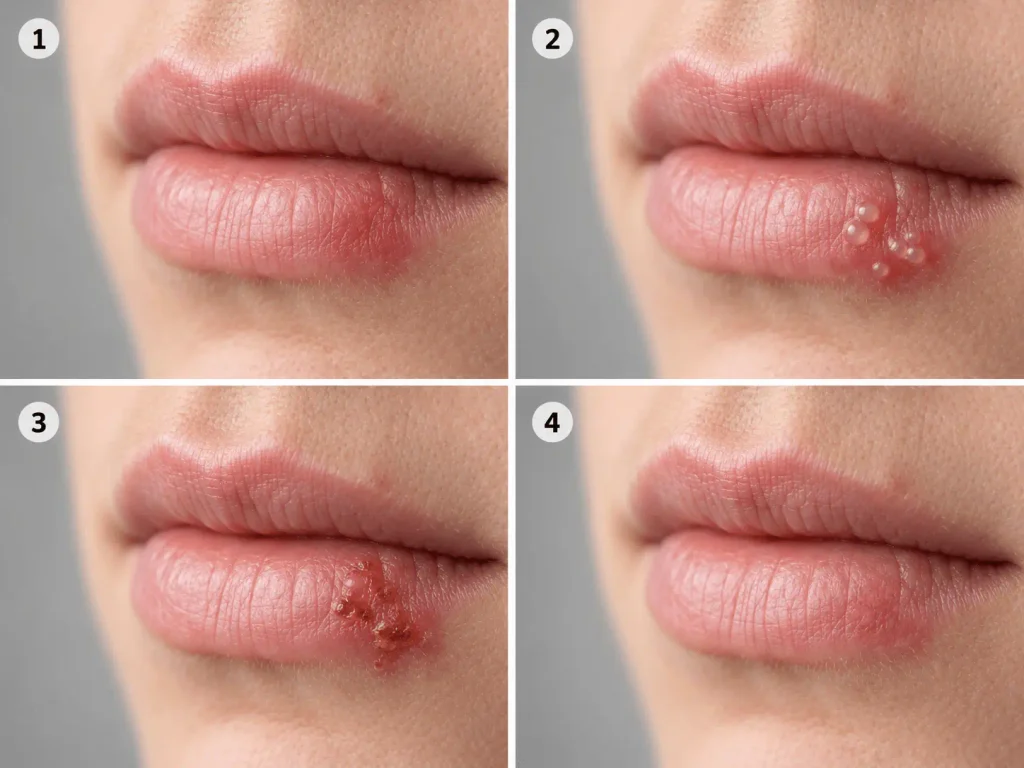
Typical course of an outbreak
- Tingling or burning: the area may feel sensitive, itchy or burning, while visible changes are absent or still very subtle.
- Blisters: small fluid-filled blisters appear, usually grouped together on a reddened area.
- Sore and crust: the blisters may burst and form a superficial sore, which then begins to dry and develop a crust.
- Healing: the crust gradually comes away and the skin recovers. A typical recurrent outbreak most often lasts about one to two weeks.
Where do cold sores usually appear?
They most commonly occur on the border of the lip or immediately next to it, but may also appear on the skin around the mouth or near the nose. Recurrent outbreaks often occur in the same or a similar area as before.
However, not every sore or blister near the lip is a cold sore. A single spot, a crack at the corner of the mouth or an ulcer on the inside of the lip may have a different cause. The difference between a cold sore and a mouth ulcer is explained later in this article.
Why does herpes occur and why does it recur?
Cold sores are caused by infection with herpes simplex virus, most commonly HSV-1. After the first infection, the virus does not disappear from the body. Instead, it remains inactive in nerve cells and can occasionally reactivate, causing another outbreak on or near the lip.
What can trigger another outbreak?
In some people, cold sores recur without an obvious reason, but an outbreak may coincide with one or more common triggers:
- a cold, fever or another infection,
- strong sun exposure or UV radiation,
- stress or lack of sleep,
- physical exhaustion,
- hormonal changes,
- injury or irritation of the skin around the lips.
Triggers are not the same for everyone. If cold sores recur frequently, it can therefore be useful to notice whether outbreaks follow a pattern, for example after strong sun exposure, illness or periods of increased stress.
Why does it often return in a similar place?
When the virus reactivates, it travels along nerve pathways towards the skin. Recurrent outbreaks therefore often appear in the same or a nearby area. This is typical of recurrent cold sores and does not mean that the skin at that spot has been newly infected from outside.
How long does a cold sore last and how long is it contagious?
A typical recurrent cold sore most often heals within about one to two weeks. The course is not identical for everyone: in some people the blisters quickly progress to crusting, while in others healing takes somewhat longer.
How long is a cold sore contagious?
A cold sore can be contagious from the first symptoms, such as tingling, itching or burning, until the skin has completely healed. The risk of transmission is generally highest while fresh blisters or a weeping sore are present.
Even once a crust has formed, the area is not necessarily completely free of transmission risk. A practical endpoint is therefore when the lesion has fully healed and the skin is intact again.
How can you reduce the risk of spreading it?
- avoid touching the lesion unnecessarily,
- wash your hands after touching it or applying a product,
- avoid kissing and direct contact with the sore during an active outbreak,
- do not share lip balm, lipstick or other items that directly touch the lips,
- take particular care not to touch your eyes after touching a cold sore.
Extra caution is needed around newborn babies, because herpes simplex infection can be considerably more serious in newborns than in healthy adults.
What helps with a cold sore on the lip?
Most recurrent cold sores heal on their own. Treatment is mainly aimed at shortening symptoms, reducing pain and irritation, and limiting transmission. With antiviral treatment, starting early is particularly important.
Antiviral medicines
Antiviral creams containing active ingredients such as aciclovir or penciclovir may shorten an outbreak slightly when started at the first signs, for example during tingling or burning.
For frequent, pronounced or more severe outbreaks, a doctor may prescribe oral antiviral medicines. These also generally work best when treatment is started very early.
What can you do at home?
- do not scratch the area, burst the blisters or pick off the crust,
- a cool compress may temporarily reduce burning and pain,
- protect the lips from further drying and cracking,
- always wash your hands after touching the lesion,
- if sunlight tends to trigger your outbreaks, protect the lips from UV exposure.
Standard pain-relieving medicines may be used when needed if they are otherwise suitable for you and are taken according to their instructions.
Does toothpaste help?
Toothpaste is often mentioned as a home remedy, but it is not a standard treatment for cold sores. Some ingredients may further dry or irritate already sensitive and damaged skin. It therefore makes little sense to try to aggressively “dry out” the blisters with irritating products.
Mouth ulcer, pimple or cold sore?
A sore or bump near the lip is not always a cold sore. The most useful clues are where it appears, what it looks like and how it started.
| Feature | Mouth ulcer | Pimple | Cold sore |
|---|---|---|---|
| Typical location | Inside the mouth on softer oral mucosa | On the skin next to the lip | Most often on the lip border or immediately next to it |
| Appearance | A shallow round or oval ulcer with a whitish or yellowish centre and red border | A single red bump, sometimes with a white or pus-filled head | Several small grouped blisters on a reddened base |
| How it starts | Usually a painful ulcer without preceding blisters | A tender or painful bump develops gradually | Often begins with tingling, itching or burning |
| Contagious? | No | No | Yes |
Location is particularly helpful: a mouth ulcer is usually inside the mouth, while a cold sore most often occurs on the border of the lip or the skin immediately next to it. More detail is available on our mouth ulcers page.
Appearance is not always completely typical, so the cause of every lesion cannot be determined reliably from a photograph or a single sign alone. An unusual, worsening or persistent lesion should be assessed.
Primary infection and oral herpes in children
The first infection with herpes simplex virus often causes little or no noticeable illness, but in some children it can produce a much more extensive picture than a typical recurrent cold sore on the lip.
When herpes is more than a single blister on the lip
A symptomatic first infection may cause numerous painful lesions throughout the mouth, red and swollen gums, fever, drooling, irritability and difficulty eating or drinking. This condition is known as herpetic gingivostomatitis.
In children, the most important practical issue is to monitor fluid intake and general condition. If pain makes the child drink very little, urination decreases, the mouth becomes dry, the child is unusually tired or the condition worsens, earlier medical assessment is advisable because of the risk of dehydration.
Are all mouth sores in children caused by herpes?
No. Painful oral lesions can have many causes, including aphthous ulcers, other viral infections and mechanical injury to the mucosa. A symptomatic primary herpes infection is more suggestive when there are multiple lesions together with inflamed gums, fever and general illness.
When is medical assessment needed for a cold sore?
Most typical recurrent cold sores do not require medical assessment. However, some situations call for greater caution.
Seek medical advice promptly if:
- lesions develop on or very close to the eye, or you develop eye pain, redness, sensitivity to light or changes in vision,
- a newborn baby develops blisters or other symptoms that could suggest herpes simplex infection,
- you have a severely weakened immune system and develop an active cold sore,
- a person with atopic dermatitis or eczema develops numerous, rapidly spreading or painful blisters or sores.
Medical assessment is also advisable if:
- the outbreak is unusually large, very painful or extensive,
- the lesion has not clearly started to heal after about 10 days or lasts unusually long,
- cold sores recur very frequently or outbreaks are becoming more severe,
- there are numerous mouth lesions, severely inflamed gums, fever or difficulty drinking,
- you are unsure whether the lesion is actually a cold sore.
For frequent recurrences, a doctor can also assess whether antiviral treatment at the first symptoms or preventive treatment for particularly frequent outbreaks would be appropriate.
Smrekovit for cold sores – practical use
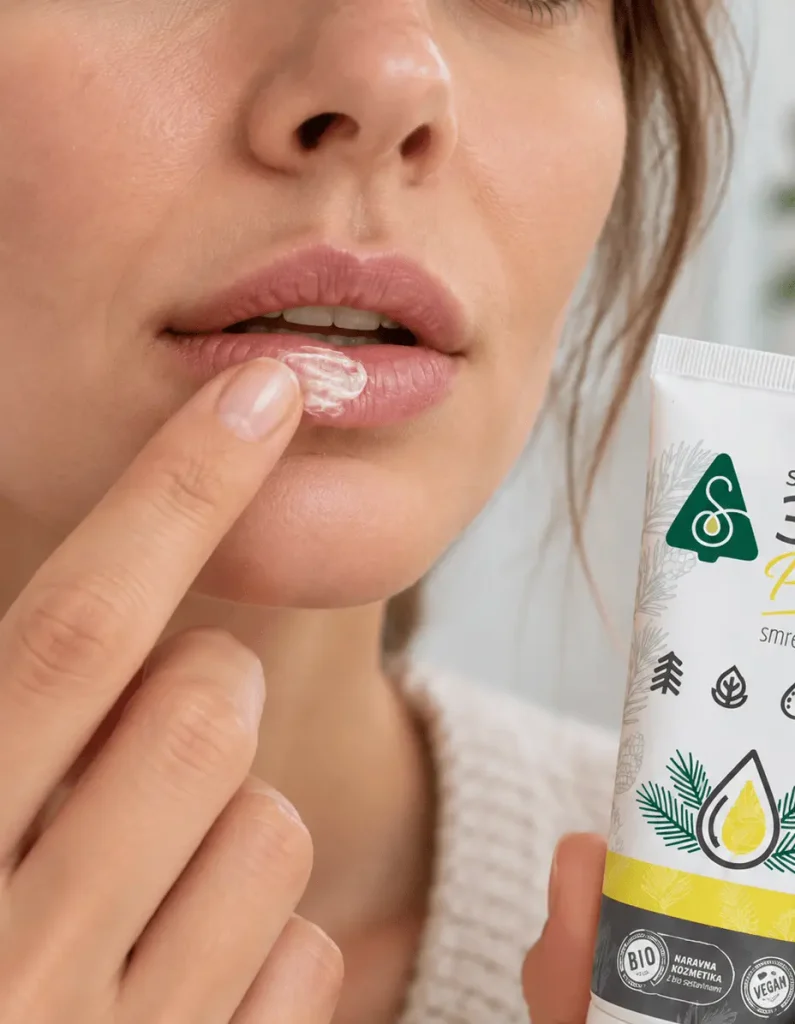
For an external cold sore on the lip, our practical documentation most commonly uses Smrekovit 365 Prima. The cream is applied locally to the outer lip or to the area where the typical first signs appear.
Early application is particularly important
In our practical experience, it is best to start at the stage of tingling, itching or burning, before visible blisters develop. If the cold sore has already appeared, the cream is applied directly to the affected area.
This is practical guidance based on many years of advising users and is not a substitute for antiviral treatment when such treatment is needed.
A practical tip for a longer-lasting application
If you want the cream to remain on the lip for longer, a slightly thicker layer can be applied. In our practical experience, it can then be gently dried for a short time with a hair dryer so that a more persistent layer forms on the surface and the product is less easily rubbed away.
Use only a gentle airflow and keep a suitable distance so that hot air does not further irritate the sensitive area.
More detailed instructions are available in our Smrekovit instructions for cold sores.
User experiences with cold sores
Below are two individual user experiences from the Smrekovit archive. Individual experiences are not evidence of a general effect and results may vary between users.
I used Smrekovit 365 for a cold sore when it had already started to break out. I applied it around the affected area and a kind of film formed and peeled away, while the condition improved quickly. I used it twice a day, morning and evening.
Zofka, Nova Gorica
[188] user experience received on 9 June 2021, kept in the Smrekovit archive
Smrekovit Klasik ointment really helps me a lot during cold sore outbreaks. My daughter and I both tried it, and it helped both of us.
Majda, Ljutomer
[215] user experience received on 31 March 2021, kept in the Smrekovit archive
Read more user experiences here →
Frequently asked questions about cold sores on the lip
How long is a cold sore contagious?
A cold sore can be contagious from the first signs, such as tingling, itching or burning, until the skin has completely healed. The risk of transmission is particularly high while fresh blisters or a weeping sore are present.
Can herpes also occur inside the mouth?
Yes. Herpes simplex infection can also cause lesions inside the mouth, particularly during a symptomatic first infection. In children, numerous painful mouth sores may occur together with severely inflamed gums and fever.
Does toothpaste help with cold sores?
Toothpaste is not a standard recommended treatment for cold sores. Some of its ingredients may further dry and irritate already sensitive or damaged skin.
How is Smrekovit used for a cold sore?
For an external cold sore on the lip, our practical documentation most commonly uses Smrekovit 365 Prima. It is applied locally to the affected area or at the first signs, such as tingling, itching or burning. More detailed instructions are available in our instructions for use with cold sores.
What is the difference between a mouth ulcer and a cold sore?
A mouth ulcer is usually a painful ulcer inside the mouth and is not contagious. A cold sore most often develops on or next to the lip as a group of small blisters and is contagious. More is explained on our mouth ulcers page.
What should I do if cold sores keep coming back?
It can help to notice possible triggers such as strong sunlight, illness or stress. If outbreaks are very frequent, extensive or severe, a doctor can assess whether early or preventive antiviral treatment is appropriate.