
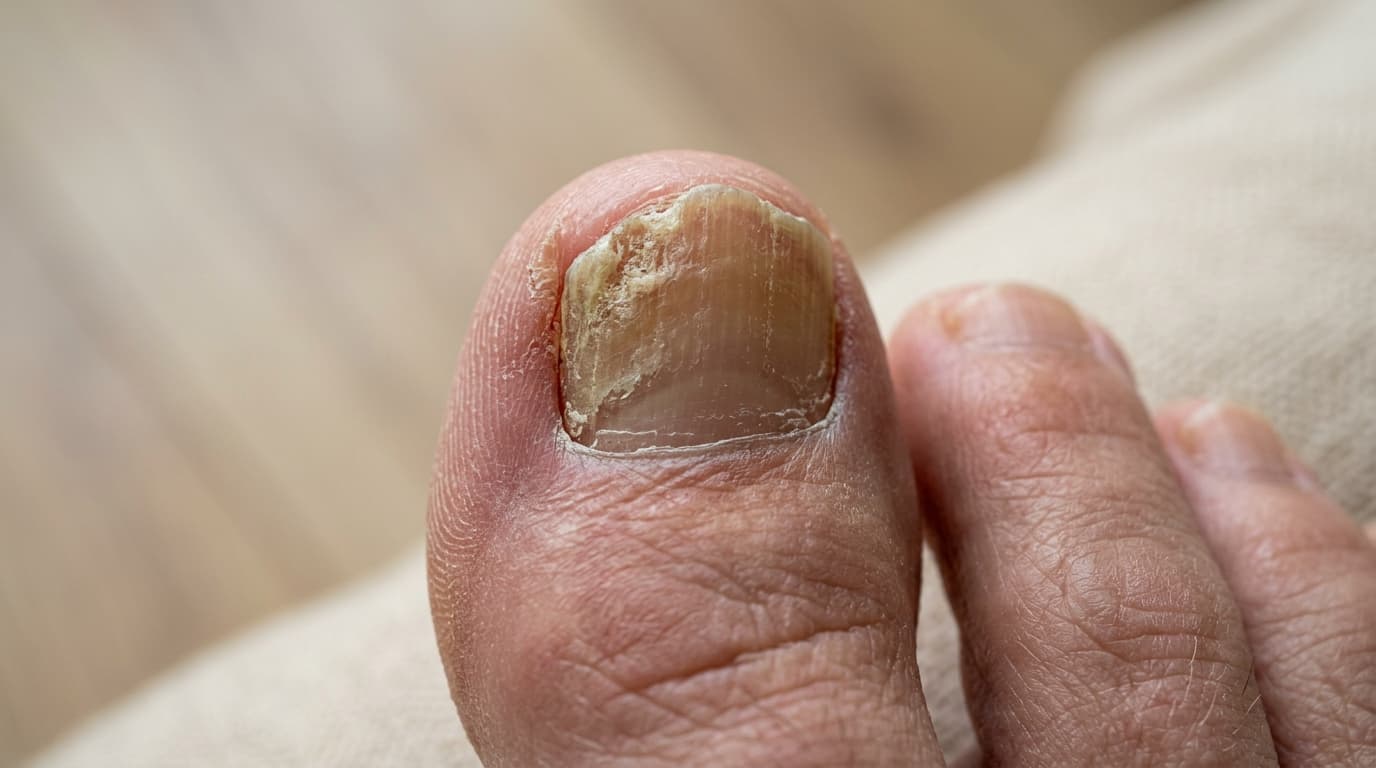
What helps with fungal nail infections?
With fungal nail infections, the first important step is to make sure that the problem really is a fungal infection, as a thickened, discoloured or damaged nail can also have other causes. The treatment approach then depends mainly on how much of the nail is affected and whether the infection involves several nails or the nail matrix.
For milder forms, topical antifungal medicines specifically intended for the nail are used, while for more extensive or persistent infections a doctor may prescribe antifungal treatment in tablet form. Ordinary antifungal creams intended mainly for the skin are not the same as medicines designed to deliver the active ingredient through the nail plate.
Key points at a glance
- Not every nail change is a fungal infection. Injuries, pressure from footwear and some diseases can cause a similar appearance.
- Treating the nail takes time. Even when the approach is successful, the healthy part of the nail has to gradually grow out and replace the damaged part.
- Look for the first signs of improvement at the nail base. A new, healthy part of the nail growing out is a more important sign than the appearance of the old, already damaged part.
- Consistency matters. Because nails grow slowly, stopping too early is a common reason why an approach is abandoned before the result can be properly assessed.
- Preventing reinfection is important. Keeping footwear and socks dry and disinfecting nail scissors, files and other nail-care tools is sensible.
Among Smrekovit users, monitoring the new nail growth at the nail base is also the main practical indicator we use to assess whether a local approach appears worthwhile. The exact method of use will be described in a separate practical section.
Table of contents
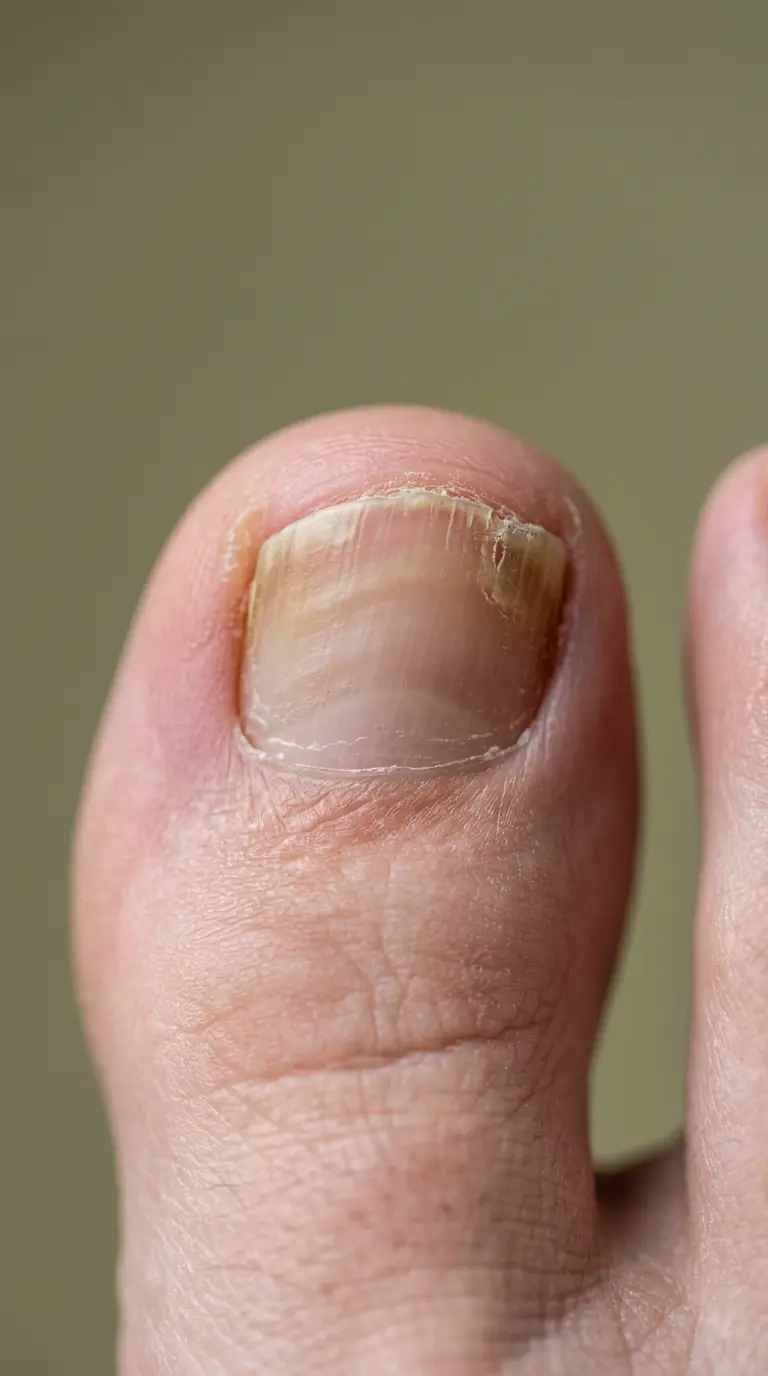
How to recognize nail fungus?
Fungal nail infections often begin subtly, at first as a change in the colour or structure of part of the nail. Toenails are affected most often, especially the big toe, and the infection usually progresses slowly.
Change in nail colour
The first sign is often a whitish, yellowish or brownish discolouration that may begin at the edge of the nail and gradually spread. A change in colour alone, however, is not proof of a fungal infection.
Thickened and altered nail
Over time, the nail may become thicker, harder and irregular in shape. Keratinised material may accumulate beneath the nail, making it more difficult to trim.
Brittle or crumbling nail
The affected edge of the nail may begin to split, break or crumble. In more advanced cases, the nail may partially separate from the nail bed.
Do fungal nail infections hurt?
In the early stages, they often do not cause pain. If the nail becomes markedly thickened or deformed, however, pressure from footwear may cause discomfort or pain.
It is important to understand that the appearance of the nail alone is not always sufficient for a reliable diagnosis. Nail injuries, psoriasis and other changes can look similar, so professional confirmation is advisable in unclear or persistent cases.
Not every nail change is a fungal infection
A yellow, thickened, brittle or deformed nail does not necessarily mean a fungal infection. A similar appearance can also be caused by mechanical injury to the nail, prolonged pressure from footwear, psoriasis, age-related changes and other conditions.
Damaged or stressed nail
An impact, repeated pressure inside footwear or sports-related stress can cause discolouration, thickening or separation of the nail. Such changes can look very similar to a fungal infection.
Black or dark spot on the nail
A dark area under the nail is often caused by bleeding after an injury or pressure, but it may also have other causes. If it appears without a clear injury, becomes larger, changes shape or does not grow outward with the nail, professional assessment is advisable.
A thickened nail is not necessarily fungal
Nails can become thickened because of long-term mechanical stress, age-related changes or other nail conditions. With a fungal infection, discolouration, crumbling or accumulation of material under the nail are often present at the same time, but even this combination is not a completely reliable diagnosis on its own.
When is it sensible to confirm the diagnosis?
If the change is pronounced, persists for a long time, affects several nails or treatment with tablets is being considered, it is sensible to confirm whether the problem is really a fungal infection. A doctor or dermatologist can, if needed, take a nail sample for mycological testing.
This is also important because there is little point in treating presumed fungal infection for several months if the nail change has another cause.
How are fungal nail infections treated?
Treatment of fungal nail infections depends on the extent of the infection, the number of affected nails, the location of the infection and the person’s general health. Milder cases are often treated with topical antifungal medicines, while for more extensive or persistent cases a doctor may prescribe tablets.
Topical treatment
For milder infections, preparations specifically intended for application to the nail are used and can reach the site of infection through the nail plate. These mainly include antifungal solutions or medicated nail lacquers. They need to be used regularly and for long enough, often for several months.
What about cream for fungal nail infections?
When talking about “cream for fungal nail infections”, it is important to distinguish between a fungal infection of the skin and an infection of the nail itself. Ordinary antifungal creams for the skin are generally not intended to treat infection within the nail plate, because the active ingredient penetrates the nail less easily.
If fungal infection of the skin of the foot or between the toes is also present, the skin can be treated separately with an appropriate antifungal preparation. This also reduces the possibility of the infection being transferred back to the nail.
Treatment with antifungal tablets
For more pronounced infections, involvement of several nails or unsuccessful topical treatment, a doctor may prescribe systemic antifungal treatment. Before such treatment, it is especially important to confirm that the problem really is a fungal infection, as similar nail changes can also have other causes.
Why does treatment take so long?
Even successful treatment does not immediately change the already damaged part of the nail. Improvement is seen mainly at the nail base, where a new, healthier part of the nail begins to grow. The old affected part then has to gradually grow out, so results are assessed over months rather than days.
Smrekovit for fungal nail infections – practical instructions for use
Among Smrekovit users who contact us because of typical fungal changes of the nails, our practical approach differs from that used for fungal skin problems. With the nail, it is not only the application to the surface that matters, but also regularity, the application site and sufficiently long contact of the product with the nail.
For this type of local use, we use Smrekovit 365 Prima. Based on our many years of practical experience, fungal nail changes are among the more predictable uses of Smrekovit for skin-related problems, but they require much more time and persistence than fungal changes of the skin.
How do we apply it locally?
- After showering or washing, dry the nail thoroughly.
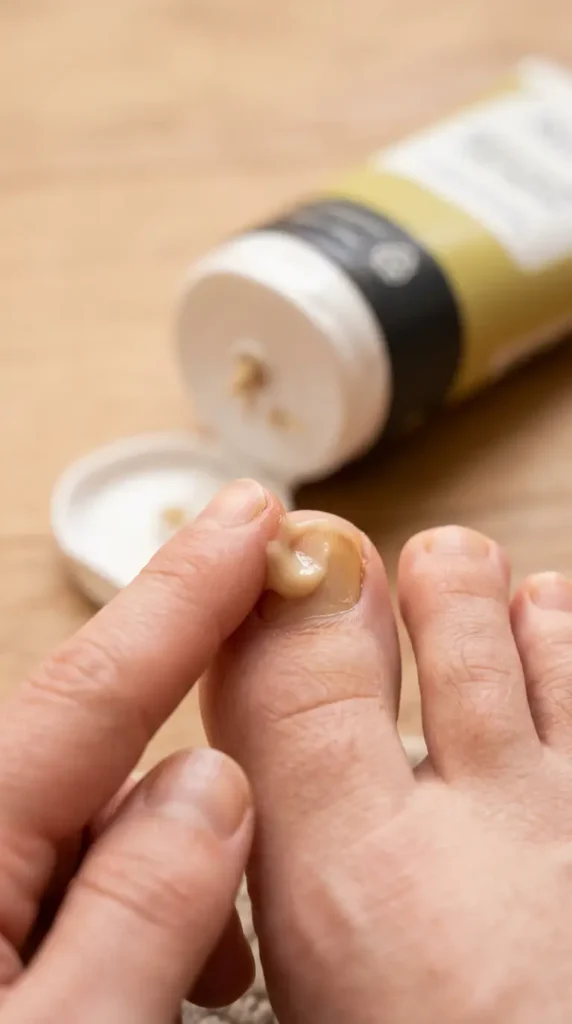
- Apply Smrekovit 365 Prima over the entire surface of the nail, along its edges and at the nail base.
- Then cover the nail with white medical tape or microporous tape so that the product remains in place for as long as possible.
- Repeat the procedure once daily, preferably after showering. This type of application will usually last until the next shower.
Do not assess the old part of the nail
With this type of use, we do not expect the already altered, yellowish or thickened part of the nail to return to normal within a few days. The main practical sign we monitor is a new, healthier-looking part of the nail at the nail base.
If a healthier-looking new part of the nail begins to appear at the base, it is important to continue use for long enough for this new part to gradually grow out and replace the affected part of the nail.
Do not forget nail scissors and files
This is one of the most commonly overlooked points. Regularly disinfect nail scissors, files, clippers and other nail tools, and do not use them on healthy and affected nails without cleaning them in between.
This section describes our practical method of local use of Smrekovit products. If the diagnosis is unclear, the nail is severely affected or treatment with medicines is being considered, professional confirmation of the cause of the nail change is also advisable.
See detailed practical instructions for fungal nail infections →
How long does nail fungus last?
With fungal nail infections, it is important to distinguish between the time needed to bring the infection under control and the time the nail needs to regain a normal appearance. Even when the approach is successful, the already damaged part of the nail does not disappear – it must gradually be replaced by new nail growth.
For toenails, this therefore means months. The big toenail in particular grows slowly and may take about a year or even longer to renew completely. In some people, full nail regrowth may take 12–18 months.
Where do we first notice improvement?
Do not assess progress by looking at the tip or the old, already altered part of the nail. The most important area is the nail base. If a new, healthier-looking part of the nail begins to grow from there, the boundary between the new and old part gradually moves toward the tip.
This is also the main practical criterion we use when monitoring Smrekovit users. When healthier-looking new nail growth appears at the base, it is important to continue regular use until the new part gradually grows out and replaces the affected nail.
Why do people often give up too soon?
Because the old part of the nail changes very little visually during the first few weeks, it may seem as though nothing is happening. With nails, however, the direction of new growth is more important than a rapid change in the overall appearance.
If, after a longer period of correct use, there is still no sign of healthier growth at the nail base or the change continues to spread, it is sensible to reassess the diagnosis and the chosen approach.
Why do fungal nail infections recur and how can the risk be reduced?
Fungal nail infections can recur even after successful treatment. This does not necessarily mean that the previous approach failed; often, conditions that favour reinfection remain present – especially moisture, fungal infection of the skin of the feet, contaminated footwear or nail tools.
Pay attention to the skin between the toes as well
A fungal infection of the skin of the foot can occur at the same time as a fungal nail infection and can act as a source of reinfection. If there is peeling, itching, cracking or other typical changes between the toes, it makes sense to address the skin as well as the nail.
Reduce moisture in footwear
Fungi thrive in warm and moist environments. Change socks regularly, dry the feet thoroughly after washing, especially between the toes, and allow footwear to dry completely between uses. If possible, alternate shoes and avoid wearing damp footwear for long periods.
Separate and disinfect nail tools
Nail scissors, clippers and files can come into contact with an affected nail and then transfer fungi to other nails. Clean and disinfect them after use and do not share them with other people.
Swimming pools, shared showers and changing rooms
In shared damp environments, it is sensible to wear your own sandals or flip-flops. After visiting a swimming pool, sauna or shared shower, dry the feet thoroughly, as small skin injuries and prolonged moisture can make infection easier.
Protect the nail from repeated injury
Shoes that are too tight and repeated pressure on the nail can damage the nail plate and surrounding tissues. Properly fitting footwear and correct nail trimming are therefore important not only for comfort, but also for maintaining healthy nails.
With recurrent problems, it is useful to think beyond the nail itself: a successful approach also includes the skin of the feet, footwear, socks and the tools that come into contact with the nails.
When is an examination advisable for fungal nail infections?
With a mild change affecting a single nail, an examination is not always immediately necessary. However, professional assessment is advisable when the diagnosis is unclear, the change is spreading or the chosen approach is not leading to improvement.
If the condition does not improve or continues to spread
An examination is advisable if several nails are affected, if the change continues to spread despite correct and sufficiently long use of a local approach, or if no new, healthier-looking nail is visible at the nail base.
Pain, swelling or inflammation around the nail
If the nail or the skin around it becomes markedly painful, red or swollen, or if discharge appears, an examination is needed. Such signs may also indicate an additional bacterial infection or another problem that is not simply a fungal nail change.
Diabetes or poor circulation
With diabetes, poor circulation in the feet or a weakened immune system, greater caution is advisable when nail changes occur. Foot problems can become complicated more quickly in these cases, so earlier professional assessment is sensible.
Before treatment with antifungal tablets
If systemic treatment is being considered, it is sensible to first confirm that the problem really is a fungal infection. A dermatologist or doctor can, if needed, take a nail sample, as a similar appearance can also be caused by injury, psoriasis and other conditions.
An unusual dark nail change
A dark spot or streak that has no clear connection with an injury, changes, spreads or does not grow outward with the nail is also a reason for examination. Such changes are not a typical sign of an ordinary fungal nail infection.
A prolonged course is common with fungal nail infections, but that does not mean it makes sense to continue for months with an incorrect diagnosis. If the appearance or course is not typical, it is better to have the cause checked.
What causes fungal nail infections?
Fungal nail infections, or onychomycosis, can be caused by different groups of fungi. The most common are dermatophytes, especially species from the genus Trichophyton. A smaller proportion of infections are caused by moulds, while yeasts are less common in toenail infections.
This difference is not just a technical detail. Different causative organisms may respond differently to treatment, so in persistent or atypical cases it can be useful to know which fungus is actually present.
Dermatophytes
Dermatophytes cause most fungal nail infections. One of the most common causative organisms is Trichophyton rubrum, which can also affect the skin of the feet and spread from there to the nail.
Moulds and yeasts
Fungal nail infections can also be caused by some moulds and yeasts. With moulds, diagnosis can be more difficult because they may also appear in laboratory culture as contaminants of the sample and are not necessarily the true cause of the nail change.
Knowing the causative organism is also important when interpreting research on spruce resin, as the results were not the same for all groups of fungi.
Are fungal nail infections caused by “Candida in the body”?
In alternative diagnostic methods, especially bioresonance, it is sometimes claimed that various health problems are caused by an excessive presence of Candida in the body and that fungal nail infections are one of its signs. This explanation is overly simplified and is not how fungal nail infections are diagnosed in medicine.
Yeasts from the genus Candida can indeed cause fungal nail infections, so it would not be correct to exclude Candida entirely. However, they account for only a smaller proportion of cases of onychomycosis. By far the most common causative organisms are dermatophytes, especially species from the genus Trichophyton.
It is therefore not possible to conclude from the appearance of a nail that a person has “Candida in the body”. Likewise, bioresonance testing is not an established diagnostic method for identifying the causative organism of a fungal nail infection.
If we want to determine whether a nail change is truly fungal and which fungus is causing it, a sample of the affected nail or material beneath it is examined in the laboratory, for example by microscopy, culture or another appropriate microbiological method.
For persistent or unclear nail changes, it is therefore much more sensible to confirm the causative organism with an appropriate test than to conclude that there is “systemic Candida” on the basis of bioresonance testing.
If you are interested in the broader topic of “systemic Candida”, saliva tests, bioresonance and symptoms that are often attributed to Candida, we have covered this in a separate article: Candida: uncovering the facts, debunking the myths.
Spruce resin and fungal nail infections – what does the research show?
Spruce resin is of interest not only because of its traditional use. Resin from Norway spruce (Picea abies) has also been studied directly in relation to dermatophytes and fungal nail infections.
What did laboratory studies show?
In a laboratory study of purified Norway spruce resin, researchers found pronounced fungistatic activity against the tested dermatophytes, including species from the genus Trichophyton. Electron microscopy also revealed changes in fungal hyphae and cell walls.
An important limitation, however, is that the result did not apply to all fungi. In the same study, the resin did not show antifungal activity against the tested Candida yeasts and opportunistic fungi. This is a good example of why the term “antifungal” should not be used without explaining which fungi the activity was actually studied against.
Spruce resin was also tested in fungal nail infections
Researchers then developed a special lacquer containing 30% purified Norway spruce resin. The first prospective observational study included 37 participants, who applied the lacquer to affected nails every day for nine months. The results showed both mycological and clinical signs of improvement in some participants, but the study had no control group, so the authors themselves regarded it as preliminary.
What did the comparative clinical study show?
In 2015, a randomized, investigator-blinded comparative study followed in 73 people with dermatophyte onychomycosis. Three approaches were compared: a 30% spruce resin lacquer once daily for nine months, a 5% amorolfine lacquer once weekly for nine months, and oral terbinafine for three months.
After ten months, complete mycological cure was achieved in 13% of users of the spruce resin lacquer, 8% of users of amorolfine and 56% of users of terbinafine. In this study, the spruce resin lacquer and amorolfine had comparable results, while systemic terbinafine was substantially more effective than either topical approach.
What do these studies show – and what do they not show?
The studies indicate that Norway spruce resin has interesting and measurable effects against dermatophytes and that a specially formulated 30% spruce resin lacquer has also been tested in clinical studies in onychomycosis.
These results cannot, however, be directly transferred to Smrekovit 365 Prima. The studies used a specially formulated 30% resin lacquer, not Smrekovit cream. The research therefore provides a scientific basis for understanding the properties of spruce resin as a substance, but it is not evidence of the clinical effectiveness of a specific Smrekovit product.
When interpreting the findings, the relationship of some of the researchers with the developer of the resin lacquer studied should also be taken into account. In the comparative study, the company Repolar funded the medicines, laboratory tests and follow-up visits, and two of the authors were shareholders in the company.
User experiences with fungal nail infections
Below are individual comments from Smrekovit users who described their experience with nail changes associated with fungal infections. These are personal experiences of individual users; the course and outcome may not be the same for others.
…My husband had problems with nail fungus on his feet. With regular application of Smrekovit, they have almost completely disappeared. He has been applying it for more than 6 months. (94)
Renata, Rovte
[94] handwritten feedback received on an unknown date, kept in the Smrekovit archive
I finally found a cream that really helps. I have been battling with nail fungus for three years. A friend recommended your product to me. She lent me half a box and as I can see an improvement in my nails after only 25 days, I am very happy and hopefully I will get rid of the fungus.
Emilija, Bled
[101] handwritten feedback, received 6.8.2018, stored in the Smrekovit archive
My boyfriend and I tried it for nail fungus and after just one week, we saw concrete results.
Petra Mahnič, Facebook
[77] Facebook feedback, received 24.2.2016, printed and stored in the Smrekovit archive
I use Smrekovit on a fungal nail, which is improving slowly but nicely…
Mariša, Polzela
[6] handwritten feedback received on an unknown date, kept in the Smrekovit archive
You can find more user experiences here →
Frequently asked questions about fungal nail infections
What do fungal nail infections look like?
A fungal infection can cause white, yellowish or brownish discolouration of the nail, thickening, crumbling and changes in shape. It often begins at the edge of the nail and progresses slowly. Similar changes can also have other causes, so appearance alone is not always sufficient for a reliable diagnosis. More is explained in the section How to recognise a fungal nail infection?.
What helps with fungal nail infections?
With a confirmed fungal infection, topical antifungal medicines intended specifically for the nail are used depending on the extent of the problem, while for more pronounced infections a doctor may also prescribe treatment with tablets. Consistency, sufficiently long treatment and prevention of reinfection are important.
Is cream enough for fungal nail infections?
Ordinary antifungal creams for the skin are not the same as medicines intended to treat infection within the nail plate. If fungal infection is also present on the skin of the foot or between the toes, the skin is treated separately. More about the options is explained in the section How are fungal nail infections treated?.
How is Smrekovit used on an affected nail?
In our practical method of use, Smrekovit 365 Prima is applied over the entire surface of the nail, along the edges and at the nail base, after which the nail is covered with white medical tape or microporous tape. The procedure is generally repeated once daily, preferably after showering. The more detailed procedure is described in the practical instructions.
How long do fungal nail infections take?
Changes in the appearance of the nail take time because the damaged part must gradually be replaced by new nail growth. With toenails, complete renewal may take about a year or even longer. Progress is therefore best monitored mainly at the nail base, where a new, healthier-looking part of the nail appears first. More is explained in the section How long do fungal nail infections take?.
Can fungal nail infections go away on their own?
A fungal nail infection generally does not disappear simply with the passage of time. Without an appropriate approach, it may persist or gradually progress, so it is sensible to take action, especially if the change spreads to a larger part of the nail or to other nails.
Can fungal nail infections spread?
Yes. Fungi can spread between nails and between the skin and nails, and they can also be transmitted through shared nail tools, footwear and damp communal surfaces. Drying the feet and footwear, changing socks regularly, and cleaning and disinfecting nail tools are therefore important.
Can I cut or file away the infected part of the nail?
A thickened or damaged part of the nail can be carefully trimmed or filed, but this does not remove the cause of the infection. Clean and disinfect the tools after use and do not use them on healthy nails without cleaning them first.
When is an examination advisable for a nail change?
An examination is advisable if the diagnosis is unclear, several nails are affected, the condition is spreading or not improving, pain, redness, swelling or discharge develops, or if you have diabetes, poor circulation or a weakened immune system. More is explained in the section When is an examination advisable for fungal nail infections?.