

What helps with heel spur?
For pain commonly associated with a heel spur, the most helpful measures are usually to reduce the activities that trigger the problem, choose suitable footwear, and regularly stretch the plantar fascia and calf muscles. Insoles or heel pads may also help some people, while persistent or severe symptoms should be professionally assessed.
It is important to know that a bony growth on the heel bone is not necessarily the cause of pain in itself. The symptoms are often mainly associated with overloading of the plantar fascia and tissues on the underside of the heel, so treatment is generally not aimed at “removing the spur”, but at reducing the load and gradually calming the symptoms.
Key points at a glance
- Pain during the first steps in the morning is one of the most typical patterns of plantar fascia problems.
- Adjusting the load is more important than continuing activities that repeatedly trigger the pain.
- Stretching and suitable footwear are among the basic conservative measures.
- Improvement is usually gradual and may require several weeks of consistency.
- Not every heel pain is caused by a heel spur. Pain at the back near the Achilles tendon, marked swelling, tingling, or sudden severe pain may point to another cause.
Table of contents
How to help yourself with a heel spur
For typical pain on the underside of the heel, there is usually no single measure that will resolve the problem overnight. The most sensible approach is a combination of adjusting the load, stretching, suitable footwear and, if needed, additional local approaches.
Adjust the load
Temporarily reduce activities that noticeably increase the pain, especially prolonged standing, longer walks on hard surfaces, running or repetitive loading. This does not necessarily mean complete rest – the main goal is to interrupt the pattern in which the foot is overloaded again every day.
What does “cream for a heel spur” mean?
The term “cream for a heel spur” is very common when searching for solutions, but it is important to understand that a cream cannot remove or “dissolve” a bony growth. Local application can be part of a broader practical approach, together with adjusting the load, suitable footwear and other measures.
Among Smrekovit users who contact us because of typical problems in the heel area, a combination of Smrekovit 365 Prima and the Smrekovit Kontakt compress is often used in practice. The cream is intended for local application, while the Kontakt compress allows the product to remain at the application site for longer.
Consistency is particularly important with this type of use. If wearing the compress for a longer period during the day is impractical, users usually apply it at least overnight and apply the cream several times during the day.
We have described the exact method of use and practical expectations separately in the instructions.
See practical instructions for use →
Stretch the plantar fascia and calf muscles
Regular and gentle stretching of the underside of the foot and the calf muscles is one of the common conservative measures for plantar fascia problems. It is particularly useful with typical morning pain and a feeling of tightness after rest.
Choose suitable footwear
Footwear should be comfortable, well cushioned and provide appropriate support for the foot. Walking barefoot on hard surfaces and worn-out or very rigid footwear can further aggravate the problem. Heel pads or insoles may also help some people, especially as part of a broader approach.
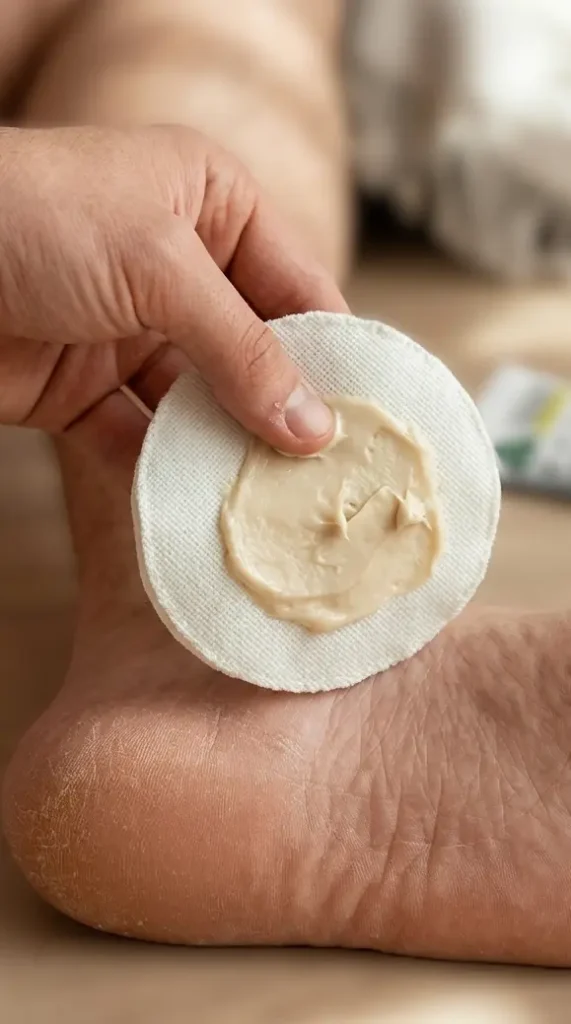
Onions, potatoes and other home remedies for heel spurs – do they help?
When searching for advice on heel spurs, various “home remedy” approaches also often come up – for example onion or potato compresses, prunes and other traditional recipes.
There is no reliable clinical evidence that such approaches remove the bony growth or address the cause of the typical heel pain. Even if a particular compress feels soothing to someone, that does not mean it affects the spur itself or the plantar fascia.
Onion for a heel spur
Onion compresses are among the more common home remedies, but there is no evidence that onion can “dissolve” or remove a heel spur.
Potato for a heel spur
The same applies to potato compresses. Potato appears in traditional advice for various problems, but it is not an established approach for plantar fascia problems or heel spurs.
What about prunes and other home remedies?
There is also no good evidence that prunes or similar home remedies affect the development or size of the bony growth. It is also not advisable to try to mechanically “break up” the spur by striking the heel, as this can further irritate the painful area.
What about a local approach?
A local approach is different from trying to “dissolve the spur”. It is intended for local use on the painful area and is best considered as part of a broader approach together with load adjustment, suitable footwear and other measures.
With this type of use, longer contact of the product with the skin can also be important, for example by using a suitable compress. This is also the approach described in our practical instructions for users of Smrekovit products.
How long does a heel spur last?
With a heel spur, it is important to distinguish between the bony growth and the pain. The bony growth may remain present even after the symptoms have resolved, so the course is usually assessed mainly by the level of pain and how well the foot can be loaded.
Without an effective change in loading, the symptoms may persist for several weeks or months. The foot is used with almost every step, which makes it difficult to completely unload the irritated area.
How quickly can the pain decrease?
The course is different for every person. With conventional conservative approaches, improvement often develops gradually and may take several weeks or even months.
Among Smrekovit users, however, with a typical pattern of symptoms and a consistent local approach, we often observe a faster change: the pain may noticeably decrease within about one week, and within one to two weeks users often report a very marked improvement.
This is our practical observation with the use of a local approach and does not mean that the course will be the same for every individual. Consistent use is particularly important, and with heel spur problems, longer contact with a compress also plays an important role.
How can you tell whether things are improving?
Rather than focusing on an exact date, it is more useful to follow the trend: whether the first steps in the morning are less painful, whether you can load the heel more easily and whether pain-free periods are becoming longer.
If there is no change after about one week of a consistent local approach, it makes sense first to check the method of use and, in the case of atypical or persistent symptoms, also whether the cause of the pain is really what was initially assumed.
What is the heel spur?
A heel spur is a bony growth on the heel bone, most commonly on the underside of the heel. It often develops gradually at a site where the foot has been exposed to repeated loading over a longer period of time.
However, it is important to understand that the presence of a heel spur does not necessarily mean that the heel must be painful. Bony growths are relatively common even in people without symptoms, so an X-ray alone does not show what the actual source of pain is.
Does a heel spur really cause pain?
It can be associated with heel pain, but the relationship is not that simple. With typical pain on the underside of the heel, changes and overloading of the plantar fascia and other tissues around the heel bone are often important.
That is why someone may have no pronounced spur on an X-ray and still have severe symptoms, while another person may have a clearly visible bony growth without pain.
This distinction is also important when choosing an approach: the goal is generally not to “dissolve” or mechanically remove the bony growth, but to reduce problems in the painful area and eliminate or adjust the factors that are overloading it.
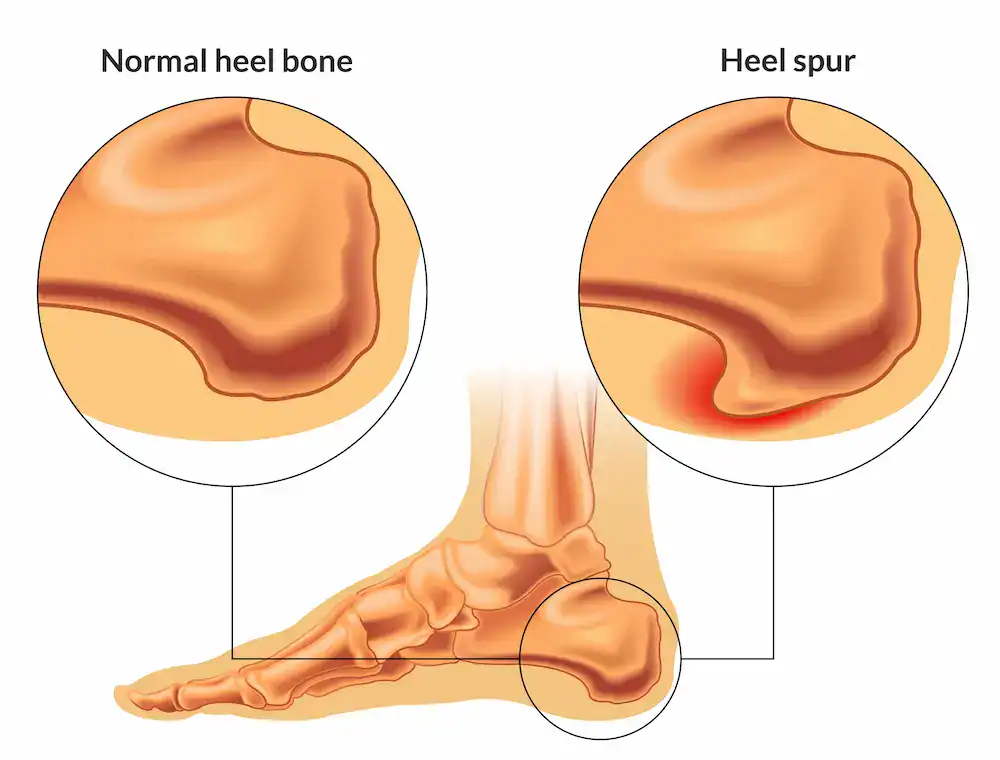
Heel spur – symptoms and typical signs
For problems that people often describe as a heel spur, the most characteristic feature is a pattern of pain on the underside of the heel. It is important not only where the pain is located, but also when it appears and how it changes throughout the day.
Pain during the first steps in the morning
Severe pain during the first steps after getting up or after a longer period of rest is very characteristic. After a few minutes of walking, it may ease somewhat, then increase again with prolonged standing, walking or greater loading.
Pain on the underside of the heel
The pain is most often concentrated on the underside of the heel, often slightly toward the inner side, where the plantar fascia attaches to the heel bone. The area may also be tender to direct pressure.
Tightness after rest
In addition to pain, a feeling of tightness or stiffness in the foot may occur after sleep or prolonged sitting. This often eases somewhat once the foot has been “walked in”.
Pain after prolonged loading
Prolonged standing, walking, running or repetitive loading can increase the pain again, especially toward the end of the day or after activity.
When is the pattern not typical of a heel spur?
Tingling, numbness, pain spreading through the foot or leg, marked swelling and pain mainly at the back of the heel are not typical of plantar heel pain. In such cases, other causes should also be considered.
If pain on the underside of the heel is strongest during the first steps after sleep or rest and then partly eases, this is one of the most characteristic patterns of plantar fascia problems.
Why does a heel spur develop and what increases the risk?
A heel spur usually does not develop because of a single event. More often, it results from long-term repetitive loading of the area where the plantar fascia and other tissues attach to the heel bone. Over time, the bone may adapt to this type of loading by forming a bony growth.
It is important to understand that the heel spur itself is not necessarily the cause of pain. With typical problems on the underside of the heel, it is often more important how much load the plantar fascia and surrounding tissues can tolerate.
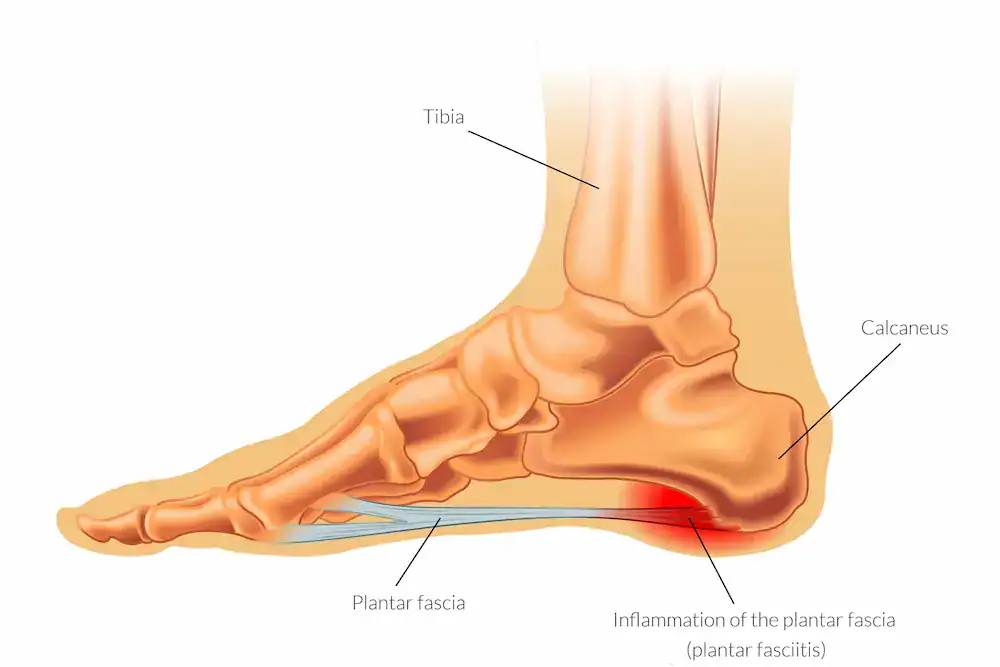
Prolonged or suddenly increased loading
A lot of walking or standing, running, working on hard surfaces, or a sudden increase in activity can increase the load on the plantar fascia. The problem therefore often appears after a change in training, work or everyday habits.
Tight calf muscles and reduced ankle mobility
If the calf muscles and Achilles tendon are less flexible, or if ankle mobility is limited, more load may be transferred to the underside of the foot during walking.
Unsuitable or worn footwear
Footwear with little cushioning or support, as well as worn-out shoes, can increase the load on the foot, especially in people who spend a lot of time standing or walking.
Foot shape and biomechanics
Both a markedly flat and a high foot arch can alter the way forces are transmitted through the foot in some people. What matters most is the combination with loading, mobility and footwear – foot shape alone does not mean that someone will develop problems.
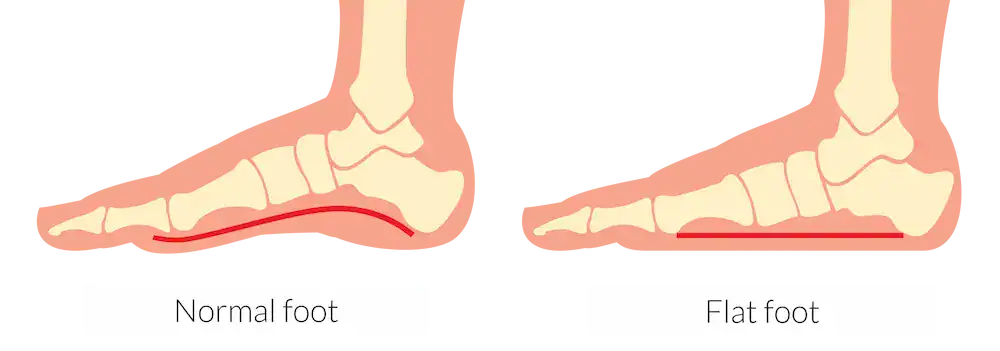
Body weight and other loads
Higher body weight means greater mechanical load on the foot with every step. The risk may also be higher during periods of rapid weight gain.
Age
Plantar heel pain is more common particularly in middle age, as the properties of tissues and their ability to tolerate repeated loading change over time.
There is usually no single “culprit” factor, but rather a combination of loading, mobility, footwear, body weight and individual foot structure.
Heel pain is not always caused by a heel spur
Pain on the underside of the heel that is most pronounced during the first steps after sleep or a longer period of rest is a typical pattern of plantar fascia problems. However, if the pain is located elsewhere or different symptoms are present, the cause may be different.
Pain at the back of the heel near the Achilles tendon
If the pain is mainly at the back of the heel or slightly higher toward the calf, problems with the Achilles tendon should also be considered. These may become more noticeable when walking uphill, running, rising onto the toes or after greater physical load.
Pain at the side of the heel or deep within it
Pain that is not concentrated at the typical site under the heel may have another cause. Possibilities include irritation of a bursa, overloading of other soft tissues or, more rarely, a problem in the bone itself, such as a stress injury.
Especially when pain appears after a sudden increase in walking, running or another type of load and becomes worse with continued activity, it is not advisable to automatically assume that a heel spur is the cause.
Tingling, numbness or spreading pain
Tingling, reduced sensation or pain that spreads through the foot or upward along the leg are not typical of the usual plantar heel pain pattern. Such symptoms may also indicate nerve irritation or a problem originating elsewhere.
If the pain spreads from the lower back or buttock down the leg toward the foot, you can read more about this pattern in our article on sciatica.
Sudden severe pain or marked swelling
Sudden severe pain after an injury, a popping sound or sensation that something has torn, marked swelling, bruising or inability to walk normally are not typical signs of a heel spur. In such cases, professional assessment of the injury is needed.
When is an examination advisable?
An examination is advisable if the pain is very severe, is worsening or recurring, significantly limits walking and everyday activities, or does not improve despite reducing the load and taking other measures.
It is also sensible to investigate the cause further if there is tingling or loss of sensation, marked swelling, pain after an injury, or when the symptoms do not fit the typical pattern of pain on the underside of the heel.
User experiences with heel spur problems
Below are individual feedback excerpts from Smrekovit users who described their experience with problems that they themselves or their doctors associated with a heel spur. These are personal experiences, and the course in one individual may not be the same for other users.
Heel spur (that's what the doctor said). First it just started to sting, then the pain, then the swelling. I put on some ointment during the day, and at night I put on some gauze and put on a sock. This lasted for three days, and by the fourth day it was fine. This happens 1-2x a year but I always get rid of it immediately with Smrekovit.
Francka, Komel
[98] handwritten feedback received on an unknown date, kept in the Smrekovit archive
I had a heel spur. Once I was walking on a cold floor and my heel hurt so much that I could barely walk. I did the same as I described above, and after about a week the pain disappeared. I am still sensitive, though, and I can no longer walk barefoot on a cold floor.
Marija, Dol pri Ljubljani
[127] handwritten feedback, received 31.1.2019, stored in the Smrekovit archive
Several members of our family use Smrekovit products… I would especially highlight my problem, which is a heel spur. I used your products twice a day. I started noticing changes after one week of use, and the pain completely disappeared after three weeks.
Frančiška, Dvor
[93] handwritten feedback received on an unknown date, kept in the Smrekovit archive
A few years ago I had unbearable pain in the heel (heel spur). A friend recommended Smrekovit. I rubbed it on my heel twice a day for a couple of weeks. The pain disappeared and has not reappeared. I also use Smrekovit for colds, herpes and insect stings.
Jožica Jarc, Bistrica ob Dravi
[15] handwritten feedback received on 4.9.2018, stored in the Smrekovit archive
Read more user experiences here →
Frequently asked questions about heel spurs
What is a heel spur?
A heel spur is a bony growth on the heel bone. The growth itself is not necessarily painful; with typical problems on the underside of the heel, overloading of the plantar fascia and surrounding tissues is often more important. More is explained in the section What is a heel spur?.
What are the symptoms of a heel spur?
Pain on the underside of the heel during the first steps in the morning or after a longer period of rest is very characteristic. It may ease after a few steps, then increase again after prolonged standing, walking or greater loading. The typical signs are described in more detail in the section Symptoms and typical signs.
What helps with a heel spur?
A combination of adjusting the load, suitable footwear, stretching the plantar fascia and calf muscles and, if needed, other local approaches is usually sensible. Consistency is particularly important, as the problems often do not settle immediately.
Can a cream help with a heel spur?
A cream cannot remove or “dissolve” the bony growth. Local application can, however, be part of a broader practical approach to the painful area. Among Smrekovit users, Smrekovit 365 Prima is often used for such problems together with the Smrekovit Kontakt compress, which allows longer contact of the product with the skin. The detailed procedure is described in the practical instructions.
How long does heel spur pain last?
The course varies considerably and symptoms may last for several weeks or months. It is important to monitor whether morning pain is decreasing, whether the heel can be loaded more easily and whether pain-free periods are becoming longer. Our practical experience with the local approach is described in more detail in the section How long does a heel spur last?.
Can a heel spur be broken up or removed?
It is not advisable to try to mechanically “break up” a heel spur by striking the heel. This does not remove the bony growth and may further irritate the painful tissues. Removing the growth itself is also generally not the main goal, as a heel spur may be present without causing pain.
Are exercises for a heel spur useful?
With typical plantar problems, gentle stretching exercises for the plantar fascia and calf muscles are often useful. Loading should be increased gradually, while exercises that cause a marked worsening of pain should be avoided.
Do onions, potatoes and other home remedies help?
There is no reliable clinical evidence that onions, potatoes, prunes or similar home remedies remove a heel spur or affect the size of the bony growth. A local approach can be part of a broader way of managing the problem, but it is sensible to combine it with measures that reduce overloading of the foot. More is described in the section on home and local approaches.
When is an examination advisable for heel pain?
An examination is advisable in cases of very severe or worsening pain, marked swelling, problems following an injury, tingling or loss of sensation, and when the pain significantly limits walking or does not improve despite the measures taken. More about other possible causes is available in the section Heel pain is not always caused by a heel spur.