

Sore throat in brief
- Most acute sore throats are not serious and gradually settle without specific treatment.
- Cough, a runny nose and hoarseness are more commonly associated with a viral infection, but symptoms alone cannot always reliably distinguish a viral from a bacterial infection.
- For mild symptoms, the main aim is symptom relief: adequate fluids, rest, avoiding smoke and other irritants, and suitable pain relief if needed.
- The course of symptoms matters. If the condition worsens rapidly, does not start to improve after about a week, or sore throats keep recurring, medical assessment is advisable.
- Difficulty breathing, inability to swallow, drooling, or rapidly worsening severe swelling or pain require urgent medical attention.
Table of contents
What helps with a sore throat?
For most acute sore throats, the main aim is to relieve pain and irritation while the underlying problem gradually settles. Simple measures are usually the most useful, and you can choose what feels most comfortable.
Basic measures
- Drink plenty of fluids. Choose cool or warm drinks depending on what feels better.
- Rest and avoid cigarette smoke and other irritants.
- Gargling with warm salt water may temporarily soothe irritation in adults and older children.
- Soft or cool foods may be easier to tolerate when swallowing is painful.
Pain relief
For more pronounced pain or fever, paracetamol or, if suitable for you, ibuprofen may be used. Always follow the instructions and any restrictions that apply to the medicine.
Medicated lozenges containing a local anaesthetic, anti-inflammatory or antiseptic ingredient may reduce pain slightly, although their effect is usually modest.
Antibiotics are not the usual solution for a sore throat
Most acute sore throats are caused by viruses and antibiotics do not help in these cases. Antibiotics may be appropriate for certain bacterial infections when a clinician decides, based on symptoms, examination and testing where needed, that they are indicated.
Why does a sore throat occur?
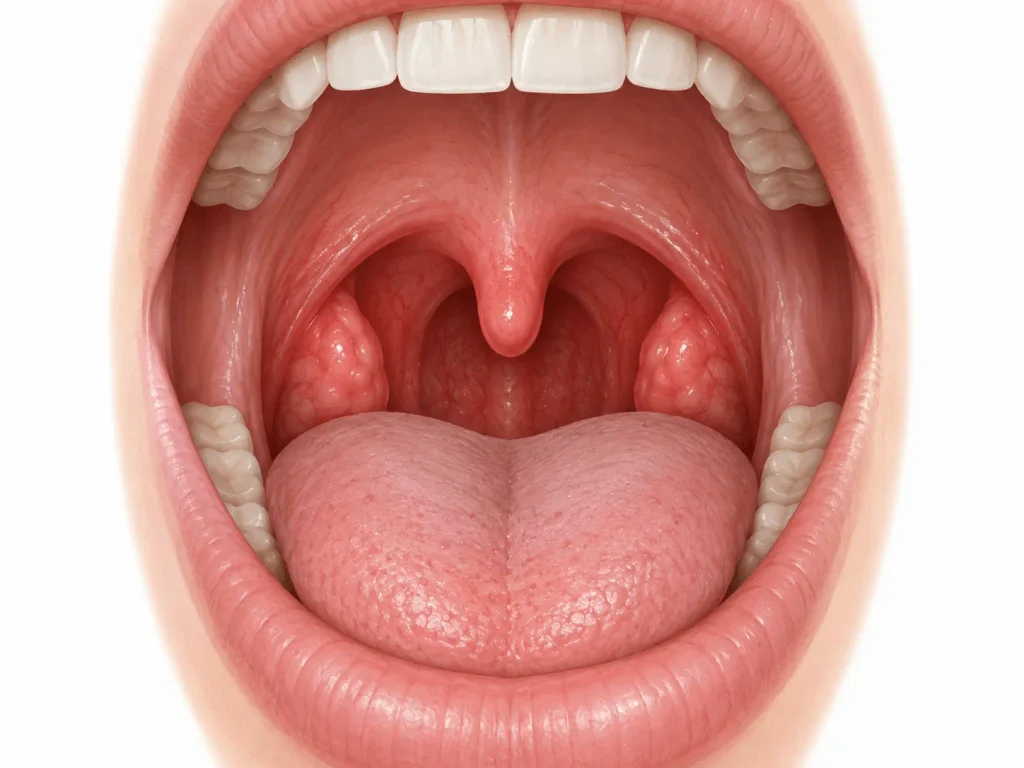
A sore throat develops when the lining of the throat becomes inflamed or irritated. Viral infections are the most common cause, but a sore throat is not always caused by an infection.
Infections
Colds, flu and other viral infections often cause a sore throat together with cough, a runny nose, hoarseness or general malaise. Bacterial infections are less common; an important example is streptococcal infection of the throat and tonsils.
Irritation without infection
The throat may also feel sore or burning because of cigarette smoke, dry air, dust, pollution, allergies or heavy use of the voice. In such cases, fever and other typical signs of an acute infection may be absent.
Persistent irritation and reflux
If a sore or irritated throat keeps returning or lasts for a longer period, other causes should also be considered. One of these is acid reflux, which may also be associated with cough, hoarseness or throat irritation.
When advising users, one of the first distinctions we make is between an acute problem and persistent irritation. In people with long-lasting throat irritation or cough, reflux is one of the possibilities that, in our practical experience, should not be overlooked.
Viral or bacterial throat infection – how can you tell the difference?
With a sore throat, accompanying symptoms can suggest whether a viral or streptococcal infection is more likely, but symptoms alone cannot always establish the diagnosis reliably.
| Feature | More suggestive of a viral infection | More suggestive of streptococcal infection |
|---|---|---|
| Cough | Common | Usually absent |
| Runny nose | Common | Usually absent |
| Hoarseness | May occur | Not typical |
| Onset | May be gradual | Often sudden |
| Fever | May occur | More common, often above 38 °C |
| Pain when swallowing | May occur | Often pronounced |
| Tonsils | May be red | May be very red, enlarged and have exudate |
| Neck lymph nodes | May be enlarged | More often enlarged and tender at the front of the neck |
White or purulent tonsillar exudate alone does not prove a bacterial infection. When clear viral features are absent, a clinician may use clinical scoring criteria and, where appropriate, a rapid strep test or throat culture.
Group A streptococcus is the most common bacterial cause of pharyngitis and is more common in children than in adults.
Sore throat without fever, on one side or when swallowing
The way a sore throat presents can provide useful clues, but a single symptom usually cannot reliably identify the cause.
Sore throat without fever
The absence of fever does not rule out an infection. A sore throat without a raised temperature may occur with a mild viral infection, but it can also be related to irritation from dry air, smoke, allergies, heavy voice use or reflux. Other symptoms and the course of the problem are therefore important.
Pain on only one side of the throat
Throat pain may be more pronounced on one side, for example when one tonsil or a local area is more affected. However, severe one-sided pain that is rapidly worsening, especially with swelling in the mouth or throat, difficulty opening the mouth, a changed voice or difficulty swallowing, needs prompt medical assessment. These symptoms can also occur with rarer complications such as a peritonsillar abscess.
Sore throat when swallowing
Pain when swallowing is one of the most common symptoms of an inflamed or irritated throat and may occur with both viral and bacterial infections. On its own, it does not identify the cause.
Sometimes the source of the pain is more localised. An aphthous ulcer located further back in the mouth or near the entrance to the throat can cause marked pain, particularly when swallowing, and may feel like the pain is coming from the throat itself.
It is important to distinguish painful swallowing from being unable to swallow. If a person cannot swallow fluids or saliva, is drooling, has difficulty breathing or is deteriorating rapidly, urgent medical attention is required.
How long does a sore throat last?
An acute sore throat usually lasts from a few days to around one week. Most people gradually improve within this time, including many cases in which the cause may be bacterial but antibiotics are not needed.
More important than the exact number of days is how the symptoms are progressing. The pain should gradually lessen. If it has not started to improve after about a week, becomes significantly worse or important new symptoms appear, medical assessment is advisable.
If symptoms last longer or keep returning, the cause may no longer be a typical acute infection. Other possibilities include recurrent inflammation, persistent irritation, allergies or reflux.
Persistent or recurring sore throat
If a sore throat lasts longer than the usual course of an acute illness or keeps returning, it is not useful to assume that every episode is simply another infection. It becomes important to look at when the symptoms occur, what accompanies them and whether there is a recurring pattern.
What can cause persistent throat irritation?
Possible causes include recurrent infections, dry or polluted air, smoking, allergies or post-nasal drip, heavy voice use and acid reflux. Reflux does not always cause typical heartburn; it may also be associated with throat irritation, hoarseness or a recurrent cough.
The pattern of symptoms matters
It can be useful to notice whether the throat is worse in the morning, after meals, when lying down, in a particular environment, during allergy season or after heavy use of the voice. Such a pattern may help a clinician identify the cause more than the fact that the throat is sore by itself.
What do we look for when advising users?
With persistent symptoms, one of the first questions we ask is whether these are truly repeated acute infections or ongoing or recurrent irritation. Particularly when cough, hoarseness or digestive symptoms are also present, our practical experience is to consider reflux as one of the possibilities. This is a useful clue, not a diagnosis.
A persistent unexplained sore throat should be medically assessed. Assessment is particularly important if there is difficulty swallowing, persistent hoarseness, a lump or swelling in the neck or mouth, unexplained weight loss, or another new or progressively worsening symptom.
Sore throat in a child
Viruses are also the most common cause of sore throat in children. Streptococcal throat infection is more common in children than in adults, particularly between about 5 and 15 years of age. Typical strep throat is much less common in children younger than 3 years.
When should strep throat be considered?
A sudden sore throat, fever, marked pain when swallowing, enlarged lymph nodes at the front of the neck, and red or enlarged tonsils with exudate can make streptococcal infection more likely. Children may also develop abdominal pain, nausea, vomiting or a rash.
Cough, a runny nose, hoarseness and oral ulcers are more suggestive of a viral infection. When the features are not clear, looking at the throat alone cannot reliably distinguish the cause; a clinician may use a rapid strep test or throat culture where appropriate.
Keeping a child hydrated is particularly important
With mild illness, the child should drink plenty of fluids and rest. Cool drinks or soft foods may be easier to tolerate when swallowing is painful. Pain or fever can be relieved with a medicine suitable for the child’s age and body weight, following the instructions or advice from a doctor or pharmacist.
Hard sweets or lozenges that could pose a choking risk are not suitable for young children. Salt-water gargling is only appropriate for a child who can gargle safely and spit it out.
When does a child need prompt medical help?
Urgent medical attention is needed if a child has difficulty breathing, cannot swallow fluids or their own saliva, is drooling excessively or is deteriorating rapidly. Medical assessment is also advisable if there are signs of dehydration, the child is markedly unwell, has a persistent high fever, or the sore throat is not improving or keeps recurring.
When should you see a doctor for a sore throat?
Most sore throats improve without specific treatment, but some signs are more important than the intensity of the pain itself. The five situations below help distinguish when urgent medical attention is needed and when medical assessment is advisable.
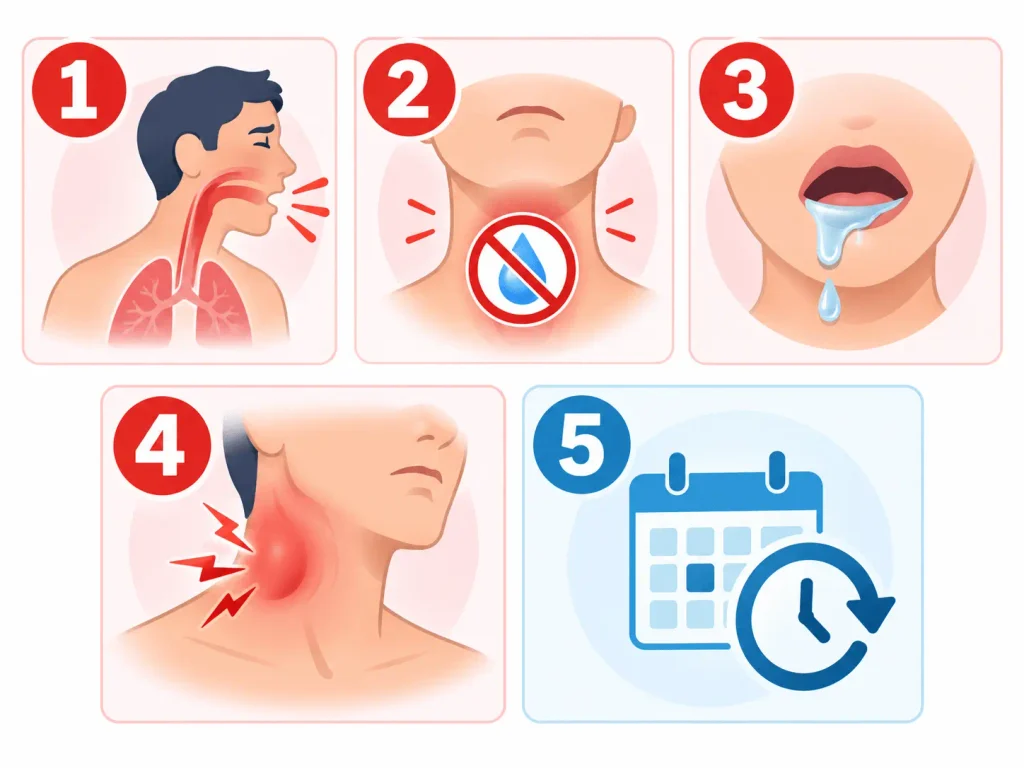
- Difficulty breathing. A feeling of choking, marked breathing difficulty or unusual breathing sounds require immediate medical attention.
- Inability to swallow fluids or saliva. Painful swallowing is common with a sore throat. Being unable to swallow fluids or one’s own saliva is not a symptom that should simply be monitored at home.
- Marked drooling. Drooling, particularly together with difficulty swallowing or breathing, is a warning sign and needs prompt medical assessment.
- Rapid deterioration or severe one-sided pain and swelling. Rapidly increasing pain, swelling in the mouth or throat, difficulty opening the mouth or a changed voice are particularly important. These symptoms may occur with a complication such as a peritonsillar abscess.
- Symptoms are not improving or keep returning. If a sore throat has not started to improve after about a week, frequently recurs, or is accompanied by persistent hoarseness, a lump or swelling in the neck, unexplained weight loss or other new symptoms, medical assessment is advisable.
In children, medical assessment should be considered sooner if the child drinks poorly, shows signs of dehydration, appears markedly unwell or has a high or persistent fever.
Smrekovit for a sore throat – practical use
For a sore throat, Smrekovit is used primarily locally in the oral cavity. Based on our long-standing practical experience, users most often direct the oral spray towards the back of the mouth or the area where the irritation feels most pronounced.
How often?
In practice, the spray is usually used several times a day. The purpose of local application is primarily to bring the product into direct contact with the selected area in the oral cavity.
More detailed instructions are available in the instructions for throat-related use.

How long is it reasonable to try it?
Based on our practical observations, users for whom this type of use is suitable often notice a clear change within one to two days. If there is no improvement, it makes little sense simply to continue indefinitely or keep increasing the frequency; the possible cause of the problem should be reconsidered.
This is particularly important with persistent or recurrent sore throat, where reflux, allergies, irritation or another underlying cause may be involved and will not be resolved by local application alone. The warning signs described above are a reason for medical assessment regardless of whether Smrekovit is being used.
Users’ experiences with a sore throat
Below are two specific user experiences with Smrekovit oral spray for a sore throat. These are individual experiences and the results cannot be generalized to all users.
I must praise the Smrekovit oral spray. This week I suddenly got a severe sore throat overnight. I immediately used the spray, even during the night, and was amazed to wake up without throat pain.
Marjana, Loče
[140] experience received on 20 August 2017, kept in the Smrekovit archive
When I had a sore throat, I used Smrekovit three times a day and after two days my throat no longer hurt.
Erna, Slovenske Konjice
[23] experience received on 12 January 2015, kept in the Smrekovit archive
Individual user experiences are not evidence of a general effect and do not replace medical assessment when warning signs are present or symptoms are not improving.
Read more user experiences →
Frequently asked questions about sore throat
What helps with a sore throat?
Drinking enough fluids, resting, avoiding smoke and other irritants, and using pain-relieving medicines such as paracetamol or ibuprofen when suitable are among the most common measures. Warm or cold drinks, soft foods and gargling with salt water may also help some people.
How long does a sore throat usually last?
Most acute sore throats begin to improve within a few days and resolve in about a week. If symptoms are not improving after about a week, are getting worse or keep returning, medical assessment is advisable.
Can a sore throat without fever still be caused by an infection?
Yes. The absence of fever does not rule out a viral or bacterial infection. A sore throat without fever can also be related to dry air, irritation, allergies, voice strain or reflux.
How can you tell a viral from a bacterial throat infection?
Symptoms alone cannot always distinguish them reliably. Cough, runny nose and hoarseness are more commonly associated with viral infections, while sudden onset, fever and marked pain when swallowing are more typical of streptococcal infection. When the distinction matters, medical assessment or testing may be needed.
What does it mean if the throat hurts only on one side?
One-sided pain can result from local irritation, a lesion on the mucosa or an infection. Severe or rapidly worsening pain, one-sided swelling, difficulty opening the mouth, a changed voice or difficulty swallowing require prompt medical assessment.
When does a sore throat require urgent medical attention?
Urgent help is needed for difficulty breathing, inability to swallow fluids or saliva, marked drooling or rapid deterioration. Medical assessment is also advisable if symptoms persist, recur frequently or are accompanied by other unexplained symptoms.
How is Smrekovit oral spray used for a sore throat?
In practice, the oral spray is used locally in the oral cavity, usually several times a day. More detailed guidance is available in the instructions for throat-related use. If symptoms are not improving or warning signs are present, local use does not replace medical assessment.