
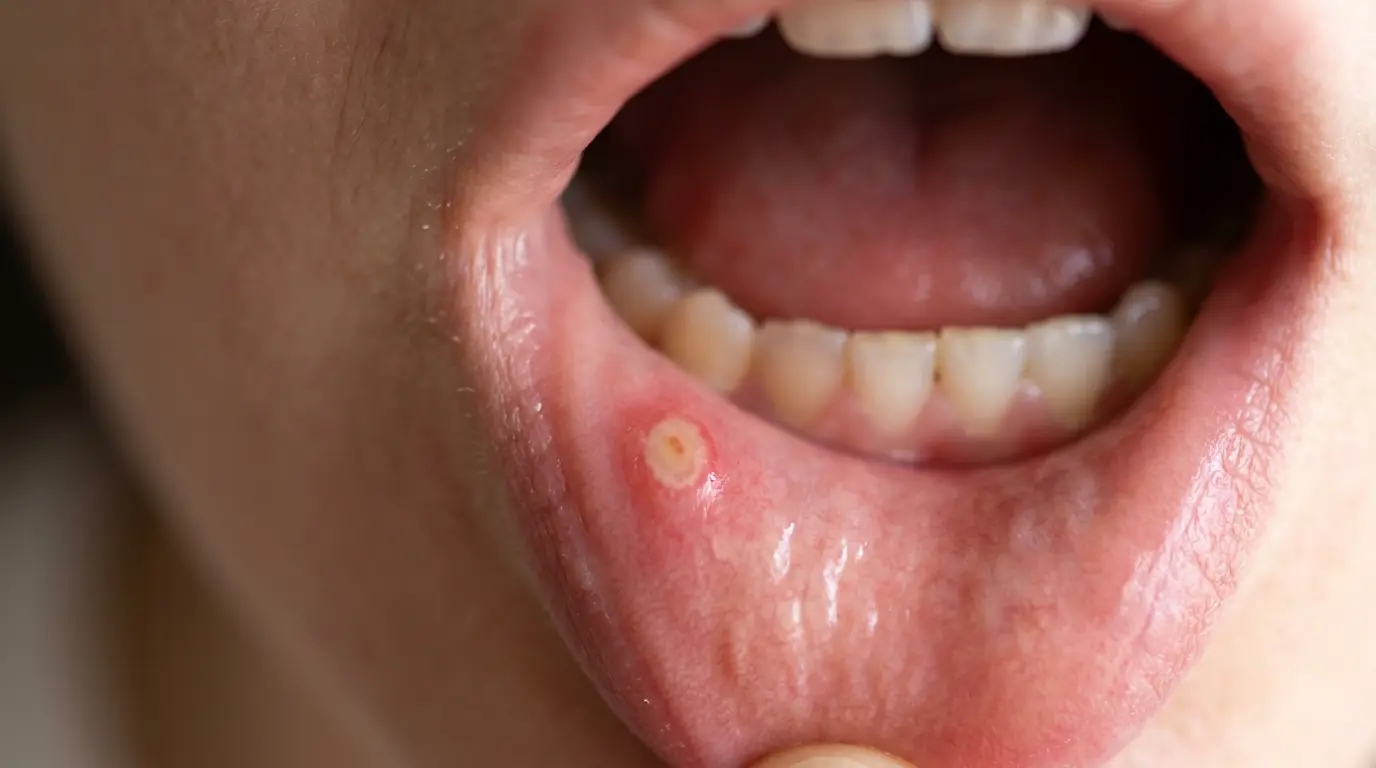
Mouth ulcers in brief
- A mouth ulcer is a small, painful ulcer of the oral mucosa. It most commonly occurs on the inside of the lips or cheeks, along the tongue, under the tongue or on other softer areas of the oral mucosa.
- Mouth ulcers are not contagious. This is one important difference compared with cold sores.
- The exact cause is often unknown. Minor injury to the mucosa, stress and hormonal changes may contribute, while in some people nutritional deficiencies or other medical conditions may also be associated with recurrent ulcers.
- Most minor mouth ulcers heal within about one to two weeks. During this time, it is useful to reduce irritation and relieve pain when necessary.
- A persistent or unusual ulcer deserves closer attention. Medical or dental assessment is advisable especially if the lesion has not healed after about three weeks, is unusually large, keeps returning or is accompanied by other symptoms.
Table of contents
What does a mouth ulcer look like and where does it occur?
A mouth ulcer is usually a small, shallow and very painful ulcer of the oral mucosa. It is often round or oval, with a whitish or yellowish centre and a red border.
How can you recognise it?
The pain may be surprisingly intense compared with the size of the lesion. It may be especially noticeable when eating, drinking, speaking or brushing the teeth. Some people notice tingling, stinging or a burning sensation at the same spot before the ulcer becomes visible.
A typical mouth ulcer does not consist of fluid-filled blisters. Once the ulcer develops, it usually appears as a pale lesion of the mucosa surrounded by a reddish margin.
Where do mouth ulcers most commonly occur?
They most often appear on the softer areas of the oral mucosa. The illustration shows four typical locations:
- the inside of the lip,
- the inside of the cheek,
- the edge or underside of the tongue,
- the floor of the mouth or the area under the tongue.
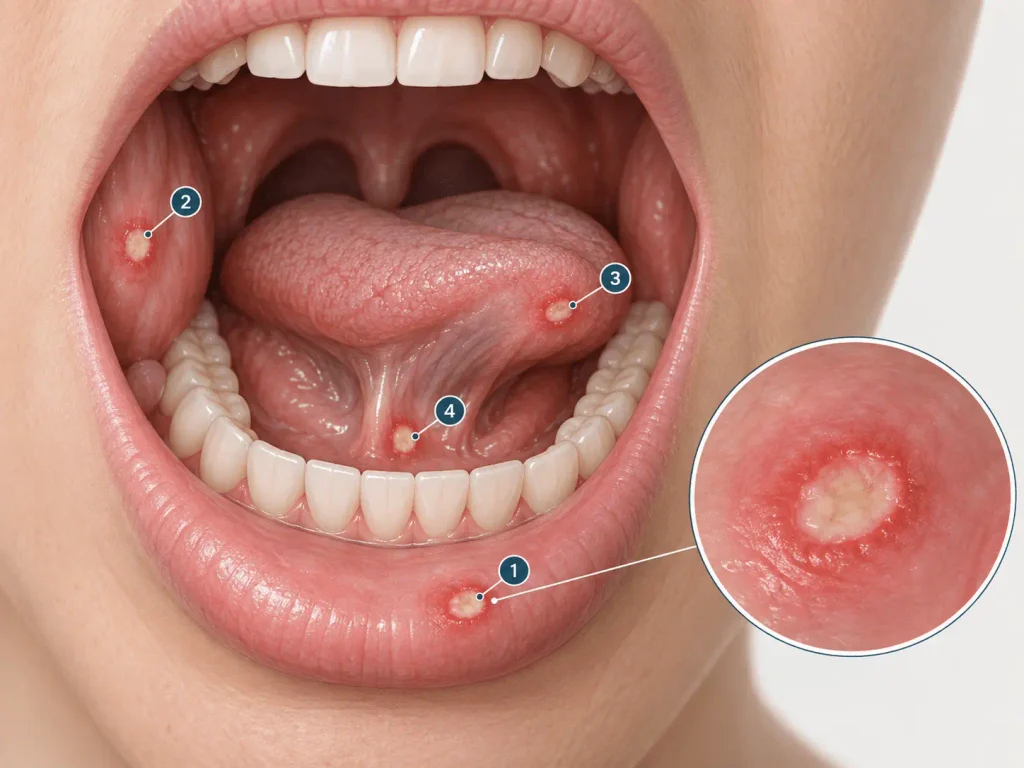
Mouth ulcers can also occur further back in the mouth. Because of their position, such ulcers may be particularly uncomfortable when swallowing.
A mouth ulcer on the lip or something else?
A “mouth ulcer on the lip” usually means an ulcer on the inner surface of the lip. Lesions on the outer edge of the lip, especially clusters of small blisters, are more typical of cold sores.
Not every ulcer of the oral mucosa is an aphthous ulcer. If a lesion looks unusual, is very large, does not heal or persists for several weeks, it should be assessed by a doctor or dentist.
Why do mouth ulcers occur and why do they recur?
With common mouth ulcers, the exact cause often cannot be identified. Some people are simply more prone to developing them, while an individual ulcer may be triggered by a combination of factors.
What can trigger a mouth ulcer?
More common triggers or associated factors include:
- minor injury to the mucosa, for example biting, a sharp tooth edge or an orthodontic appliance,
- stress and increased physical or psychological strain,
- irritation during tooth brushing or from harder foods,
- in some people, particular foods or other individual triggers.
This does not mean that every ulcer has an identifiable cause. Mouth ulcers often occur without any obvious trigger.
Why do mouth ulcers recur in some people?
Recurrent mouth ulcers are simply part of an individual tendency in some people. They also occur more often in certain families, suggesting that inherited susceptibility may play a role.
It can be useful to notice whether ulcers appear in similar circumstances: after injury to the mucosa, during stressful periods, after certain foods or in other recurring situations. Such a pattern may be more useful than trying to find one single “cause”.
When can nutritional deficiencies or other conditions be relevant?
When ulcers recur very frequently, are numerous or unusually large, it may sometimes be appropriate to consider other factors. Mouth ulcers can be associated with iron, vitamin B12 or folate deficiency, and in some cases with gastrointestinal, immune or other systemic conditions.
This does not mean that recurrent mouth ulcers by themselves indicate a serious disease. However, if they are a new problem, occur very frequently or are accompanied by other symptoms, medical or dental assessment is advisable.
What helps with canker sores in the mouth?
Most minor mouth ulcers heal on their own. The main aim of self-care is therefore to reduce pain and further irritation of the mucosa while the ulcer heals.
Reduce irritation of the ulcer
- choose softer foods that require less chewing,
- avoid very acidic, spicy, salty or rough foods if they irritate the ulcer,
- avoid very hot drinks,
- brush gently with a soft toothbrush,
- do not scratch, squeeze or otherwise mechanically irritate the ulcer.
A practical rule for food is simple: if a particular food causes marked stinging or pain when it touches the ulcer, it is sensible to avoid it until the area heals.
What can help with the pain?
Some people find cool drinks or other cool, soft foods soothing. The mouth can also be rinsed with lukewarm salt water, which should be spat out afterwards.
Pharmacies offer various local products for pain relief or for protecting the ulcer, including gels, sprays, mouthwashes and other products intended for the oral mucosa. The most suitable option depends on age, the location of the ulcer and other health circumstances.
Does it make sense to act at the first burning sensation?
In some people, a burning, stinging or sensitive area of the mucosa appears before the ulcer becomes visible. At that stage, it is sensible to minimise irritation and begin local measures for symptom relief.
However, early action cannot reliably be expected to prevent the ulcer from developing or to substantially shorten its course.
Canker sores in children
Mouth ulcers can also occur in children and may be particularly uncomfortable because of the pain. A child may find it harder to eat, drink or brush their teeth, while younger children may mainly become irritable or refuse food.
What can be done at home?
- offer plenty of fluids, preferably in small frequent sips,
- choose soft foods that are not too hot,
- avoid very acidic, spicy or rough foods if they cause pain,
- maintain gentle oral hygiene without further injuring the ulcer.
If the child is old enough to spit safely, some local products intended for the oral mucosa may also be suitable. Age recommendations for the individual product should always be followed.
Not every sore in a child’s mouth is an aphthous ulcer
One or a few typical isolated ulcers may be consistent with aphthae. However, if a child has numerous sores, fever, markedly inflamed or bleeding gums, a rash or other general symptoms, another cause may be responsible and medical assessment is advisable.
Particular attention is needed when pain prevents a child from drinking. Dry mouth, reduced urination, marked tiredness or inability to take enough fluids are reasons to seek medical advice sooner.
How long do mouth ulcers last and when should you see a doctor?
How long does a mouth ulcer usually last?
Most minor mouth ulcers begin to improve within a few days and heal within about one to two weeks. Larger or deeper ulcers may take longer.
The course of the lesion is more important than the exact number of days. The ulcer should gradually become smaller and less painful. If it is instead getting larger, becoming increasingly painful or new ulcers are appearing, the cause should be reassessed.
When is an examination advisable?
It is advisable to speak to a doctor or dentist especially:
- if the ulcer has not healed after about three weeks,
- if it is unusually large, deep or very painful,
- if mouth ulcers occur very frequently or almost continuously,
- if there are numerous ulcers or they are spreading throughout the mouth,
- if they are accompanied by fever, marked general illness or other systemic symptoms,
- if there are also symptoms elsewhere in the body, such as recurrent digestive problems, skin changes or joint pain.
Assessment is also advisable for a lesion that does not look like a typical aphthous ulcer. Persistent ulcers of the oral mucosa can have different causes and should not simply be treated as a mouth ulcer for weeks without further evaluation.
Mouth ulcer or herpes – how can you tell the difference?
Aphthous ulcers and cold sores may look similar at first glance, but they are different conditions. The most useful clues are location, appearance and contagiousness.
| Feature | Mouth ulcer | Cold sore |
|---|---|---|
| Typical location | Most commonly inside the mouth on softer oral mucosa | Often on the edge of the lip or on the skin around the mouth |
| Appearance | One or more shallow ulcers with a white or yellowish centre and a red border | Often a cluster of small blisters that may burst and form a crust |
| Sensation before appearance | Local stinging or tenderness may occur | Tingling, itching or burning often occurs before the blisters appear |
| Contagious? | No | Yes |
| Cause | Not caused by herpes simplex virus | Caused by herpes simplex virus |
These are typical differences rather than absolute rules. Herpes can also affect the inside of the mouth, particularly during a first infection. If the appearance is unusual or the diagnosis is unclear, professional assessment is advisable.
Read more about the condition on our cold sores page.
Smrekovit for mouth ulcers – practical use
In Smrekovit’s internal practical documentation, Smrekovit Oris is applied directly to the affected area in the mouth when mouth ulcers are present. The purpose of this approach is primarily to keep the preparation in local contact with the ulcerated area.
How is it used?
Aim the spray towards the ulcer or directly onto the affected area of the oral mucosa. In practice, application is repeated several times during the day, particularly when the area again becomes more sensitive or painful.
With a very sensitive or newly developed ulcer, the first application may sting quite strongly. This can occur on irritated mucosa, but use should not cause persistent or progressively increasing irritation.

What do practical observations show?
Smrekovit’s internal practical documentation records that, in some users, pain from mouth ulcers decreased within the first one to two days of regular local use.
This is an observation from practical use and does not mean that everyone will experience the same course. Mouth ulcers normally take several days to heal, and in an unusual or persistent case, local use should not replace appropriate medical or dental assessment.
More detailed instructions are available in our instructions for use with mouth ulcers.
User experiences with mouth ulcers
The accounts below are individual experiences of Smrekovit users. An individual experience does not mean that others will have the same outcome.
“Thank you for the versatile natural products. I have been using Smrekovit for 15 years for various inflammations and wounds: with inflamed and swollen joints I notice improvement after 15–20 days, with a sore throat after three to five days, with mouth ulcers after three to seven days, and with inflamed gums after three days…”
Brigita Marhold, Zgornja Kungota
[69] experience received on an unknown date, kept in the Smrekovit archive
“The oral spray helps with mouth ulcers and irritation caused by wearing dentures; I use it preventively every day.”
Saša, Lendava
[175] experience received on 19 December 2025, kept in the Smrekovit archive
More accounts can be found among Smrekovit user experiences.
Frequently asked questions about mouth ulcers
Are mouth ulcers contagious?
No. Common aphthous ulcers are not caused by a contagious infection and are not spread by kissing, sharing utensils or touching. This is an important difference from cold sores, which are caused by herpes simplex virus and are contagious.
Can you pop a mouth ulcer?
No. A mouth ulcer is not a fluid-filled blister but an ulcer of the oral mucosa. Puncturing, scratching or squeezing it will not help and may further injure the area and increase the pain.
Does rinsing with salt water help mouth ulcers?
Rinsing the mouth with lukewarm salt water is a simple measure that may be used for local symptom relief. The solution should be spat out afterwards. In children, this is suitable only if they can reliably spit the liquid out.
Can mouth ulcers be caused by vitamin deficiencies?
They can be associated with nutritional deficiencies, but this is not the most likely explanation for every individual ulcer. In frequently recurrent cases, factors may include iron, vitamin B12 or folate deficiency. Medical assessment is advisable when ulcers are very frequent or occur together with other symptoms.
Why do I keep getting mouth ulcers?
Some people have a greater personal or family tendency to develop them. Minor injuries to the mucosa, stress and other individual factors may also act as triggers. Very frequent or unusual ulcers may warrant investigation for other contributing causes.
Can you get a mouth ulcer on the tongue?
Yes. Aphthous ulcers can occur particularly along the edge or underside of the tongue and beneath the tongue. Tongue lesions can also have other causes, so an unusual or persistent ulcer should be assessed.
How long does a mouth ulcer take to heal?
Most minor mouth ulcers heal within about one to two weeks. If an ulcer has still not healed after about three weeks, assessment by a doctor or dentist is recommended.