

Gingivitis in brief
- Gum inflammation (gingivitis) is most commonly caused by dental plaque accumulating along the gumline.
- Common signs include bleeding during brushing or interdental cleaning, swelling, redness and tender gums. Gingivitis can also cause little or no pain.
- The most important first step is regular and thorough removal of dental plaque by brushing and cleaning between the teeth.
- If the gums bleed during cleaning, this is generally not a reason to stop. Gentle cleaning and good technique remain important.
- If problems persist despite good oral hygiene, or if you notice receding gums, pus, marked swelling or loose teeth, a dental examination is advisable.
Table of contents
How can you recognize gingivitis?
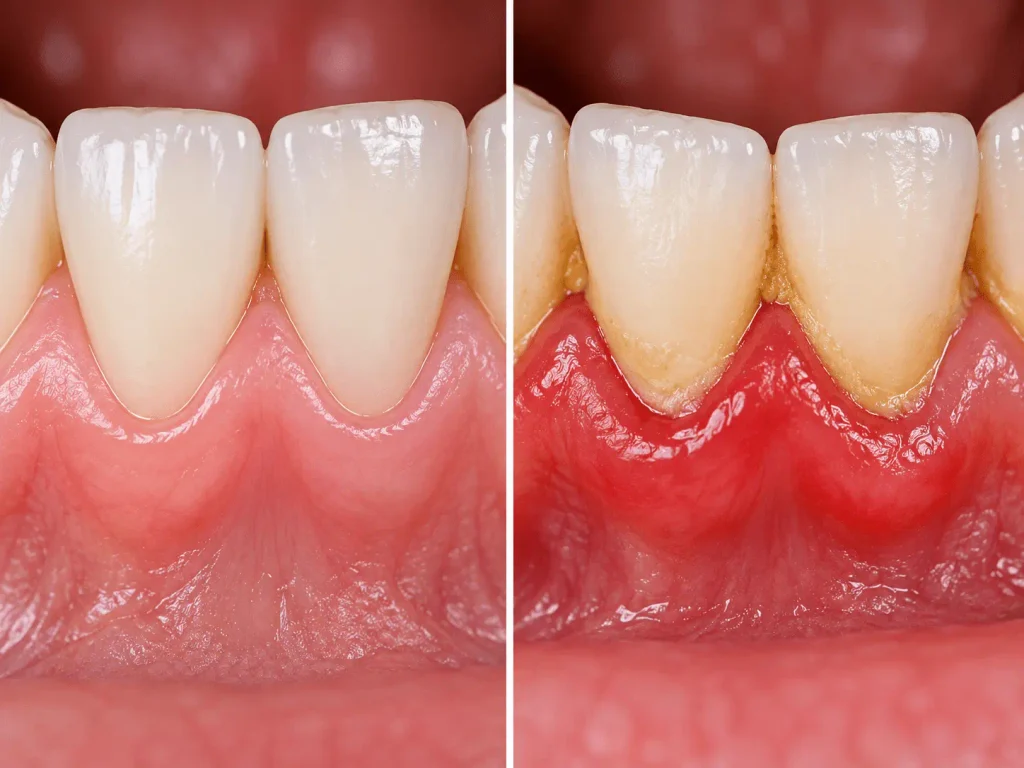
Gum inflammation often begins quite subtly. The gums may already be inflamed before significant pain or other pronounced symptoms develop.
Common signs of inflamed gums
- bleeding during brushing or interdental cleaning,
- swollen or puffy gums,
- redness or a change in the appearance of the gums,
- tenderness or discomfort when touched,
- bad breath, particularly when dental plaque accumulates along the gumline.
Healthy gum colour is not the same in everyone, as natural pigmentation can vary considerably. More important than colour alone are changes from your usual appearance, swelling and bleeding.
Does gum inflammation have to be painful?
No. Gingivitis can be quite noticeable even without significant pain. This is why bleeding during cleaning is often one of the first signs people notice.
Bleeding is not a good reason to stop cleaning the affected area. If dental plaque is the cause, its regular removal is an essential part of improving the condition. Cleaning should be gentle and thorough rather than aggressive.
When does it not look like typical gingivitis?
Marked swelling around a single tooth, pus, severe pain, fever or rapidly developing facial swelling are not typical signs of simple gingivitis. In such cases, dental assessment is needed.
Zakaj nastane vnetje dlesni?
Dental plaque is the main cause
The most common cause of gingivitis is dental plaque along the gumline. Plaque is a sticky bacterial biofilm that begins to form again on the teeth after cleaning. If it is not regularly removed, it irritates the gums and triggers an inflammatory response.
Plaque that remains on the teeth can eventually mineralise into tartar. Tartar cannot be removed by ordinary brushing, and its rough surface makes it easier for more plaque to accumulate. Professional cleaning is therefore needed to remove it.
What increases the risk?
Gingivitis is more likely to develop where plaque is difficult to remove effectively or when the gums are more susceptible to inflammation. Factors that may increase the risk include:
- inadequate brushing and cleaning between the teeth,
- smoking and other tobacco use,
- dry mouth or reduced saliva production,
- diabetes, particularly when poorly controlled,
- hormonal changes, for example during pregnancy,
- crowded teeth and some poorly fitting dental restorations or appliances that make cleaning more difficult,
- certain medicines and medical conditions that affect the gums, saliva or immune response.
These factors do not mean that gingivitis will necessarily develop. The central issue remains how much plaque is retained along the gumline and how effectively it can be removed.
What helps with gum inflammation?
With ordinary gingivitis, the most important step is to remove the cause: dental plaque along the gumline and between the teeth. Mouthwashes, gels and other products cannot replace this.
1. Keep cleaning even if your gums bleed
Bleeding during brushing is often a sign of inflammation, not a reason to avoid the affected area. Clean carefully along the gumline, usually twice daily with a soft toothbrush and fluoride toothpaste.
Vigorous scrubbing is unnecessary and may further injure the gums. Good technique and consistency are more important than force.
2. Do not neglect the spaces between the teeth
Brushing alone often fails to remove plaque between the teeth. Daily cleaning with interdental brushes or dental floss where appropriate is therefore important.
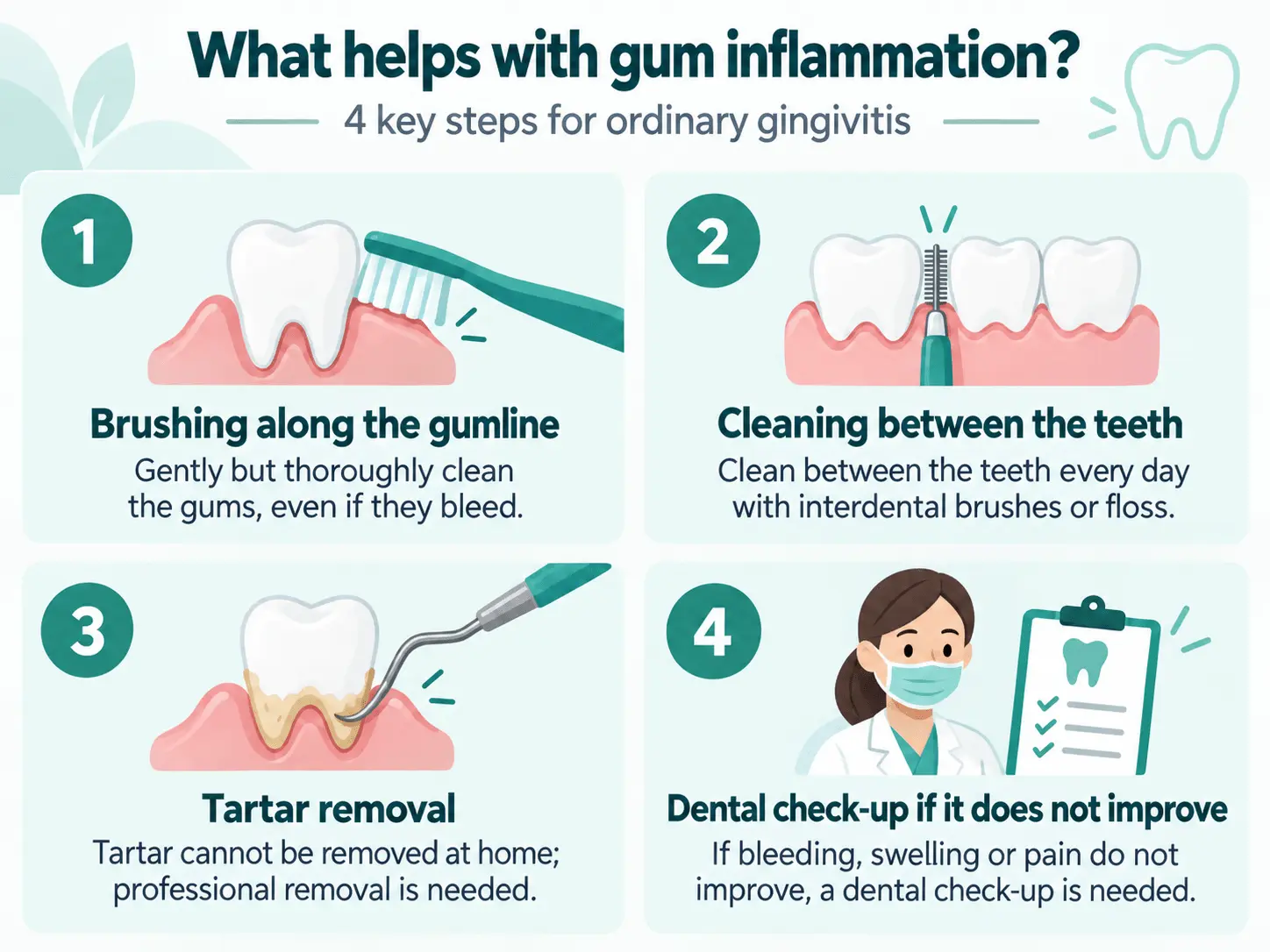
3. Tartar cannot be removed at home
Once soft plaque has mineralised into tartar, brushing and interdental cleaning are no longer enough. Tartar must be removed professionally by a dentist or dental hygienist. Good daily oral hygiene is then important to reduce renewed plaque accumulation.
What about mouthwash?
Mouthwash can be an addition to, not a replacement for mechanical plaque removal. For some more pronounced cases of gum inflammation, a dentist may recommend a short course of an antiseptic mouthwash such as chlorhexidine. Such products are not intended for unnecessary long-term routine use, as they can, among other effects, stain the teeth and alter taste.
How quickly can inflamed gums improve?
If gingivitis is caused by dental plaque and the plaque begins to be removed effectively, bleeding and swelling may start to decrease within several days. Complete improvement depends on the extent of inflammation, the presence of tartar and the quality of oral hygiene.
If the condition does not improve despite consistent cleaning, keeps recurring, or is accompanied by significant pain, pus, receding gums or loose teeth, home measures are not enough and dental assessment is needed.
Severe gum inflammation – when is it more than gingivitis?
People often use the term severe gum inflammation for gums that bleed heavily, hurt or appear markedly swollen. In practice, however, it is important to distinguish between gingivitis, which mainly affects the gums, and periodontitis, in which the inflammation also affects the supporting tissues around the tooth.
Gingivitis often improves once plaque is effectively removed and oral hygiene is improved. Periodontitis is a more serious condition that may gradually damage tooth support if not properly treated.
| Feature | Gingivitis | Periodontitis |
|---|---|---|
| What is affected? | Mainly the gum tissue around the tooth | The gums and deeper supporting tissues around the tooth |
| Common signs | Bleeding, redness, swelling, tenderness | Bleeding, gum recession, deeper pockets, bad breath, sometimes pus |
| Pain | May be mild or absent | Not always severe, but pressure, tenderness or pain may occur |
| Loose teeth | Not typical | May occur in advanced disease |
| Is the condition generally reversible? | Yes, often with good hygiene and plaque removal | Treatment may stop or improve the condition, but lost support usually cannot be fully restored |
| What should be done? | Improve cleaning and arrange tartar removal if needed | Dental examination and targeted treatment |
Which signs are especially concerning?
Something more than ordinary gingivitis should be suspected especially when bleeding is accompanied by gum recession, teeth appearing longer, pus, persistent bad breath, discomfort when biting or loose teeth.
It is also important if bleeding or swelling does not settle despite better cleaning, or if the problems keep returning. In that case, home care alone is not enough and professional assessment is needed.
Severe gum inflammation – when is it more than gingivitis?
Problems beneath a denture are not uncommon. People often describe them as gum inflammation under a denture, although this is not always exactly the same as ordinary gingivitis around natural teeth.
If some natural teeth are still present and the denture sits close to them, dental plaque, food debris and tartar may accumulate around the denture, irritating the gums and promoting inflammation. If the jaw is fully without teeth and covered by a full denture, the main issue is often more mucosal irritation, pressure or poor denture fit rather than classic gingivitis.
Why do problems under a denture develop?
- plaque and food debris collect beneath the denture or along its edges,
- cleaning is more difficult, especially with partial dentures and tight spaces,
- the denture may mechanically rub or press on the gums,
- a poorly cleaned denture can further irritate the oral tissues,
- dry mouth and wearing the denture continuously for long periods may worsen the problem.
What helps with inflammation under a denture?
The first step is to clean both the denture and the mouth thoroughly. With a partial denture, this means regular cleaning of the remaining teeth, the spaces between them and the gumline. The denture itself should be mechanically cleaned according to the advice of a dental professional or the manufacturer.
If the denture presses, rubs or the redness keeps returning beneath it, cleaning alone is often not enough. In that case, the fit of the denture should also be checked.
When is a dental examination needed?
Dental assessment is advisable if there is persistent redness, pain, sores, bleeding, swelling or unpleasant odour beneath the denture, if the denture rubs, or if the condition does not improve despite better cleaning.
If the problem keeps recurring, it is also worth considering that the denture may no longer fit properly or that the issue is not just superficial irritation.
Severe gum inflammation – when is it more than gingivitis?
Mild gingivitis can often improve quite quickly once dental plaque is removed effectively. However, if problems persist, keep returning or signs of deeper tissue involvement develop, home care alone is not enough.
Arrange a dental examination if:
- bleeding or swelling does not begin to improve despite good cleaning,
- the inflammation keeps returning,
- you notice gum recession or the teeth appear longer than before,
- teeth become loose,
- pus drains from the gums or there is a persistent unpleasant taste or bad breath,
- there is marked local swelling or pain around a particular tooth,
- tartar is present and cannot be removed at home,
- a denture repeatedly rubs, presses or causes sores and inflammation.
When is more urgent assessment needed?
Seek dental or medical advice promptly if swelling is increasing rapidly, spreading to the face or jaw, or is accompanied by fever or significant general illness.
Difficulty swallowing, difficulty breathing or rapidly spreading swelling of the face or neck requires urgent medical assessment.
Smrekovit for gingivitis – practical use
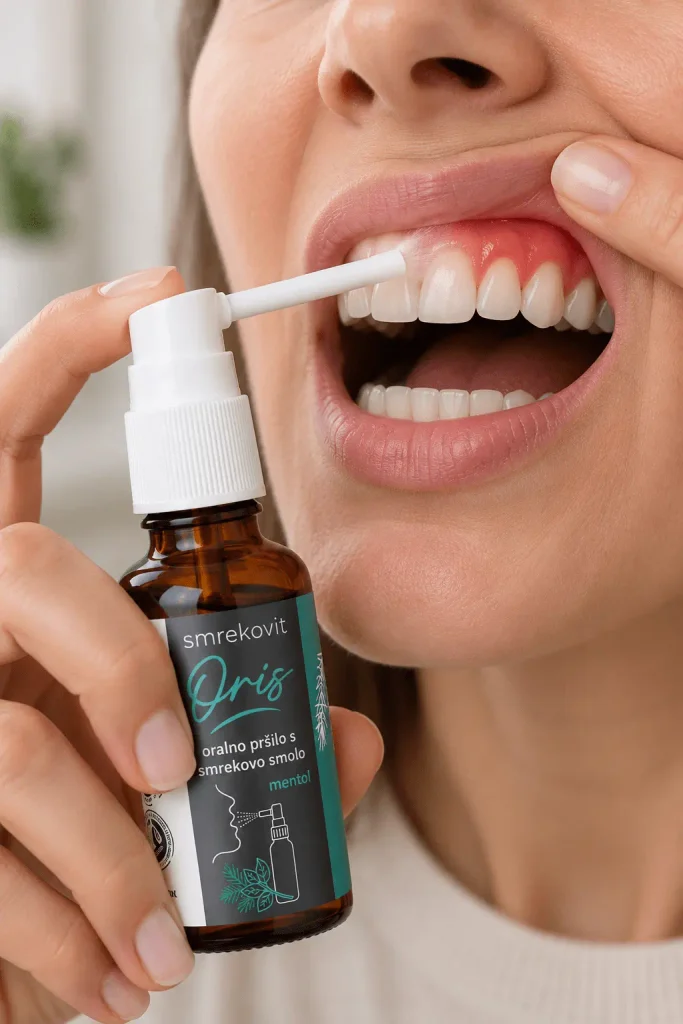
For inflamed gums, our practical documentation uses Smrekovit Oris (oral spray). The spray is directed straight onto the affected part of the gum so that the product comes into contact with the problem area.
How do we use it?
- spray directly onto the affected gum,
- use it several times a day,
- for a localised problem, aim the spray as precisely as possible at the affected area,
- for more widespread problems, apply it to several areas of the gums.
When advising users, we often find that the problem is also associated with trapped food, difficult interdental spaces, tartar, periodontal pockets or a denture. In such cases, it is important to address the underlying cause as well as the local discomfort.
When should it become clear whether the application is helping?
In our practical experience, users with inflamed gums often notice clear improvement within one or two days. This is a practical observation from many years of advising users, not a guarantee that every individual will follow the same course.
The important point is that the condition should be moving in the right direction. If the inflammation is not improving despite use and good oral hygiene, simply applying more or continuing indefinitely without checking the cause is not sensible.
What can the spray not replace?
Smrekovit Oris does not remove dental plaque or tartar, correct a poorly fitting denture or replace treatment for periodontitis. Local use should therefore be regarded as an addition to appropriate oral hygiene and, when necessary, professional dental care.
The same applies to periodontitis: in our practical documentation the oral spray is applied directly to the gums several times a day, but the disease requires professional dental or periodontal care.
More detailed instructions are available in our Smrekovit instructions for gums and periodontitis.
User experiences with inflamed gums
The following are personal experiences shared by Smrekovit users. An individual experience does not prove product effectiveness and does not mean that others will have the same result.
Smrekovit has been very effective for my gum inflammation. For inflammation in general, including in the mouth, I used it twice a day.
Jože, Orehova Vas
[24] user experience, received 30 April 2015, kept in the Smrekovit archive
The oral spray, which I also gently work in with a soft brush, has been a real relief for my inflamed gums …
Darja, Facebook
[256] user experience, received 13 March 2020, kept in the Smrekovit archive
Read more user experiences here →
Frequently asked questions about gingivitis
How long does gum inflammation last?
With ordinary plaque-related gingivitis, bleeding and swelling may begin to decrease within a few days once plaque is being removed effectively. How quickly the gums fully settle depends on the extent of inflammation, the presence of tartar and the quality of oral hygiene.
If the condition does not improve despite thorough cleaning or frequently returns, a dental examination is advisable.
Why do my gums bleed when I brush?
Repeated bleeding during brushing or interdental cleaning is often a sign of inflammation caused by dental plaque. Bleeding is generally not a reason to stop cleaning; instead, clean gently and thoroughly.
A single episode of bleeding can also result from brushing too hard or injuring the gum. Persistent or spontaneous bleeding should be assessed.
What helps with swollen gums?
The most important step is effective removal of dental plaque along the gumline and between the teeth. If tartar is present, it must be removed professionally by a dentist or dental hygienist.
Marked swelling around a single tooth, pus, severe pain or rapidly increasing swelling requires dental assessment.
Is mouthwash enough for gum inflammation?
No. Mouthwash cannot replace brushing and interdental cleaning. It can only be an addition to mechanical plaque removal. Antiseptic mouthwashes, such as products containing chlorhexidine, are generally used for a limited period and on professional advice.
What does severe gum inflammation mean?
The term is not a precise diagnosis. If marked bleeding or swelling is accompanied by gum recession, pus, deeper periodontal pockets or loose teeth, a more serious periodontal condition such as periodontitis may be present. Dental assessment is needed.
What about gum inflammation in children?
Dental plaque is also a common cause of inflamed and bleeding gums in children. However, if a child has very inflamed gums together with fever and multiple painful sores or blisters in the mouth, another infection such as gingivostomatitis may be involved. Medical or dental assessment is appropriate.
More information about herpes-related lesions is available on our cold sore page.
How do we use Smrekovit for inflamed gums?
In our practical use, Smrekovit Oris is directed straight onto the affected part of the gum and applied several times a day. Local use does not replace plaque or tartar removal and does not replace treatment for periodontitis.
More detailed instructions are available in our Smrekovit instructions for gums and periodontitis.