
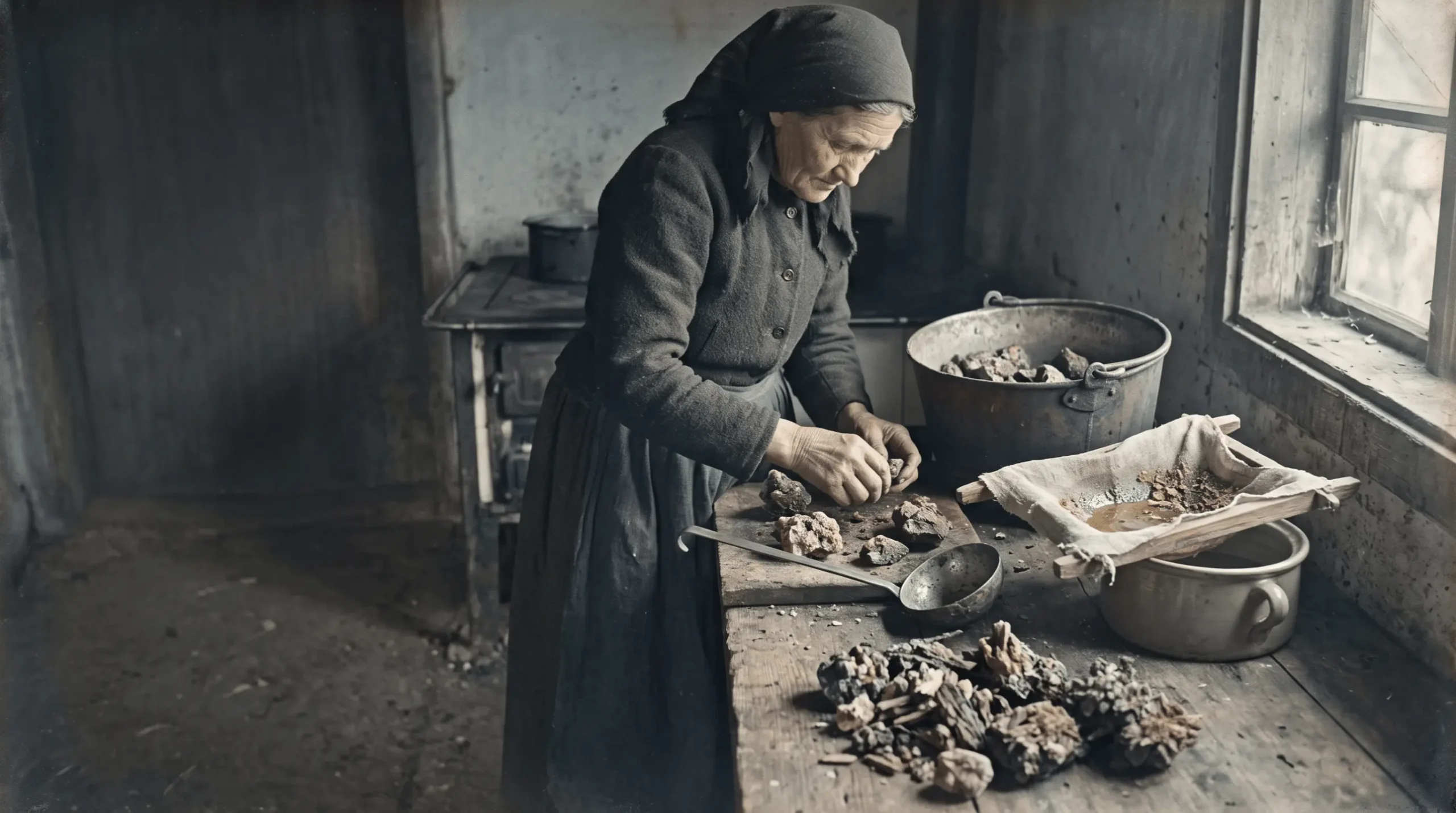
Traditional spruce resin ointment recipes in brief
- There is no single traditional recipe for spruce resin ointment. Historical and ethnographic sources describe different raw materials, proportions and preparation methods, so it would be misleading to speak of one original recipe.
- In Slovenia, several independent ethnographic and field records document resin combined with fats or oils and wax. The composition varied from place to place, while some records explicitly identify spruce resin. What recurs most clearly is therefore a method of preparation rather than one fixed formula.
- In northern Europe, combinations of spruce resin with butter or other animal fats are well documented. One research reconstruction of a Finnish preparation used 1 part resin to 3 parts unsalted butter and heated the mixture at approximately 100 °C, but this should not be generalised to all traditional recipes.
- “Preparing resin” could refer to very different forms: resin used directly, a soft ointment, a cooked resin preparation, a resin plaster or another processed material. Slovenian records also describe steps such as heating, straining, allowing mixtures to settle and applying preparations to cloth or another support.
- This page compares documented historical preparation methods. For information on how the raw material is collected today, see spruce resin collection, while a broader overview is available on the spruce resin page.
Table of contents
Is there one authentic recipe for spruce resin ointment?
No. Historical and ethnographic sources do not reveal a single standardised recipe that could be described as the original or only authentic recipe for spruce resin ointment. Different regions and periods used different types of resin, fatty carriers, wax and other ingredients, while heating methods and the final form of the preparation also varied.
This is further confirmed by field records from the Slovene Ethnographic Museum, where resin ointments, plasters and other mixtures with different compositions appear in several regions. Some records describe resin with butter and wax, others with oil and wax, while elsewhere marrow, tallow or additional plant ingredients were used.
Terminology adds another difficulty. Historical terms for ointments, plasters and resins did not necessarily refer to the same material or the same preparation. Even when two sources both mention spruce resin, this does not mean that they describe an identical recipe.
We therefore treat individual recipes on this page as documented examples from a particular place, period or source, rather than as instructions for reconstructing one universal traditional ointment. We also distinguish historical descriptions from modern research reconstructions, in which quantities, temperatures and procedures may already be more precisely standardised.
This is also a different purpose from the page about spruce resin ointment, which focuses on the modern product and its use. Here the main question is what historical recipes and preparation methods actually document.
What was traditionally added to resin ointments?
Slovenian ethnographic sources show that resin preparations did not follow one fixed recipe. In different places resin was combined with fats, oils, wax and other ingredients, while individual formulations varied considerably. The field records of the Slovene Ethnographic Museum show particularly clearly that this was not limited to one regional example but was a recurring method of preparation.
| Place or source | Documented composition | Important note |
|---|---|---|
| Škofja Loka region – Meta Sterle | Resin, beeswax, linseed oil and a small amount of animal fat. The same regional material also records melted honey combined with spruce resin. | The individual records do not describe the same preparation and do not provide one standard ratio of ingredients. |
| Gorice near Postojna, 1979 – SEM | Resin, butter and wax. | The tree species is not specified in the record. |
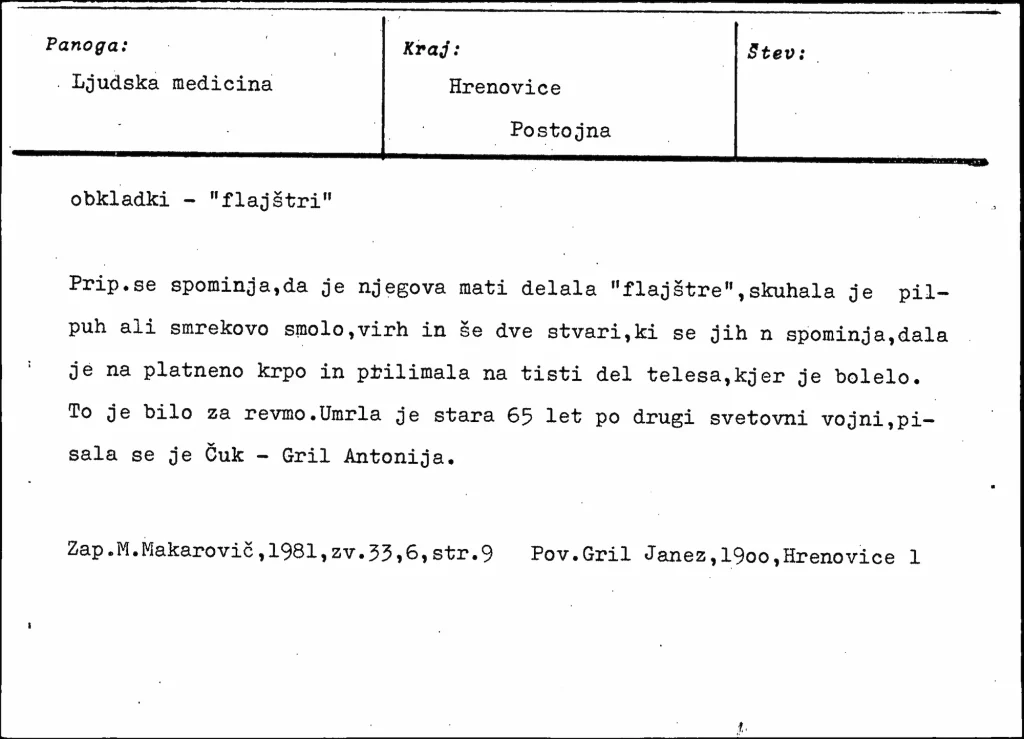
| Hrenovice, 1979–1981 – SEM | One record describes oil, resin and beeswax; another resin plaster explicitly mentions “pilpuh or spruce resin” together with virh and other ingredients. | The Hrenovice record is particularly valuable because it directly associates pilpuh with spruce resin in this specific local context. |
| Dob pri Špajih, 1950 – SEM | Wax, bone marrow and resin. | The preparation is described as a traditional ointment for wounds and boils. |
| Stavča vas, 1957 – SEM | Resin, wax and marrow. | The mixture was prepared as a resin plaster. |
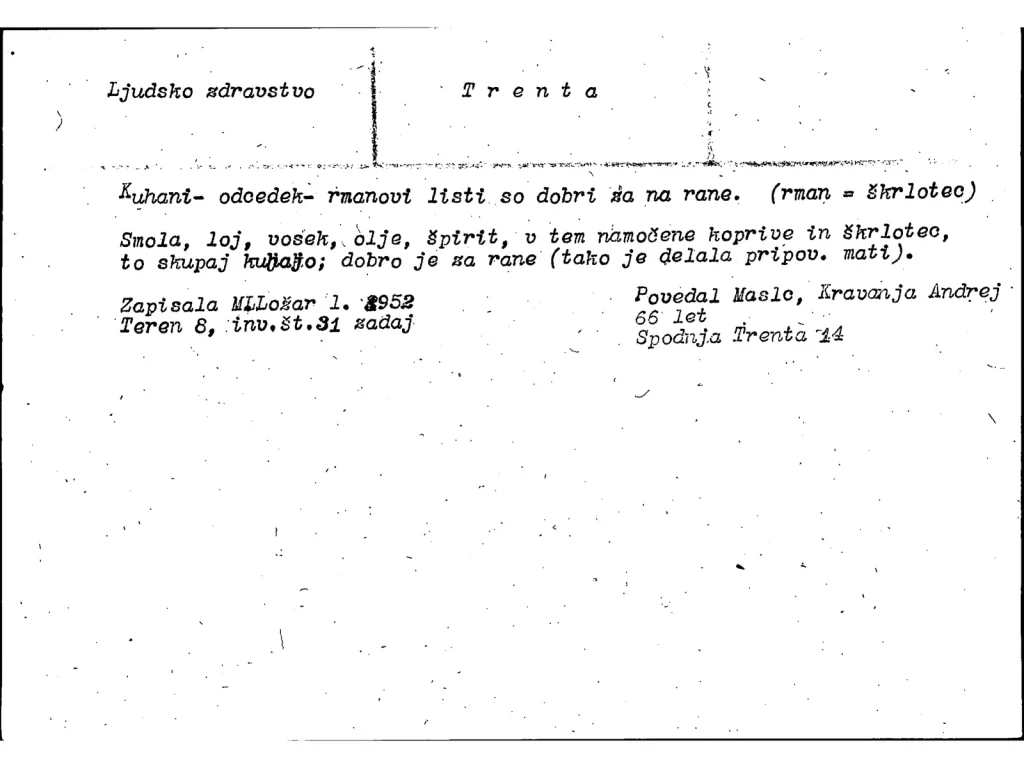
| Trenta, 1952 – SEM | Resin, tallow, wax, oil and spirit together with plant ingredients. | The ingredients were cooked together; the resin species is not specified. |
| Soča, 1952 – SEM | Juniper resin, beeswax, oil, pork fat, bone marrow and alum. | This example does not contain spruce resin, but it illustrates the wider Slovenian tradition of preparing resin mixtures. |
Despite the differences, a clear pattern emerges: resinous material was often combined with a fatty or oily base and wax. This produced softer ointments, denser preparations or resin plasters, while individual formulas could also include camphor, spirit, honey, bone marrow, plants or other ingredients.
Northern European sources show a comparable principle. In a research reconstruction of a traditional Finnish spruce resin ointment, spruce resin was prepared with unsalted butter at a ratio of 1 : 3. This is a specific Finnish model, not a universal traditional recipe.
Historical preparations are therefore better understood in terms of recurring preparation principles rather than one fixed formula. Even two preparations containing resin, fat and wax could differ in resin species, proportions, additional ingredients, heating and final consistency.
How was the resin heated, and what does “cooked resin” mean?
Heating was primarily a practical step in many resin preparations. Hard or highly viscous resin softens or becomes more fluid when heated, making it easier to combine with fat, oil or wax and, where necessary, to remove larger mechanical impurities.
Historical terminology needs to be understood in context. The expression “cooked resin” does not necessarily mean that the resin literally boiled at a specific temperature. In older descriptions, “cooking” may refer to heating resin or a resin mixture until it became sufficiently fluid for mixing or until the preparation reached the desired consistency.
Finnish example: resin and butter at approximately 100 °C
One of the more precisely described procedures comes from a modern research reconstruction of a traditional Finnish resin ointment. Spruce resin was mixed with unsalted butter at a mass ratio of 1 : 3 and heated with stirring at approximately 100 °C.
This example is valuable because it provides a specific ratio and temperature. However, it represents a research-standardised reconstruction and does not show that all historical Finnish or other European recipes followed the same procedure.
Slovenian records describe more than simply “cooking”
Slovenian ethnographic sources usually do not provide an exact temperature or heating time, but they document individual preparation steps quite well. Different field records mention cooking resin with fat and wax, heating resinous material, straining, allowing sediment to settle and applying preparations to cloth or paper.
A record from Trenta in 1952, for example, describes a preparation made from resin, tallow, wax, oil and spirit together with plant ingredients, cooked as a mixture. Another preparation from Soča was strained through cloth after cooking, while in Zapodnem the sediment was allowed to settle after heating.
Kočar’s black ointment from Dolenčice is documented as containing cooked spruce resin with camphor and spirit, but this record likewise does not specify a temperature or a complete heating procedure.
Historical records can therefore often provide a fairly good picture of the sequence of operations without supplying a technologically precise modern protocol. Terms such as cooked resin, ointment or resin plaster should therefore not be converted into invented temperatures, times or proportions.
Slovenian recipes and salves with spruce resin
Slovenian ethnographic sources reveal considerably more diversity than the modern term “spruce resin ointment” might suggest. In some places spruce resin was used directly, while elsewhere it was one ingredient in ointments, plasters and other resin mixtures. The field records of the Slovene Ethnographic Museum also show that such preparations were not confined to a single part of Slovenia.
Spruce resin and ointments in the Škofja Loka region
Meta Sterle documents several different resin preparations from the Škofja Loka region. One record describes a mixture of melted wax, resin, linseed oil and a small amount of animal fat; another mentions melted honey with spruce resin, while the direct use of spruce resin itself is also documented.
A particularly interesting example is Štimc’s ointment from Železniki, prepared by Janez Petrač – Štimovc. Informants recalled that it definitely contained spruce resin, camphor and marrow, while another plant ingredient was also mentioned but cannot be reliably identified from the source. The complete recipe has therefore not survived.
A similar pattern in other parts of Slovenia
Field records from the Slovene Ethnographic Museum extend this picture far beyond the Škofja Loka region. Gorice near Postojna records a mixture of resin, butter and wax; Hrenovice records resin with oil and beeswax; Dob records wax, bone marrow and resin; and Stavča vas records a plaster made from resin, wax and marrow.
More complex preparations are recorded in Trenta and Soča, where cooked resin mixtures included tallow or fat, wax, oil, bone marrow, spirit or plant ingredients. The individual formulations differ, but the same basic principle recurs in several places: resinous material was heated and combined with a fatty or oily base, often together with wax.
Ointment, plaster and pilpuh did not refer to one fixed formula
A particularly informative field record comes from Hrenovice in 1981. The informant recalled that his mother made plasters by “cooking pilpuh or spruce resin, virh and two other ingredients”, placing the mixture on a linen cloth and applying it to the painful area.
The record is also important for terminology: in Hrenovice, pilpuh is directly associated with spruce resin. This cannot be generalised to Slovenia as a whole. Möderndorfer uses related terms such as pilpoh, pilpah and pilpali elsewhere for fir and larch resins as well.
The same applies to traditional terms for ointments and plasters: they describe a form or local name of a preparation rather than one fixed chemical composition. Slovenian tradition therefore shows not one recipe for spruce resin ointment, but multiple local formulations with strikingly similar preparation principles.
Black resin, black salve and cooked resin – are they the same thing?
The terms black resin, black ointment and cooked resin may appear alongside one another in historical sources, but they do not necessarily describe the same material. Colour and traditional naming alone do not reveal which resin was used or how a preparation was produced.
Two black ointments – two different compositions
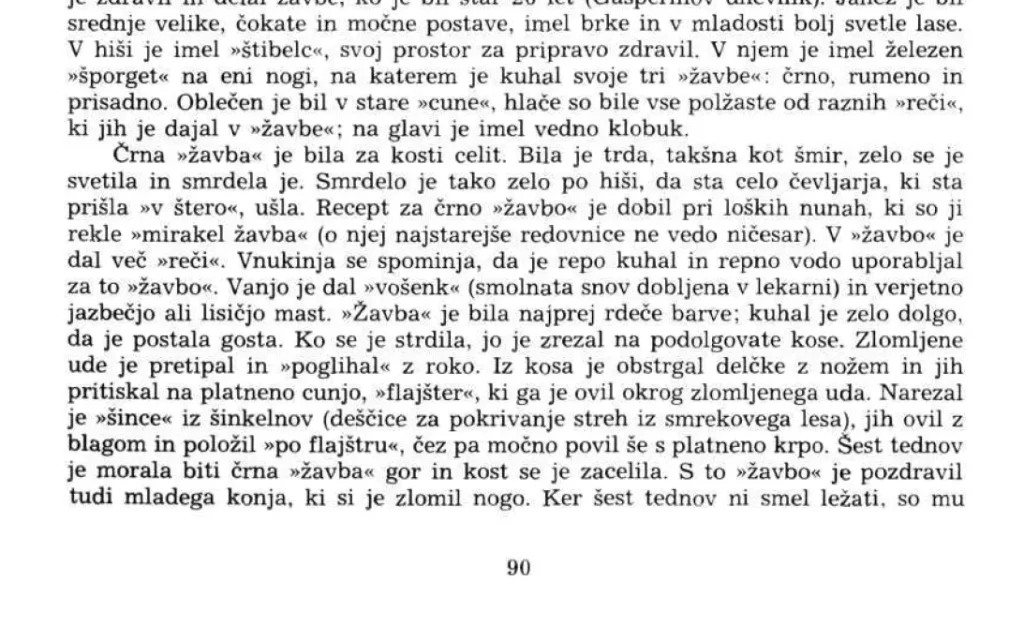
This is clearly illustrated by Meta Sterle’s material from the Škofja Loka region. Janez Potočnik – Krivar is associated with a black ointment described as hard, shiny and very strong-smelling. An informant remembered turnip water, “vošenk”, a resinous substance obtained from a pharmacy, and probably animal fat. The preparation was cooked for a long time, but the source does not state that spruce resin formed its base.
A different record concerns Kočar’s black ointment from Dolenčice. Here Sterle explicitly mentions cooked spruce resin, camphor and spirit. Two preparations bearing similar names therefore already have different documented compositions within the same regional source.
“Cooked resin” is not automatically tar
The word cooked also needs to be interpreted carefully. Resin could be heated simply to soften or liquefy it so that it could be mixed with other ingredients. Such heating is not the same process as the thermal decomposition of wood that produces tar-like materials.
Historical terms such as Pech, pitch, cooked resin or black resin therefore cannot automatically be translated as “tar”. To understand a particular record, it is necessary to establish which raw material was used and what process the source actually describes.
Dark colour is not a reliable indication of composition either. Resinous material may darken through ageing, prolonged heating, additives or impurities, while entirely different processes can also produce dark materials from wood.
Smolnak and smovnak – when resin preparation was no longer just an ordinary ointment
Alongside ointments, resin preparations and plasters, Slovenian tradition also records materials known as smolnak and smovnak. The names are similar, but they should not automatically be treated as the same preparation. The sources primarily indicate that these could be more extensively processed resinous materials, produced by methods going beyond simply melting resin with fat or wax.
Tonc’s smolnak from Sorica
The most detailed account concerns Tonc’s smolnak from Sorica. Mira Omerzel-Terlep describes its preparation in a special apparatus consisting of a military cooking pot, an earthenware vessel and a tube through which liquid emerged during heating. One of the known raw materials was spruce resin, while the complete formulation cannot be established from the source.
The emerging liquid darkened on exposure to air and thickened after cooling. This process is considerably different from simply mixing resin with fat, oil or wax and shows that more complex forms of thermal processing of resinous material were also known.
Smolnak and smovnak were not necessarily the same material
Other Slovenian sources also use the term smovnak. Their descriptions point to thermally or distillation-like processed resinous materials, but there is not enough evidence to identify smovnak with Tonc’s smolnak from Sorica. Similarity of names alone does not establish an identical raw material, process or final product.
Smolnak cannot simply be equated with turpentine or tar
Tonc’s method may resemble distillation, but the historical source does not provide a temperature, the complete composition of the raw materials or a chemical analysis of the resulting liquid. Smolnak therefore cannot be identified without further evidence as turpentine, wood tar or another modern chemically defined resin fraction.
Smolnak is important above all because it demonstrates the wide range of traditional resin processing: from direct use and simple ointments to resin preparations and plasters, as well as processes in which heating also resulted in the separation of a liquid fraction.
Prežla from Lesce and the beginnings of Smrekovit
The story of older resin preparations also includes Prežlja from Lesce. The name is not known only from the Smrekovit family tradition. In her overview of folk medicine, ethnologist Marija Makarovič refers to an earlier account by Finžgar mentioning a healer named Prežlja who set a broken bone.
This older account is important because it shows that the name Prežlja had already been associated with local healing practice. It does not, however, mention resin, black resin or a recipe, so it cannot tell us what preparations this earlier Prežlja may have used.
Separate from this written trace is Ivo Konc’s own recollection from Lesce. In an archival interview for Gorenjska TV from 2001, he says that while dealing with his back problems he also used resin at “old Prežla’s”. In the family recollection, this preparation was remembered as a dark or black, sticky resinous preparation.
Whether the Prežlja known to Ivo was a direct descendant of the earlier healer, or whether the name referred to a household, family or local healing tradition, is not yet documented with sufficient certainty.
Ivo Konc in an interview for Gorenjska TV, 2001. In the interview, he speaks about resin at old Prežla’s in Lesce and about the beginnings of the development of his own ointment. Read the full interview transcript.
From Prežlja to an independent development
In the same interview, Ivo says that he later made “something similar to Prežla”, but in a form that was no longer black and sticky and was more practical to use.
This statement is important to the history of Smrekovit because it shows directly that experience with an older resin preparation was one of the starting points for his thinking. It does not mean that Ivo knew or adopted Prežlja’s exact recipe.
The older written account of a healer named Prežlja and Ivo’s twentieth-century recollection should therefore be treated as two interesting historical traces. A connection between them is a reasonable research hypothesis, but without additional archival or genealogical evidence it should not be presented as established fact.
How was resin prepared in other parts of the world?
Resin preparations were not unique to Slovenia. Documented examples from northern Europe, the Alpine region and North America show that different peoples heated resin, mixed it with fats, selected it according to age and consistency, and used it in many different forms. This does not mean that the same recipe existed everywhere or that these traditions necessarily developed from a common source.
| Region or tradition | Documented examples | Why it matters |
|---|---|---|
| Northern Finland and Sweden | Descriptions of homemade ointments record spruce resin being cooked with butter or another animal fat. | This is one of the best-documented European parallels to a spruce resin ointment. |
| Alpine region | Sources distinguish several different resinous materials. An Austrian spruce resin preparation is also documented in which resin was heated in hot water and the softened material filtered through cloth. | Terms such as Harz, Pech and Faulpech do not necessarily describe the same material or process. |
| Ojibwe and other Great Lakes peoples | Early ethnobotanical sources describe liquid balsams, cooked pitch, the addition of tallow and resinous materials used as bases for different preparations. | Some of this material is medicinal, while other uses are entirely technical, for example sealing and making objects. |
| Gwich’in | A modern community source clearly distinguishes old, hard spruce resin used for chewing from fresh, sticky resin used for other purposes. | Even within a single tradition, different states of resin were not treated as the same material. |
Similar methods do not mean the same recipe
Some practical patterns recur in widely separated regions: heating resin, adding fat, removing mechanical impurities and selecting material according to hardness or age. These similarities are interesting, but they do not by themselves demonstrate a direct transfer of knowledge between cultures.
Nor does every historical reference to “resin” mean spruce resin. Different sources refer to spruce, pine, fir, larch and other conifers, as well as natural resin, cooked pitch and other processed materials. Historical recipes therefore need to be read with attention to the tree species, state of the resin and method of preparation.
A broader overview of the raw material and the differences between resinous substances is available on the spruce resin page.
What do traditional recipes tell us about spruce resin ointment?
When Slovenian, Nordic, Alpine and North American sources are viewed together, one point becomes particularly clear: traditional spruce resin ointment was not a single product with one fixed recipe. Resin was used directly, heated, combined with fats, oils or wax, and prepared as ointments, plasters and other resinous preparations.
A recurring method, not one fixed formula
This is particularly clear in Slovenian field records. Across different places, resin, a fatty or oily base and wax recur in different combinations. Some preparations also contained marrow, camphor, spirit, honey or plant ingredients; mixtures could be cooked, strained, allowed to settle or applied to cloth or paper.
The common feature is therefore not one precise formula but the adaptation of resinous material into a form suitable for use. Consistency was modified, ingredients were combined in different ways and different carriers were used according to local practice and the intended form of the preparation.
Historical did not mean uniform
Even when a historical source explicitly mentions spruce resin, this does not mean that the preparation was identical to another resin ointment from a different place or period. The state and age of the resin, heating method, added ingredients, proportions and final form could all vary.
Historical sources therefore reveal not one “authentic recipe” but several traditions of preparation in which remarkably similar technological principles recur. Today’s spruce resin ointment should be understood as a modern preparation with its own development rather than as a direct copy of any one historical formula.
From traditional resin preparations to Smrekovit
Historical and ethnographic sources show that knowledge of resin in Slovenia extended far beyond one recipe or one local tradition. Spruce and other conifer resins were used directly and prepared as ointments, plasters and other resin-based preparations using different ingredients and methods.
Smrekovit did not originate as a copy of one of these preserved traditional recipes. Drawing on his knowledge of spruce resin, experience with older resin preparations and his own development work, Ivo Konc gradually created his own preparation, from which the family story of Smrekovit later developed.
Traditional sources are therefore important primarily as a broader historical context: they show that the use and preparation of resinous materials in Slovenia was not an isolated phenomenon, while today’s Smrekovit is the result of independent development.
More about Ivo Konc, the beginnings in 1989 and the subsequent development of the company through two generations can be found on the About us – the Smrekovit story page.
From resin in the forest to the finished product
Historical records show how varied older forms of resin preparation were. The documentary film From Resin to Product shows how spruce resin makes its journey at Smrekovit today.
From Resin to Product. A Smrekovit documentary following the journey of spruce resin from the forest to the finished product.
Today’s Smrekovit is therefore not presented as a preserved “ancient recipe”, but as a modern product with its own development, rooted in long-standing knowledge and use of spruce resin.
If you would like to learn about today’s spruce resin ointment, its ingredients, different forms and use, continue to the spruce resin ointment page.
Frequently asked questions about traditional spruce resin recipes
Is there one authentic traditional recipe for spruce resin ointment?
No. Historical and ethnographic sources describe several different resin preparations. They vary in the type and state of the resin, added ingredients, proportions, heating method and final form. Slovenian field records likewise document several local formulations, so a single “original” recipe for spruce resin ointment cannot be identified.
What ingredients were traditionally added to resin?
Slovenian ethnographic records mention various animal fats or tallow, butter, wax and oils, as well as bone marrow, camphor, spirit, honey and plant ingredients. In several regions, resin repeatedly appears together with a fatty or oily base and wax, but the formulations were not uniform.
What did pilpoh or pilpuh mean?
The term did not have the same meaning everywhere. In the Škofja Loka region, pilpoh is associated with spruce resin, while a 1981 field record from Hrenovice even states “pilpuh or spruce resin”. In other Slovenian sources, related terms also refer to fir and larch resins. Their meaning therefore has to be established from the specific local context.
What does “cooked resin” mean in historical sources?
The expression alone does not define a precise process. It may refer to heating resin to soften it and combine it with other ingredients, or to more prolonged thermal processing of a resin preparation. Slovenian records also describe straining, allowing mixtures to settle and applying preparations to cloth or paper. “Cooked resin” therefore cannot automatically be identified with tar.
Are black resin and black ointment the same thing?
Not necessarily. Meta Sterle alone describes different black ointments with different compositions. One does not explicitly identify spruce resin, while Kočar’s black ointment is documented as containing cooked spruce resin, camphor and spirit. Dark colour alone therefore does not identify the resin species or method of preparation.
Were smolnak and smovnak the same preparation?
The sources do not allow this to be established reliably. Tonc’s smolnak from Sorica is described in detail as a preparation involving spruce resin and an apparatus from which liquid emerged during heating. The term smovnak also appears elsewhere, but similarity of names does not establish the same raw material, process or final product.
Who was Prežlja from Lesce?
An older written source cited by ethnologist Marija Makarovič mentions a healer named Prežlja in connection with setting a broken bone, but does not mention resin. Separately, Ivo Konc later recalled a resin preparation used by “old Prežla” in Lesce. Whether these references represent the same family, person or local healing tradition is not yet documented with sufficient certainty.
Were resin ointments used only in Slovenia?
No. Related traditions of resin ointments and other resin preparations are documented in northern Europe, the Alpine region and North America. Tree species, the state of the resin, additional ingredients and preparation methods varied, so these traditions should not be treated as one common recipe.
Is today’s Smrekovit made according to an old recipe?
Not as a direct copy of one preserved historical formula. Ivo Konc was familiar with older uses of spruce resin and gradually developed his own preparation through his own experience. Today’s Smrekovit therefore has its own development history.
Are these historical recipes instructions for making an ointment at home?
No. Historical records often lack exact proportions, temperatures, heating times or complete identification of all ingredients. They are presented here as documentation of traditional preparation methods, not as a modern standardised manufacturing procedure.