
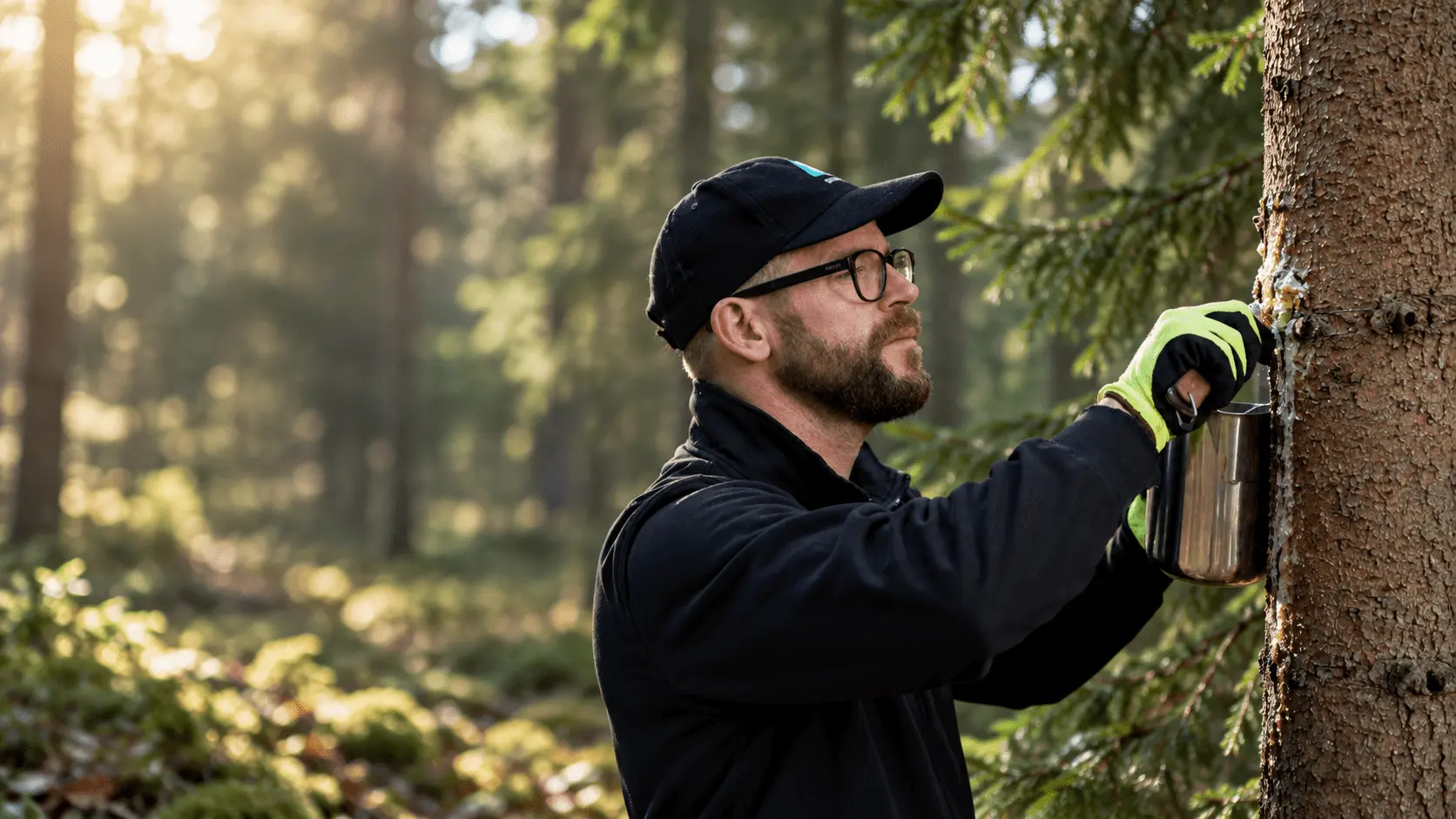
Spruce resin collection in brief
- With our approach to collection, the season itself is not the only consideration. What matters most is that the resin has already been exuded by the tree and is suitable for collection.
- Smrekovit generally collects older, partly or fully hardened resin, so there is no need to wait for freshly exuded resin.
- We do not cut into or deliberately injure trees in order to stimulate new resin flow.
- Individual pieces of resin can vary considerably in colour, hardness, aroma and cleanliness because they originate from different injuries and different periods of resin formation.
- In practice, collection is carried out in agreement with landowners or the managers responsible for the area.
Table of contents
When is spruce resin collected?
With the collection method used by Smrekovit, spruce resin is not limited to one short collecting season. We do not collect only fresh resin immediately after it has been exuded by the tree, but mainly resin that has already been exuded at the site of an earlier injury and has hardened over time.
For this reason, the condition of the resin is more important for collection than a specific date on the calendar. Resin found on a tree may be very soft and sticky, partly hardened, or considerably older and hard. With our method, we mainly look for resin that has already been exuded and can be removed without creating a new injury to the tree for the purpose of obtaining resin.
This is an important distinction from methods in which a tree is deliberately cut or otherwise injured to stimulate a new flow of resin. At Smrekovit, we do not injure trees in order to stimulate resin production.
Why does a spruce tree produce resin?
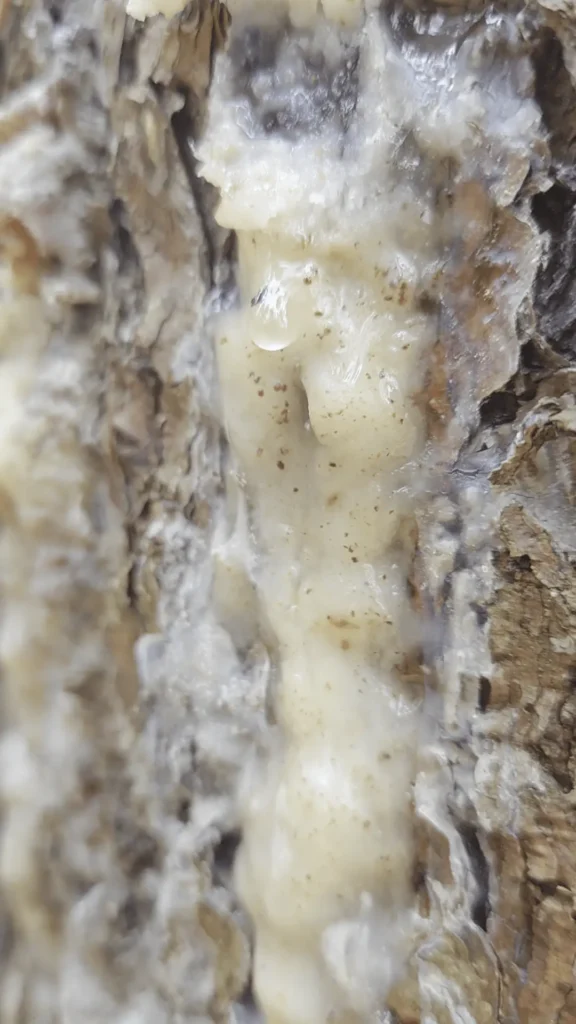
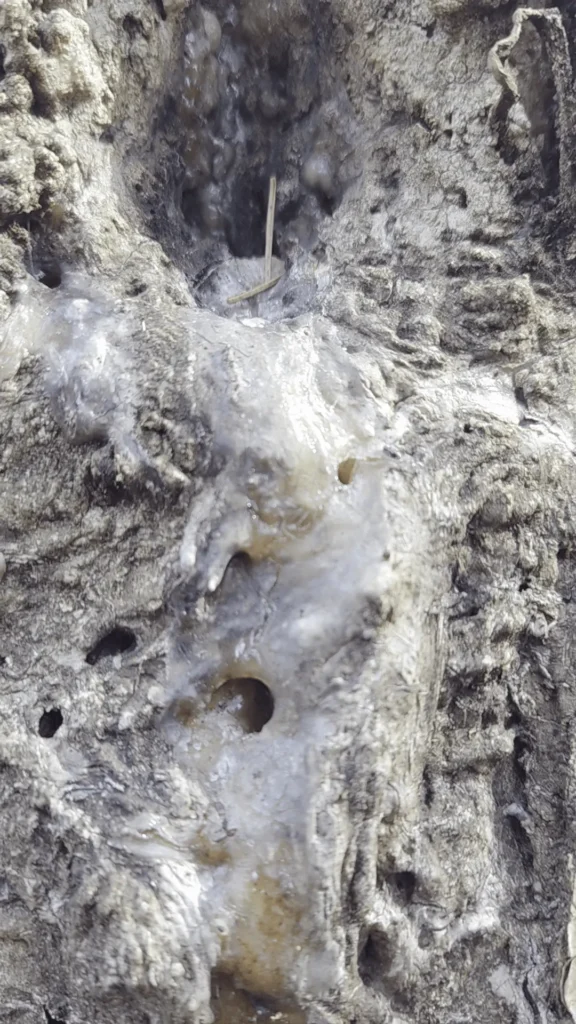
Resin is part of the spruce tree’s defence system. When the bark or deeper tissues are damaged, resinous material can quickly flow from existing resin ducts and cover the injured area.
It serves several functions at the same time. Because of its viscosity and subsequent hardening, it forms a physical barrier that helps reduce water loss and direct exposure of damaged tissue to the environment. At the same time, it contains various terpenes and other resin compounds that take part in the tree’s defence against insects and microorganisms.
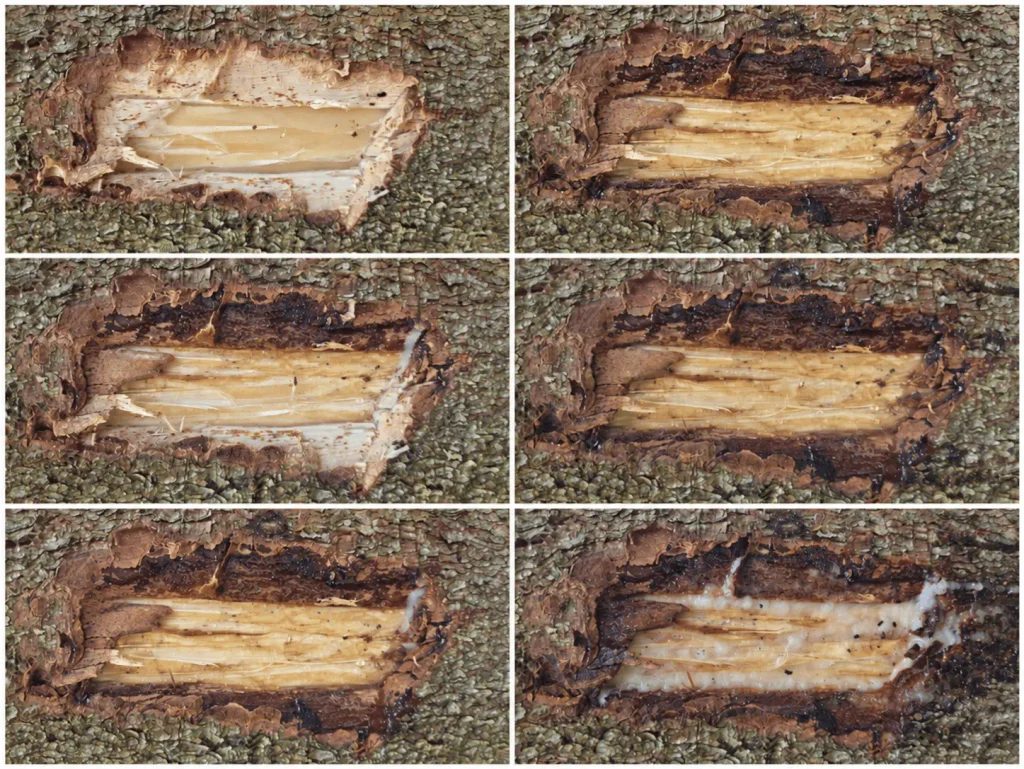
The response can continue after the initial injury. Spruce can form additional traumatic resin ducts and release further resin at the same site, while chemically different resinous material may also develop as the wound closes. A large old resin deposit on a trunk therefore does not necessarily result from a single initial flow of resin.
What kind of resin do we collect at Smrekovit?
At Smrekovit, we mainly collect spruce resin that has already been exuded by the tree and has remained at sites of earlier damage. It is generally older, partly or strongly hardened resin rather than only fresh, still-fluid resin.
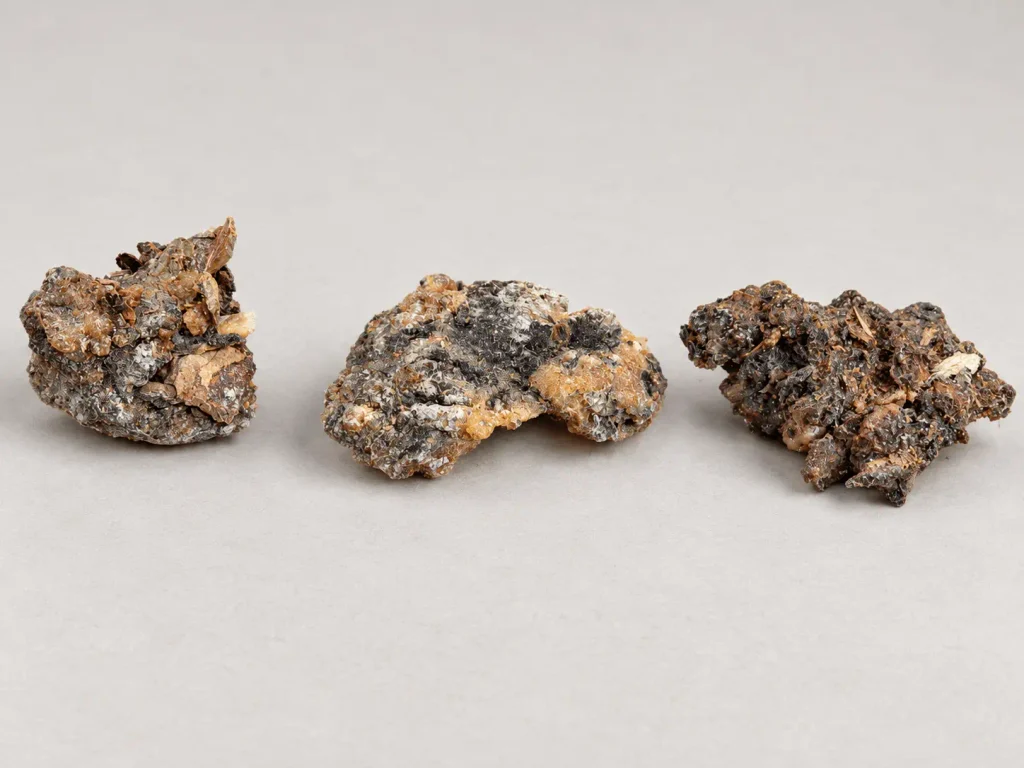
Such resin is not a uniform raw material. Individual deposits can differ considerably: the resin may be lighter or darker, softer or harder, more or less aromatic, and may contain varying amounts of bark particles and other natural impurities.
Age alone is therefore not a simple measure of quality. Ageing changes the composition and physical properties of resin, and different resinous phases may also appear over time at the same damaged site. It cannot simply be concluded that older resin is always “better” or “stronger” than fresh resin.
How do we collect spruce resin at Smrekovit?
At Smrekovit, we look for resin that the spruce tree has already exuded at the site of an earlier injury. We do not cut into trees or create new injuries in order to stimulate additional resin flow.
We first identify suitable deposits of resin that are already present on the tree. We mainly collect older, sufficiently hardened resin, while avoiding interference with healthy tree tissue.
At Smrekovit, we look for resin that the spruce tree has already exuded at the site of an earlier injury. We do not cut into trees or create new injuries in order to stimulate additional resin flow.
We first identify suitable deposits of resin that are already present on the tree. We mainly collect older, sufficiently hardened resin, while avoiding interference with healthy tree tissue.
Does collecting resin damage the tree?
With the method used by Smrekovit, the aim is to remove only resin that has already been exuded at an existing damaged site. We do not cut into the tree, reopen the injury or interfere with healthy bark or wood in order to stimulate new resin flow.
An important part of collection is recognising the boundary between the resin deposit and the underlying tissue. If the resin cannot be separated without interfering with firmly attached tissue, or if a fresh or moist surface appears, collection at that spot is stopped. The aim is therefore not to “clean the wound down to the wood”, but only to remove resin that can be separated without further intervention in the tree.
This is also a key difference from active resin tapping, where an injury is created or repeatedly renewed specifically to stimulate further resin flow.
Fresh and older resin – what is the difference?
Freshly exuded spruce resin is generally softer, stickier and more strongly aromatic. It contains a higher proportion of volatile compounds, which have an important influence on its scent and physical properties.
Over time, some of these volatile compounds are lost, while the resin hardens and undergoes chemical changes. Older resin is therefore often harder and less strongly aromatic, and its appearance may change from pale or yellowish tones to darker or greyish surfaces.
Ageing, however, is not simply a process of “drying out”. Additional resin may be exuded at the same damaged site over time, and resinous material with a different composition may also develop as the injury closes. Older resin can therefore be a heterogeneous mixture of different resin phases, rather than merely fresh resin from which volatile substances have evaporated.
Current research does not justify a simple conclusion that older resin is always better or worse than fresh resin. What can be said is that both its physical properties and its chemical composition change as it ages.
Why do individual pieces of spruce resin differ so much?
Spruce resin found on a tree is not a uniform material with an identical appearance and properties every time. Even at the same damaged site, resin from different periods and of different origins may occur together.
Over time, resin loses some of its volatile compounds, hardens and undergoes chemical changes. The tree may also exude additional resin at the same site, while resinous material with a different composition may form as the injury closes. A single deposit can therefore contain softer, harder, lighter or darker portions.
Natural impurities also influence its appearance. Older deposits may contain pieces of bark and other environmental material, so collected resin can also vary in cleanliness, texture and aroma. Such differences are normal when working with a natural resin and can often be seen with the naked eye.
What happens to the resin after collection?
After collection, the resin is still a natural and non-uniform raw material. It varies in appearance, cleanliness, hardness and the amount of natural impurities, so the next step is a basic assessment and sorting of the collected resin.
This mainly involves considering the characteristics of individual pieces and the presence of larger bark fragments, wood particles and other environmental impurities. The resin is then stored appropriately and prepared for further processing.
Collected resin is therefore not used immediately, but first goes through several stages of preparation and processing. The broader journey from resin to finished product is shown in the documentary video below.
Can spruce resin be collected anywhere?
No. The fact that access to forests in Slovenia is generally open does not mean that resin may be removed from trees anywhere and without agreement. Every forest has an owner, and resin collection is also subject to rules governing forest management.
At Smrekovit, we therefore organise collection in agreement with forest owners or managers and within previously agreed areas. Where required, the relevant forestry authorities are also involved and the procedures required by current legislation are followed.
This approach is also important because we want the origin of the resin to be clear and collection to be organised on a long-term basis, rather than removing resin randomly from forests belonging to others.
Frequently asked questions about spruce resin collection
When is spruce resin collected?
With the method used by Smrekovit, collection is not tied to one particular season. We mainly collect resin that has already been exuded by the tree and has partly or strongly hardened at the site of an older injury. The condition of the resin and the suitability of the site are therefore more important than a particular date.
Is spruce resin collected only in summer?
Not necessarily. Because we collect resin that has already been exuded, there is no need to catch the moment when fresh resin is flowing from the tree. Hardened resin can remain at a damaged site for several years. When collection is actually possible also depends on conditions in the forest and the arrangements for the particular area.
Does a spruce tree have to be cut to obtain resin?
Not with the collection method used by Smrekovit. We look for resin that the tree has already exuded following an earlier injury. We do not cut into trees or reopen older injuries in order to stimulate new resin flow.
How long can spruce resin remain on a tree?
Resin can remain at the site of an older injury for several years. During this time, it loses some volatile compounds, hardens and changes, while additional layers of resin may also appear at the same site.
Is older spruce resin better than fresh resin?
Current knowledge does not support such a simple conclusion. Fresh and older resin differ in their physical properties and chemical composition, but age alone does not show that a resin is better, worse or “stronger”.
Why does spruce resin vary in colour and hardness?
Its appearance is influenced by the age of the resin, loss of volatile compounds, changes during exposure to the environment, later resin exudation, and pieces of bark or other natural impurities. Individual pieces can therefore look very different even within the same deposit.
Can spruce resin be collected anywhere?
No. Ownership of the area and the applicable forestry requirements need to be checked before collection. Slovenian forest legislation regulates resin collection as part of forest management. At Smrekovit, we therefore arrange collection in cooperation with forest owners or managers and the relevant authorities.