
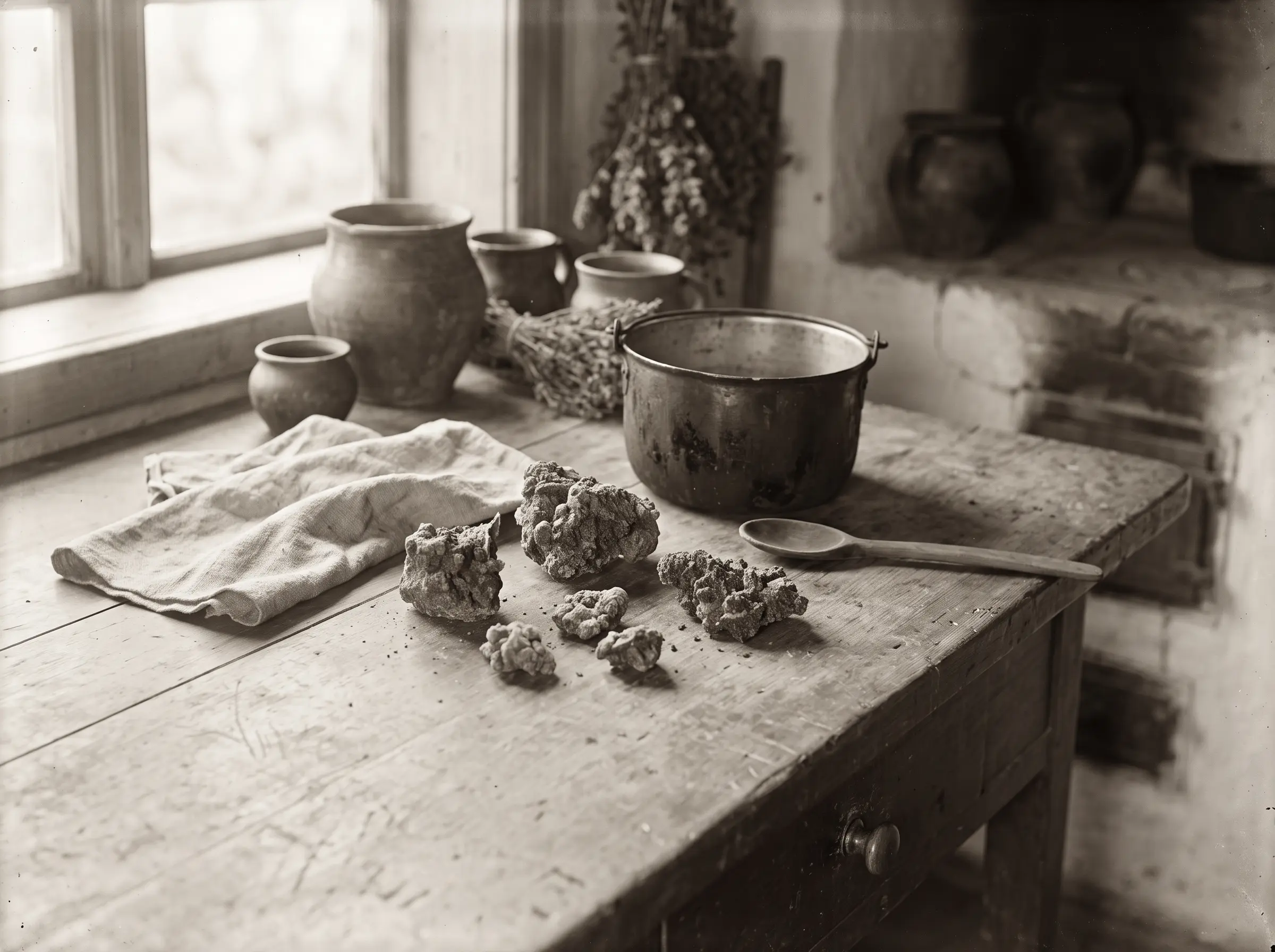
Traditional uses of spruce resin in brief
Spruce resin and other conifer resins have a long history of use. Historical and ethnographic sources from different parts of the world most consistently describe their use for wounds and damaged skin, but also for pain and injuries, respiratory complaints, chewing and internal use, and in some veterinary practices. Resin was also an important practical material in everyday life.
| Area of use | Documented examples |
|---|---|
| Wounds and skin | Wounds, cuts, suppurating wounds, boils, cracks and other forms of damaged skin represent the strongest historical pattern. In Slovenia, this is supported not only by published ethnographic works but also by numerous independent field records. |
| Pain, joints and injuries | Resin preparations are documented in connection with rheumatic pain, painful areas, swelling and various injuries. Slovenian field records also describe plasters and other resin preparations used in such contexts. |
| Respiratory and internal use | In different traditions resin was chewed or taken internally, while resin preparations were also used in connection with coughs and other respiratory complaints. |
| Animals | Veterinary uses of resinous materials are documented in several traditions. Slovenian field records concerning animals particularly mention turpentine and other resinous materials, so these accounts should not automatically be equated with the direct use of spruce resin. |
| Practical uses | Resins served as adhesives, water-resistant coatings, combustible material, chewing material and raw material for many other purposes. |
Individual traditions differed in the tree species used, the preparation of the resin and the way it was applied. It is therefore important to distinguish spruce resin from other conifer resins and from already processed resinous materials, even where their traditional uses partly overlap.
This page focuses primarily on what resin was used for. How ointments, plasters and other resin preparations were made is described in more detail on the page How was spruce resin ointment traditionally prepared?
Table of contents
What does “traditional use” actually mean?
Traditional resin use did not mean one single practice that was the same everywhere. The way resin was used depended on the environment, available tree species, local knowledge and methods of preparation. Historical sources therefore describe raw resin as well as ointments, plasters, cooked preparations and other forms.
The term resin and older local names were not always unambiguous. Sources refer to spruce, pine, fir and larch resins, as well as to already processed resinous materials. Some names had a distinctly local meaning: in individual records, for example, pilpuh or pilpoh is directly associated with spruce resin, while related terms elsewhere also occur for resins from other conifers.
The same applies to terms such as smolnak, smovnak, traditional ointment names and shoemaker’s resin. These do not necessarily refer to the same material or process. Some designate a particular preparation or form of processing and therefore should not automatically be equated with raw tree resin. To understand an individual record, it is important to know which plant the material came from, in what form it was used and what the particular term meant in its local context.
Historical names for the conditions for which resin was used also belong to their own period. Terms such as wound, boil, suppuration, swelling, rheumatic pain or “consumption” therefore cannot always be mapped directly onto modern medical diagnoses.
This page follows primarily well-documented patterns of use and, wherever possible, distinguishes spruce resin from other resin types and from processed resinous materials. More about what spruce resin is, how it forms and its characteristics can be found on the main page about spruce resin.
Wounds and damaged skin – the most commonly documented use
Among the historical uses of conifer resins, their use for wounds and damaged skin appears most consistently. Such records are known from Slovenia, northern Europe, North America and Asia. Tree species, resinous materials and preparation methods differed, yet the basic pattern recurs in widely separated regions.
Spruce resin for wounds in Slovenia
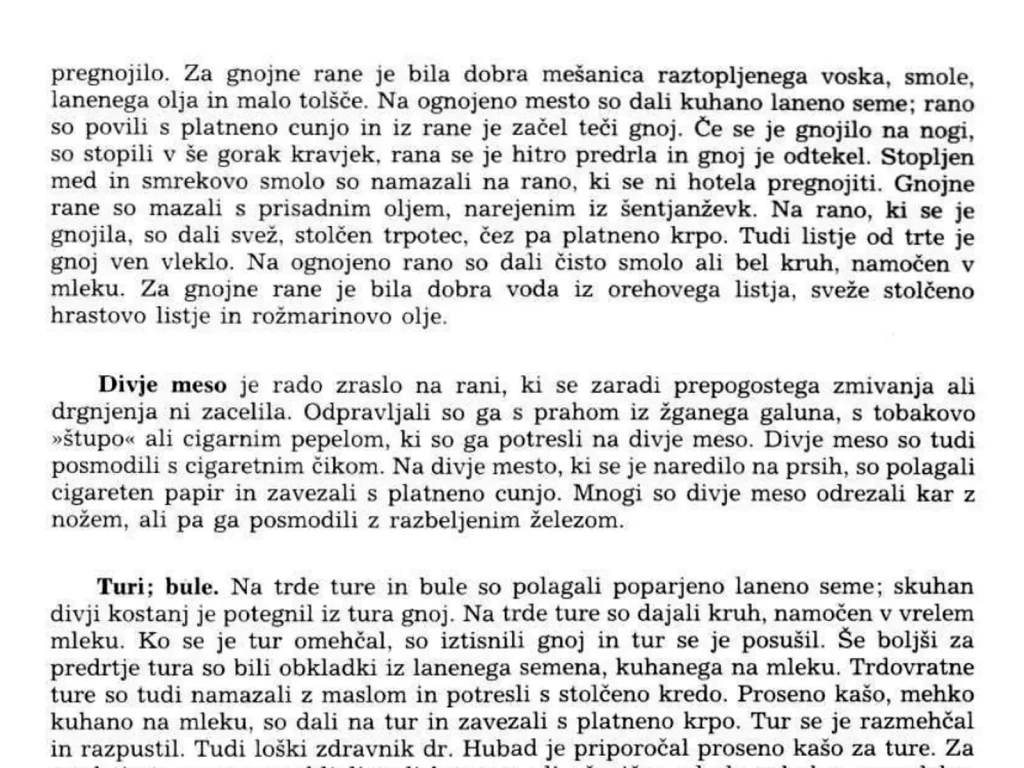
Meta Sterle directly records the use of spruce resin on old and fresh wounds in the Škofja Loka region and describes forestry workers applying a thick layer of resin to a gaping wound. For suppurating wounds, she records both pure resin and preparations combining resin with wax, linseed oil, fat or honey.
Vinko Möderndorfer documented spruce resin on cleaned wounds in the Cerkno region and also recorded larch, fir and more generally tree resins in other parts of Slovenia. These published sources already show that the use of resin for wounds was not restricted to one locality or one conifer species.
Field records of the Slovene Ethnographic Museum
This picture is now considerably strengthened by primary field records held by the Slovene Ethnographic Museum. A systematic review of 1,252 transcribed field records identified 29 records directly or supportively relevant to resin and resin preparations. Several independent records explicitly mention spruce resin in connection with wounds or suppurating wounds.
At Radohova vas near Stična, pure spruce resin was recorded for suppurating wounds; at Petrušnja vas spruce resin was recorded for wounds and a sickle cut; and at Log near Mokronog it appears again in connection with suppurating wounds. A particularly informative 1949 record from Gojnice distinguishes pine resin used as incense from spruce resin used for wounds. This is important because it shows that the word “resin” was not necessarily being used as an undifferentiated category in field accounts.
Suppurating wounds, boils and resin preparations
Slovenian records describe more than the direct application of resin. Ointments and plasters containing resin together with wax, oil, butter, tallow or bone marrow also occur in connection with wounds, suppuration and boils. Such combinations are documented in the Postojna region, Dolenjska, around Stična and in the Trenta and Soča valleys.
Some records also preserve the historical folk expression that resin or a resin preparation was believed to “draw something out”. This wording is useful as evidence of how informants understood the practice, rather than as a modern explanation of a biological mechanism.
More detailed recipes, combinations of resin with fats and wax, and the preparation of these ointments and plasters are presented on the page about traditional preparation of resin preparations.
A similar pattern outside Slovenia
In Finland, the connection between spruce resin and wounds is documented in older written sources. In the nineteenth century, Elias Lönnrot recorded the use of resin from Norway spruce (Picea abies) for wounds, while later Finnish sources also describe traditional resin preparations for various forms of damaged skin.
Similar records are known from North America. Ethnobotanical sources describe the use of conifer resins or balsams for wounds and other skin injuries among several Indigenous peoples. Among the Gwich’in, for example, fresh sticky spruce resin is described for cuts and irritated skin, while older hardened resin had other uses.
Cracks, boils, suppurating wounds and other skin injuries
The historical record is not limited to ordinary cuts. Sources from different regions also describe skin cracks, boils, suppurating wounds, ulcers and other more persistent injuries. In the Himalayas, for example, the oleoresin of Picea smithiana is documented for cracked heels, while other conifers from the same region were also used for wounds, boils and abscesses.
With the addition of the Slovenian field records, this pattern becomes even clearer: resin use for damaged skin recurs not only across widely separated cultures but also in several independent Slovenian local records. Wounds and damaged skin therefore remain the best-documented area of traditional use of spruce and other conifer resins.
Spruce resin for pain, joints and injuries
In addition to wounds, historical sources also describe resin preparations in connection with pain, rheumatic complaints, swelling and injuries. This group of uses is less uniform and less extensively documented than use for wounds, but it appears in Slovenian sources as well as in several other traditions.
Rheumatic pain in Slovenian sources
Meta Sterle describes the so-called Kočar black ointment from the Škofja Loka region, prepared from cooked spruce resin, camphor and spirit. The source records it in connection with rheumatic pain, making it a clear Slovenian example of spruce resin in this historical context.
A further direct example comes from a Slovene Ethnographic Museum field record from Hrenovice in 1981. The informant recalled that his mother cooked “pilpuh or spruce resin”, virh and other ingredients for plasters, spread the mixture on linen cloth and attached it to the painful area. He explicitly stated that it was used “for rheumatism”.
A 1951 field record from Sužid near Kobarid also mentions a combination of resin and animal fat applied to a painful area. The resin species is not identified, so this is best treated as supporting evidence for the broader traditional use of resin preparations rather than as direct evidence for spruce resin.
These terms did not refer to one standard preparation. Black ointments, plasters and other resin preparations differed between places in both composition and method of preparation. Their historical recipes are discussed in more detail on the page about traditional preparation of resin preparations.
Joints, swelling and injuries in other traditions
Similar themes are not limited to Slovenia. Tibetan sources describe resins from certain spruce species (Picea) in connection with joint complaints and tendon injuries, while a Korean traditional source lists painful and swollen joints and traumatic injuries among uses of pine resin.
Pain, swelling and injury therefore recur in connection with resinous materials across several geographically distant traditions. This historical pattern is, however, more varied and less uniform than the pattern seen for wounds: tree species, resin preparations, local terminology and methods of use all differed.
Respiratory use, chewing and internal use of resin
Resins were not used only externally. Several traditions also document chewing resin, taking resin preparations internally, and their use in connection with coughs and respiratory complaints. It is especially important here to distinguish between tree species, raw resin and already processed preparations.
Pilpoh and smolnak in Slovenian sources
Meta Sterle records the consumption of spruce resin known as pilpoh in the Škofja Loka region in connection with the historical term “consumption” and pulmonary complaints. In this particular source, pilpoh is directly associated with spruce resin.
The term was not unambiguous everywhere. Möderndorfer also associates related terms such as pilpoh, pilpah and pilpali with fir and larch resin in other regions. Pilpoh therefore cannot be treated as a universal Slovenian synonym for spruce resin; the specific local context has to be considered.
A different example is the smolnak from Sorica described by Mira Omerzel-Terlep. This was not simply a piece of raw resin but a particular processed resin preparation. According to the record, drops were placed on sugar and the preparation was also used for coughs and respiratory complaints. Its preparation is described in more detail on the page How was spruce resin ointment traditionally prepared?
Chewing spruce resin
Chewing spruce resin is also documented in Slovenia. Ethnographic summaries mention the practice in Bohinj, while similar practices are known from northern Europe and North America.
The Gwich’in record is particularly illustrative. They distinguished between fresh, sticky spruce resin and old, hard resin: the former was used on damaged skin, while hardened resin was also chewed. The choice of material was therefore connected to its age, hardness and other perceptible properties.
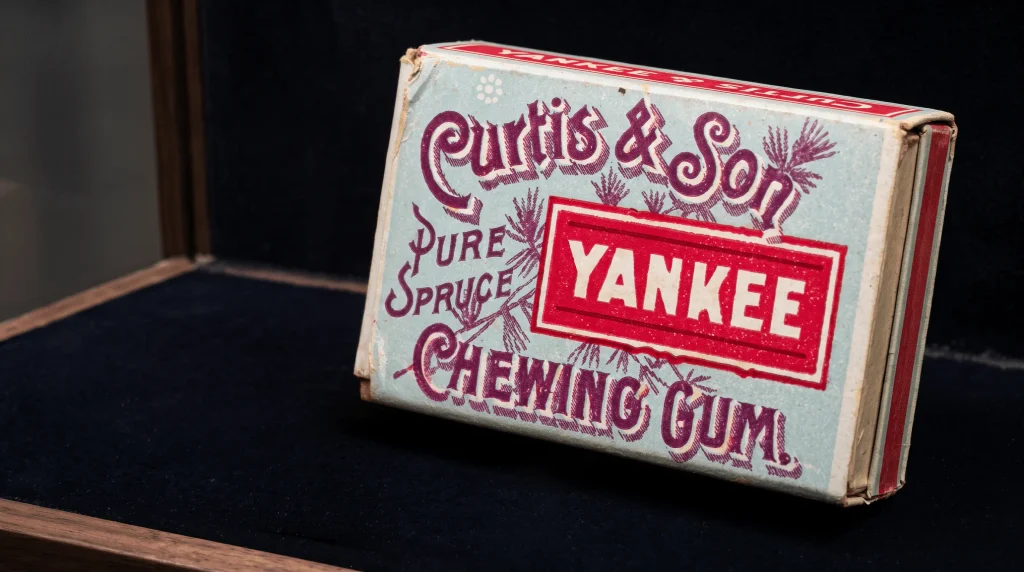
Commercial production of so-called spruce gum also developed in North America during the nineteenth century. Official historical sources from Maine place J. B. Curtis’s early commercial manufacture of chewing gum from spruce resin in 1848.
Coughs, colds, smoke and steam
Outside Slovenia, resins and other aromatic conifer materials also appear in connection with respiratory uses. North American ethnobotanical sources describe balsams and other conifer materials for colds, inhalation, smoke and steam baths. In the ancient Mediterranean world, Dioscorides also listed mastic among materials used for a persistent cough.
Respiratory and internal uses of resins were geographically diverse, ranging from chewing and ingestion to balsams, smoke, steam and specialised processed preparations. These traditions therefore should not be treated as one uniform use of a single resin type.
Use of resin in animals
Historical sources also record resinous materials in the care of animals. These accounts are more varied than those concerning wounds in humans: they mention resin, processed resin preparations, turpentine and mixtures with fats, and these materials cannot always be equated with spruce resin.
Slovenian examples
One of the clearer Slovenian examples is Tonc’s smolnak from Sorica, described by Mira Omerzel-Terlep. It was a processed preparation made from spruce resin, with a composition that is not fully known, and according to the recorded tradition it was used for both people and livestock.
Mojca Ramšak also summarises an account of Bicler’s ointment from the Lobnica area above Ruše, associated with wounds in both people and livestock. Its ingredients reportedly included pilpoh, camphor and birch oil. However, the historical term pilpoh referred to different resinous materials in different regions and cannot automatically be equated with spruce resin.
What do the Slovene Ethnographic Museum field records add?
The new review of Slovene Ethnographic Museum field records confirms that resinous materials also formed part of veterinary practice. In these animal-related records, however, turpentine appears particularly often, including in connection with injuries to cattle, damaged hooves and other livestock problems.
These accounts are important for the history of resinous materials, but they should not be presented as direct evidence for the traditional use of spruce resin. The word turpentine in older field records also does not necessarily identify exactly the same chemically defined material that the term denotes today.
Similar practices elsewhere
Veterinary resin preparations are also documented elsewhere in Europe. Sámi traditions in northern Europe, for example, include mixtures of animal fat with pine or fir resin.
Historical sources therefore clearly show that resinous materials were not used only for people. At the same time, veterinary records make it especially important to distinguish between spruce resin, other conifer resins, turpentine and processed resin preparations.
Resin was not only a remedy – practical uses in everyday life
Throughout history, resin was far more than a material used in folk medicine. Its adhesiveness, water resistance, combustibility and ability to harden made it useful for many practical everyday tasks.
Adhesion, sealing and protection against water
Resinous materials were used as natural adhesives and for filling, sealing and protecting wooden objects. North American ethnobotanical sources document resinous materials in the construction and maintenance of canoes, while in Europe and the Mediterranean various resins and processed resinous materials were also used to protect wood and vessels.
Incense, fire and other everyday purposes
Resinous wood and other resin-rich materials were also useful because they burned readily. In different regions they were used for starting fires, lighting, incense and fragrant materials.
A Slovenian field record from Gojnice in 1949 provides a particularly clear example of such distinctions. In the same record, the informant mentions pine resin as Christmas incense and separately associates spruce resin with wounds. This shows that different resins could also be distinguished according to their purpose.
From tree resin to craft material
Not every historical material described as “resin” was a raw tree exudate. A field record from Rojci near Koper, for example, mentions shoemaker’s resin, which according to the account had to be very clean and was heated with a little oil before use. This was an already processed or technical resinous material and should not be equated with raw spruce or pine resin.
Similarly, terms such as pitch, smolnak, smovnak and other craft resin products may refer to materials that had already been heated, separated or otherwise processed.
Knowledge of the material was part of the tradition
Such practical uses show that people understood not only what resin could be used for, but also its material properties. They distinguished softer from harder material, fresh from older resin, and different ways of heating, mixing and processing it.
This broader knowledge of the material also helps explain traditional medicinal uses. Resin formed part of everyday knowledge about forests, raw materials and their behaviour rather than being an isolated substance with a single purpose.
How did the use of resins differ between regions?
A comparison of historical sources quickly shows that there was no single “spruce resin tradition”. Different regions used different conifer species, different forms of resin and different methods of preparation and use. Even so, several basic patterns recur across widely separated geographical areas.
| Region | Documented materials | Characteristic uses |
|---|---|---|
| Slovenia | Spruce, fir, larch, pine and juniper resins; direct tree resin, ointments and plasters, smolnak, shoemaker’s resin, turpentine and other resinous materials. | Most prominently wounds and suppurating wounds; also rheumatic pain, painful areas, chewing and internal use, some veterinary practices, incense and other practical uses. |
| Alpine and northern Europe | Spruce, fir and larch resins, balsams and mixtures of resin with fats and other ingredients. | Wounds and damaged skin, respiratory uses, chewing, internal use and veterinary preparations. |
| North America | Spruce resins and balsams, together with resins and processed materials from various pines and other conifers. | Wounds and damaged skin, chewing hardened spruce resin, colds, steam and inhalation practices, and numerous practical uses. |
| Mediterranean and antiquity | Various plant resins, mastic, terebinth-related materials and other processed resinous materials. | Wounds, ulcers, burns, oral and internal use, chewing and numerous technical and craft applications. |
| Himalaya and East Asia | Resins from several Picea species together with pine and other conifer resins. | Wounds, skin cracks, boils and abscesses, swelling, joint complaints and traumatic injuries. |
One particularly strong shared theme is use for wounds and damaged skin. It appears in almost all of the regions compared, although the tree species, state of the resin and preparation were not always the same. Slovenian field records further strengthen this pattern by directly documenting spruce resin for wounds and suppurating wounds in several different places.
Regional differences are also clearly visible in the material itself. Some traditions used resin directly from the tree, others resin from bark blisters, older hardened resin or mixtures with fats and wax, while still others used already processed materials such as smolnak, shoemaker’s resin or turpentine. The historical word “resin” therefore cannot be assumed to refer to the same material in every source.
Differences in preparation – from direct application to cooking, combining resin with fats and wax, and other forms of processing – are described in more detail on the page about traditional preparation of resin preparations.
What does historical use tell us – and what does it not tell us?
When historical and ethnographic sources are considered together, several clear patterns emerge. The strongest is the use of spruce and other conifer resins for wounds and damaged skin. This theme appears in Europe, North America and Asia and is now also strongly documented by several independent Slovenian field records.
Slovenian sources do not describe only one form of use. Spruce resin appears as a direct application, while resinous materials also occur in ointments and plasters. Across different localities, the combination of resin with fat or oil and wax recurs repeatedly. This is one of the clearest recurring technological patterns in the Slovenian material.
At the same time, the sources show that “resin” was not one single material. They describe direct tree resin, fresher and older resin exudates, resins from different conifers, and cooked or otherwise processed preparations. Smolnak, shoemaker’s resin, turpentine and pure spruce resin are therefore not simply different names for the same substance.
Some sources also show that the choice of material was connected with its use. Among the Gwich’in, for example, fresh sticky spruce resin was distinguished from old hard resin used for chewing. In the Pohorje region, the collection of naturally exuded spruce-resin drops that were already nearly solid is also documented. More about resin on the tree and how it was collected is described on the page about collecting spruce resin.
Historical sources generally do not tell us why a particular composition was chosen, which chemical properties were important in each use, or what effect a particular preparation actually had. They primarily document which materials people used, what they called them, how they prepared them and in what circumstances they were used.
The recurrence of similar practices across different places and periods is nevertheless historically and scientifically interesting. It does not reveal one single “correct” traditional recipe, but a long and varied history of working with resins in which several motifs – especially wounds, direct use of resin, and mixtures with fats and wax – appear repeatedly.
From traditional use to modern preparations
Traditional uses of spruce resin did not survive only in old ethnographic records. Some knowledge was also transmitted personally and within families, changing and adapting over time.
The story of Smrekovit also grew out of such contact with folk tradition. In the 1970s, Ivo Konc encountered the use of a resin preparation remembered in the family tradition as “black resin”, and later developed a different spruce-resin preparation through his own work.
In an archival interview for Gorenjska Television in 2001, he said that he had made “something similar to prežla”, while emphasising that his own preparation was “not sticky, not black”. Rather than simply adopting an old recipe, he developed a different preparation from which the later story of Smrekovit evolved.
Archival interview with Ivo Konc for Gorenjska Television, 2001. The full transcript is available on the page Ivo Konc – archival interview.
Today’s Smrekovit Klasik is the result of further development over several decades. Traditional spruce resin use forms an important part of its historical background, while the current product is a distinct modern preparation.
Frequently asked questions about the traditional use of spruce resin
What was spruce resin traditionally used for?
The best-documented use of spruce and other conifer resins is for wounds and damaged skin. Historical sources also describe uses connected with rheumatic pain and injuries, chewing and internal use, respiratory complaints, and some veterinary practices. Resins also had many practical purposes, ranging from incense and adhesives to sealing and other craft uses.
Was spruce resin used for wounds?
Yes. This is the best-documented area of traditional use. Slovenian sources directly describe spruce resin for old and fresh wounds, cuts and suppurating wounds. Several independent field records held by the Slovene Ethnographic Museum document such use in different parts of Slovenia, while similar practices are also known from northern Europe, North America and Asia.
Was resin mixed with fat, oil or wax?
Yes. This is one of the clearest recurring patterns in Slovenian ethnographic sources. Preparations combining resin with butter, tallow or other fats, oil, beeswax, bone marrow and other ingredients are documented. The recipes were not standardised, but combinations of resinous material with fat or oil and wax recur in several separate local traditions. More examples are presented on the page about traditional preparation of resin preparations.
Did people chew spruce resin?
Yes. Chewing spruce resin is documented in Slovenia, including in ethnographic material from Bohinj, while similar practices are known from northern Europe and North America. Among the Gwich’in there is a particularly clear distinction between fresh sticky resin used for other purposes and old hard spruce resin that was also chewed. In nineteenth-century North America, so-called spruce gum also became a commercial product.
Was spruce resin also used internally?
Yes. Internal use of spruce resin known as pilpoh is documented in the Škofja Loka region, while Sorica provides a record of internal use of the processed preparation known as smolnak. Other Slovenian and international sources describe additional forms of consuming or chewing resinous materials. These records need to be interpreted with attention to the tree species, the form of the resin and whether the material had already been processed.
What does the term pilpoh or pilpuh mean?
The term did not have exactly the same meaning everywhere. Meta Sterle directly associates pilpoh with spruce resin in the Škofja Loka region, while a 1981 field record from Hrenovice even uses the wording “pilpuh or spruce resin”. In other Slovenian sources, related terms also occur for fir and larch resin. Pilpoh therefore cannot be treated as a universal Slovenian synonym solely for spruce resin; its meaning depends on the specific local source.
What was smolnak?
Smolnak from Sorica was a particular processed preparation made from spruce resin rather than simply raw resin from a tree. The surviving account describes a specific preparation process and a liquid that darkened and thickened after leaving the apparatus. Smolnak should also not automatically be equated with terms such as smovnak, turpentine or other historical resinous materials.
Was resin also used for animals?
Yes, but historical records refer to several different resinous materials. Slovenian sources include individual resin preparations used for livestock, while animal-related field records from the Slovene Ethnographic Museum particularly mention turpentine. It would therefore be inaccurate to present all veterinary records as direct uses of spruce resin. Veterinary mixtures of different resins with fats are also documented in other European traditions.
Were all traditional resins the same?
No. Sources mention spruce, pine, fir, larch, juniper and other plant resins. Their forms also differed: resin used directly from the tree, older hardened resin, cooked mixtures, ointments, plasters, smolnak, shoemaker’s resin, turpentine and other processed materials. The word “resin” alone therefore does not tell us exactly what material was involved.
Is today’s Smrekovit the same as historical resin preparations?
No. Traditional spruce resin use forms an important part of Smrekovit’s historical background, but today’s Smrekovit Klasik is a distinct modern preparation that has continued to develop over several decades. It is not a direct copy of one particular historical recipe.