
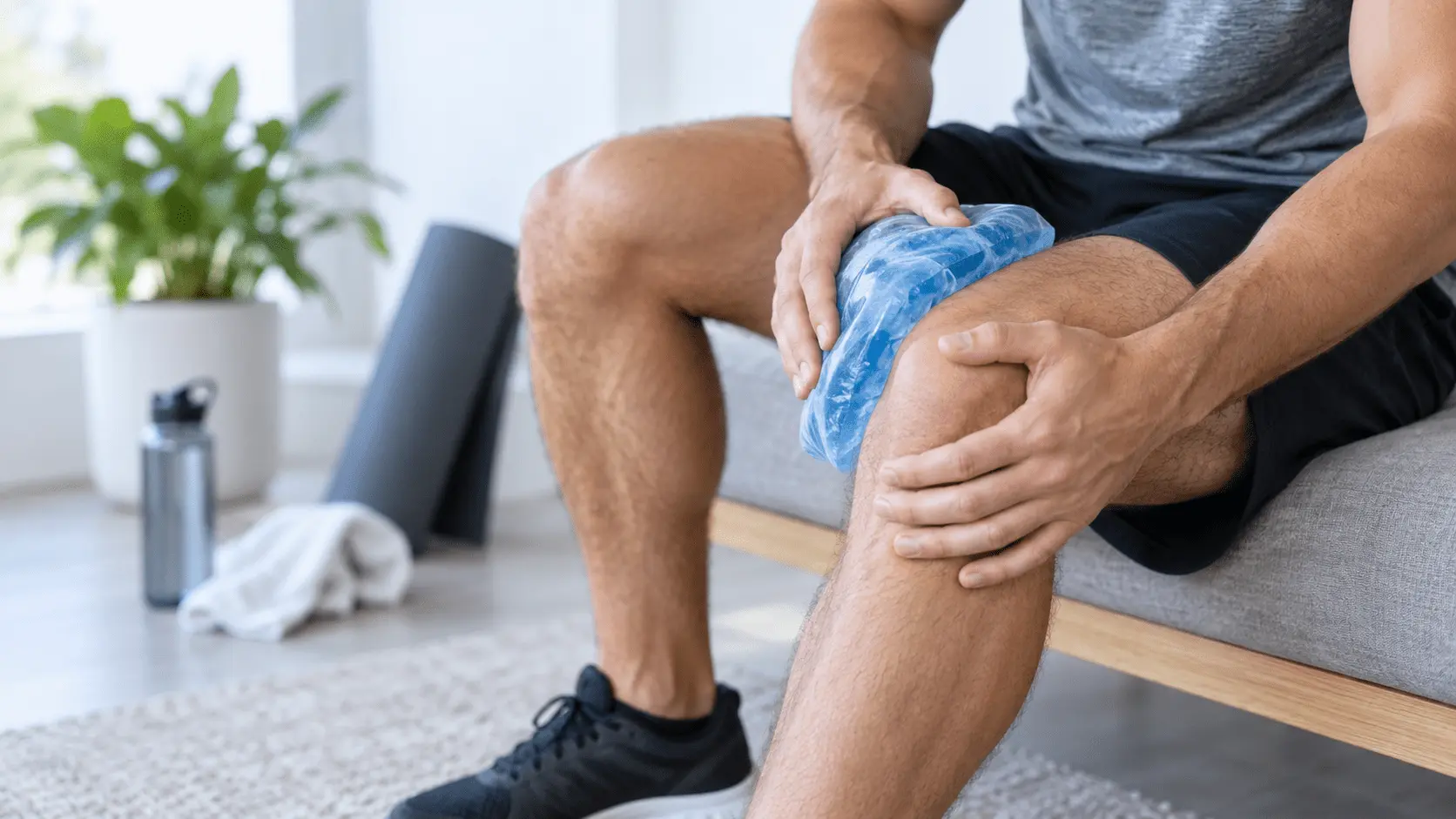
Should an injury be cooled with ice?
At Smrekovit, we generally do not recommend cooling injuries with ice. Ice can temporarily reduce pain immediately after an injury, but there is no good evidence that routine cooling makes injured tissue heal faster. For this reason, we do not consider pain reduction alone a sufficient reason for regularly interfering with the early response of injured tissue.
The key points at a glance
- Ice mainly relieves pain. Lowering the temperature reduces sensitivity in the area, so the injury may hurt less for a while.
- Less swelling does not necessarily mean faster healing. The inflammatory response is a normal part of the process by which the body begins repairing injured tissue.
- In humans, it has not been proven that ice speeds up regeneration of injured tissue. A recent review of the research also points out that some findings from animal studies suggest the possibility of inhibited or delayed regeneration with prolonged cooling.
- Our practical approach does not include routine cooling. When Smrekovit products are used regularly, we generally do not additionally cool the injured area with ice.
Short-term cooling for very pronounced pain can be understood as a symptomatic measure. We take a different view of routine repeated cooling of an injury with the aim of reducing inflammation and speeding up recovery. We do not see convincing scientific support for such use and do not recommend it as part of our practical approach.
Table of contents
What does cooling with ice actually do?
When ice or a cold pack is applied to an injured area, the temperature of the skin and deeper tissues decreases. This mainly affects nerve signal conduction, local blood flow and the perception of pain.
Ice can reduce pain
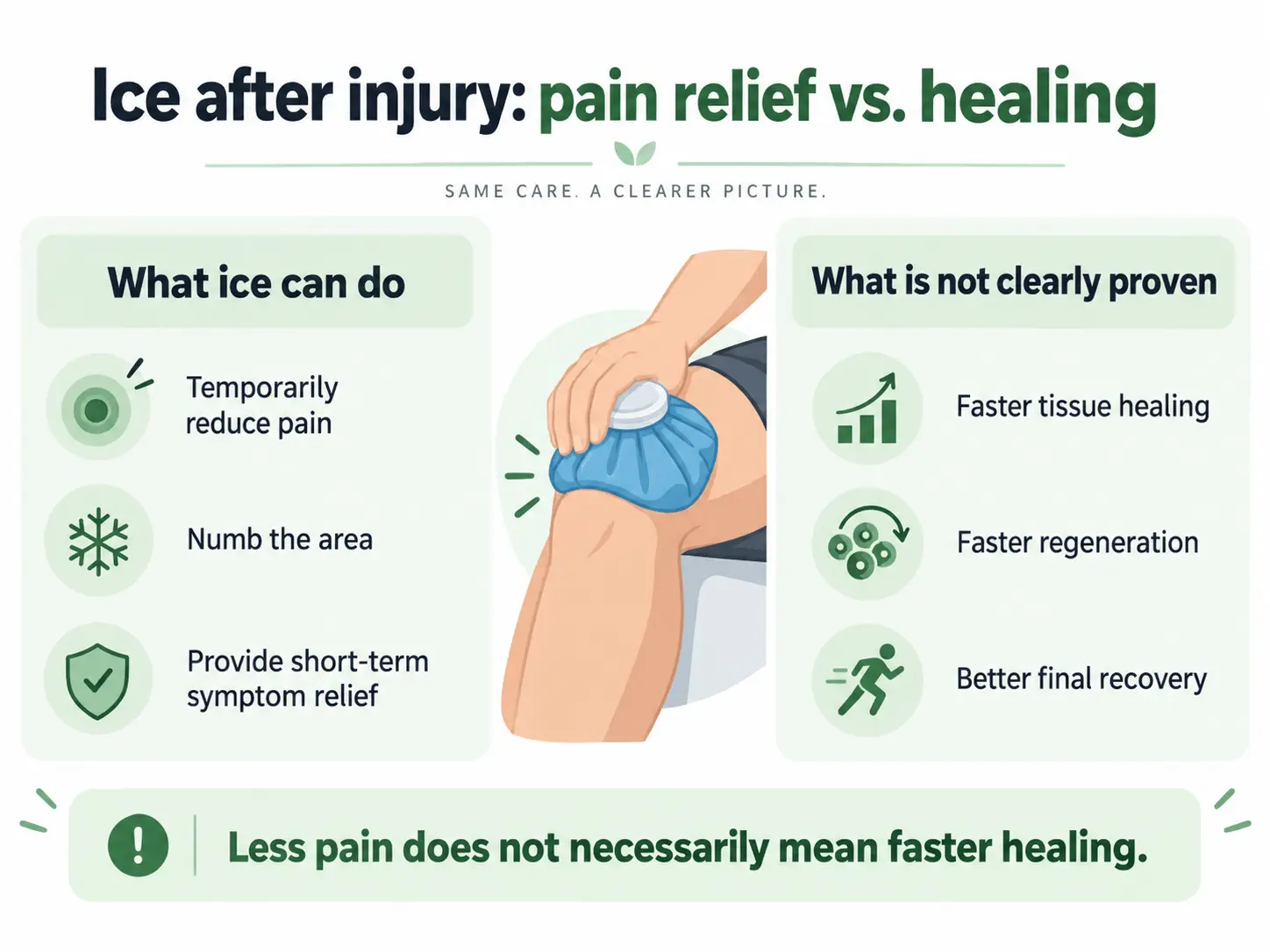
The most consistently described effect of cooling is a short-term reduction in pain. Lower temperatures reduce the speed of nerve signal conduction and the sensitivity of the cooled area, so the injury may hurt less during cooling and for some time afterwards.
This analgesic effect is one of the main reasons why ice has been used after injuries for decades.
Cooling affects local blood flow
Cold causes changes in local circulation and lowers tissue temperature. As a result, part of the early response in the injured area may also be reduced.
However, this does not necessarily mean that reducing this response is beneficial for healing. Less pain or less visible swelling is not the same as faster regeneration of injured tissue.
Does ice reduce swelling?
Cooling is often used with the aim of limiting swelling, but the results of clinical studies are much less consistent on this point than they are for pain reduction. In some circumstances an effect has been observed, while in others no significant difference was found.
Swelling is also only one part of the response to injury. Its size alone therefore does not tell us how quickly the injured tissue is actually repairing.
Less pain is not the same as faster healing
This distinction is key to understanding cooling. Ice may have a useful short-term effect on a symptom – especially pain – without necessarily improving the biological repair of injured tissue.
A recent critical review of the research found support in humans for the analgesic effect of cryotherapy, but not evidence that cooling after injury improves tissue regeneration or limits so-called secondary injury.
Does ice speed up or slow down recovery?
For this question, it is important to distinguish between short-term symptom relief and the actual effect on the repair of injured tissue. Ice can temporarily reduce pain, but it is much less clear whether this also means that the injury heals faster.
What does research in humans show?
At present, there is no high-quality evidence in humans that routine cooling after an injury speeds up the regeneration of muscle, tendon, ligament or other soft tissue.
This does not mean that ice has no effect. Its short-term pain-relieving effect is the most consistently described. It is much more difficult, however, to show that cooling helps a person recover faster or leads to a better final condition of the injured tissue.
Can ice also slow down healing?
The evidence here is less conclusive. Some experimental and animal studies suggest that more intense or prolonged cooling may influence the inflammatory response and the timing of regeneration in injured tissue.
However, these results cannot be directly transferred to humans or used to conclude that every use of ice after an injury necessarily prolongs healing.
Why is the effect on healing so difficult to prove?
“Cooling” is not always the same procedure in research. Temperature, duration, frequency, injury size and the timing of ice application all vary. Injuries also differ – an ankle sprain, a muscle injury and a blow to the knee are not the same biological problem.
A more balanced conclusion today is therefore that ice can help with pain, but it has not been proven that routine cooling speeds up the healing of injured tissue. The possibility that intense or prolonged cooling may inhibit some regenerative processes exists, but this has not yet been sufficiently defined in humans.
What does this mean in practice?
If a person uses ice immediately after an injury simply to reduce severe pain for a short time, this is primarily a symptomatic measure. At Smrekovit, however, we advise against routine cooling several times a day with the aim of reducing the inflammatory response.
Our position is based on many years of practical experience with different injuries and on the fact that current evidence does not confirm that routine cooling speeds up tissue regeneration. Because the early inflammatory response is a normal part of healing, we see no reason to suppress it systematically without a clear need.
Why is the inflammatory response part of injury healing?
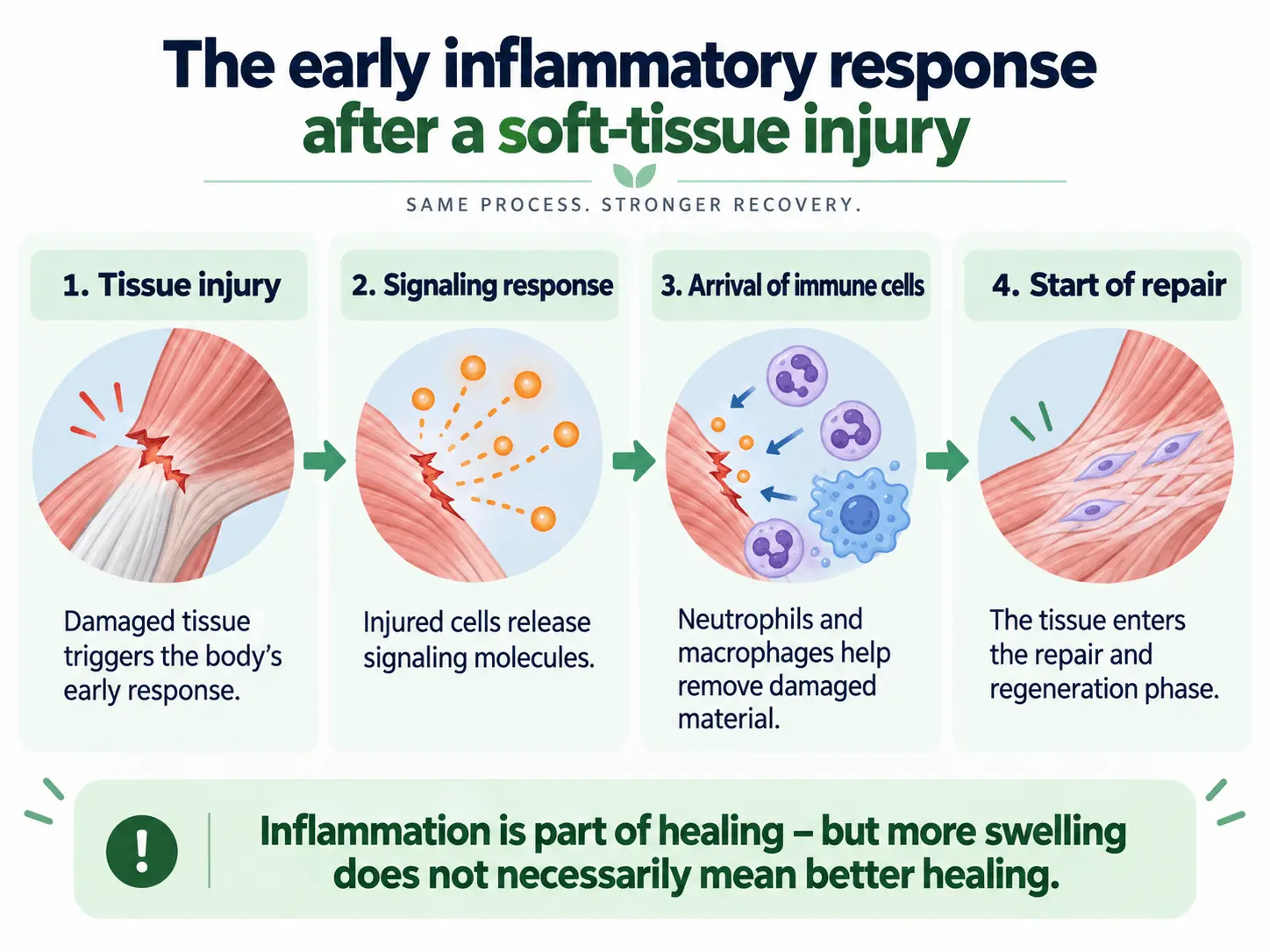
After an injury, an acute inflammatory response is triggered in the tissue. The word “inflammation” often has a negative connotation, but in a fresh injury it does not necessarily mean that something is wrong. It is a normal early part of the process by which the body removes damaged structures and begins tissue repair.
What happens immediately after an injury?
Damaged cells release signaling molecules that alter local blood flow and vascular permeability and attract immune cells to the site of injury. This can result in pain, warmth and swelling.
Among the important cells involved in this response are neutrophils and macrophages. They help remove damaged material and participate in signaling that guides the subsequent phases of tissue repair.
Inflammation is not the same as infection
Inflammation is a response of the body and can occur entirely without bacteria or other microorganisms. In an injury to a muscle, ligament or tendon, an early inflammatory response is therefore an expected part of the process.
This of course does not mean that every inflammatory response is beneficial. Prolonged, excessive or inappropriate inflammation can become a problem. In a recent injury, however, the goal is not automatically to suppress every sign of the inflammatory response as much as possible.
Swelling itself is not the goal either
It is important to distinguish between a necessary biological response and excessive swelling that can cause additional pain or restrict movement. The statement that the inflammatory response is necessary for healing therefore does not mean that “more swelling is always better”. More about why swelling occurs and when it requires additional attention is described on the page Swelling – causes, what helps and when to seek medical assessment.
The key point is elsewhere: a reduction in swelling or pain does not in itself prove that we have improved the repair process of the injured tissue.
What does this mean for cooling with ice?
This is where our main concern about routine cooling comes from. If the early inflammatory response is an integral part of healing, we consider it questionable to cool an injury intensively several times a day primarily with the aim of reducing this response as much as possible.
This alone is not proof that every use of ice harms healing. It is, however, an important reason why at Smrekovit we do not recommend routinely suppressing the early response of injured tissue with ice, especially since there is no convincing evidence that such cooling speeds up regeneration.
From RICE to PEACE & LOVE – how the approach to injuries has changed
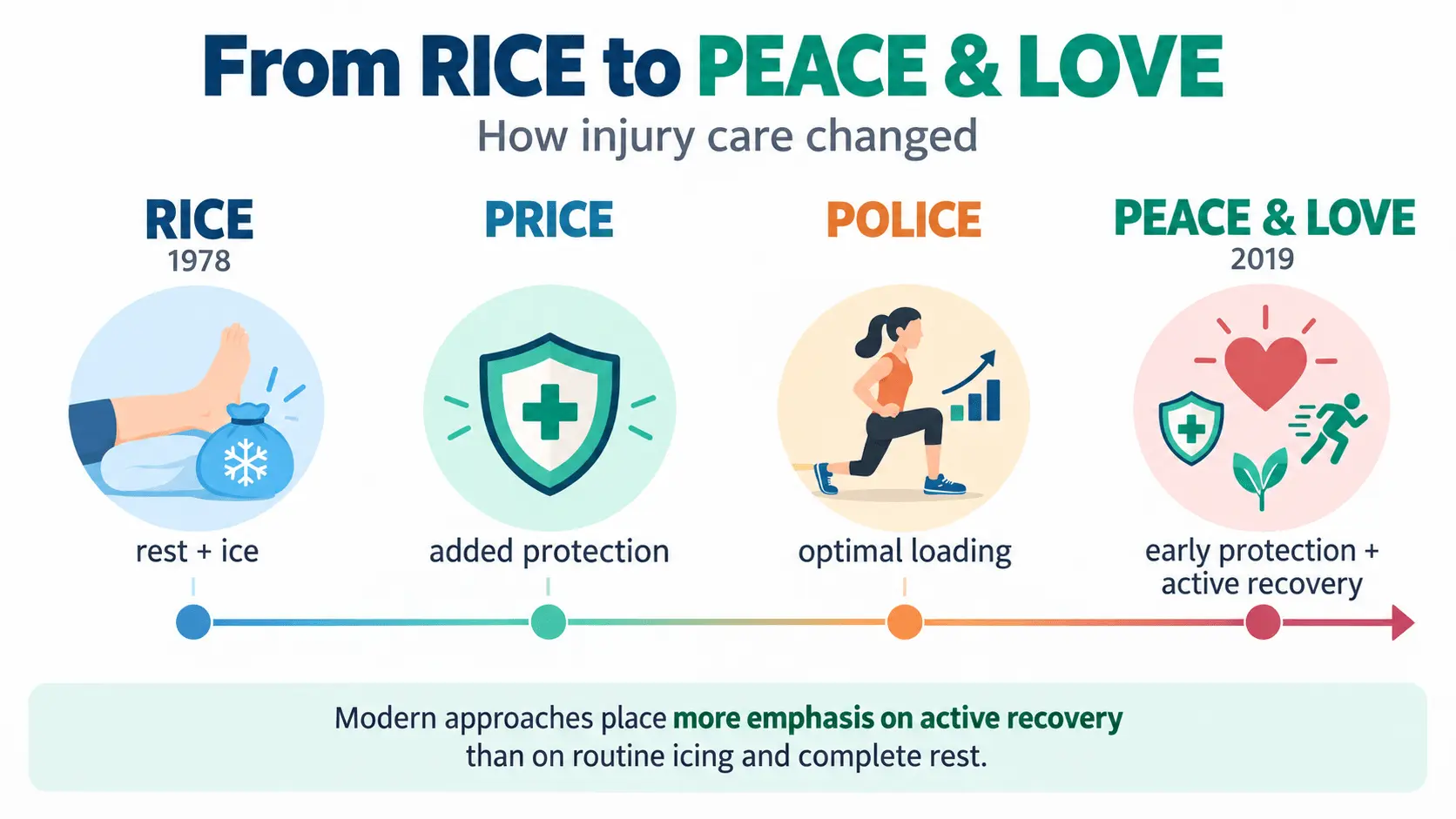
For many decades, one of the best-known approaches to acute sports injuries was RICE – Rest, Ice, Compression, Elevation. The concept was popularized in 1978 by American physician Gabe Mirkin, and cooling subsequently became an almost automatic part of first aid for injuries.
Why did RICE begin to change?
Over time, it became clear that complete rest is not always the best approach and that, with many injuries, timely, gradual and appropriate loading is important. RICE was therefore expanded by various concepts, including PRICE and POLICE, which placed greater emphasis on protecting the injured tissue and on appropriate loading.
The view of ice also changed. Its short-term pain-relieving effect is not particularly controversial, but the evidence that routine cooling improves the actual healing of injured tissue is far less convincing.
The author of RICE later changed his position too
Decades after introducing the term RICE, Gabe Mirkin himself pointed out that ice and complete rest had probably been overemphasized. His later view was that ice can reduce pain, but that this does not mean it speeds up recovery.
This is particularly interesting because the change did not come only from critics of RICE, but also from the person who originally popularized the term.
PEACE & LOVE – emphasis on active recovery
In 2019, Blaise Dubois and Jean-François Esculier presented the PEACE & LOVE framework for managing soft-tissue injuries in the British Journal of Sports Medicine. Its aim is to cover not only the first hours after an injury, but also the subsequent recovery period.
In the early phase, PEACE emphasizes protecting the injured area, elevating the limb, compression and patient education. The authors also specifically caution against automatically suppressing the inflammatory response and explicitly question the routine use of cryotherapy, as there is no high-quality evidence that it has a positive effect on the healing of soft-tissue injuries.
Once the initial phase has passed, LOVE emphasizes gradual loading, movement, aerobic activity and exercise. The more modern view of injury therefore moves away from the idea that it should primarily be cooled and completely unloaded, and places greater emphasis on an active and gradual return of function.
What does this mean for our approach?
At Smrekovit, we have been cautious about routinely cooling injuries with ice for decades. Interestingly, the broader professional view has also gradually moved away from the former automatic rule of “injury = ice and rest”.
PEACE & LOVE is not proof that every use of ice is harmful, nor is it a universal guideline for all injuries. It is, however, a good example of how thinking has changed: reducing pain and the inflammatory response is no longer automatically equated with better healing.
Why we do not recommend cooling with ice when using Smrekovit
At Smrekovit, we have long had a clear practical position on cooling injuries: when Smrekovit products are used regularly, we generally do not recommend additionally cooling the injured area with ice.
This recommendation is based on many years of practical work with injuries and on the way we want Smrekovit to be used: regularly, for a sufficiently long period, and without constantly alternating between different local approaches. The same rule is also included in our internal guidance for advising on injuries.
We do not combine two different approaches
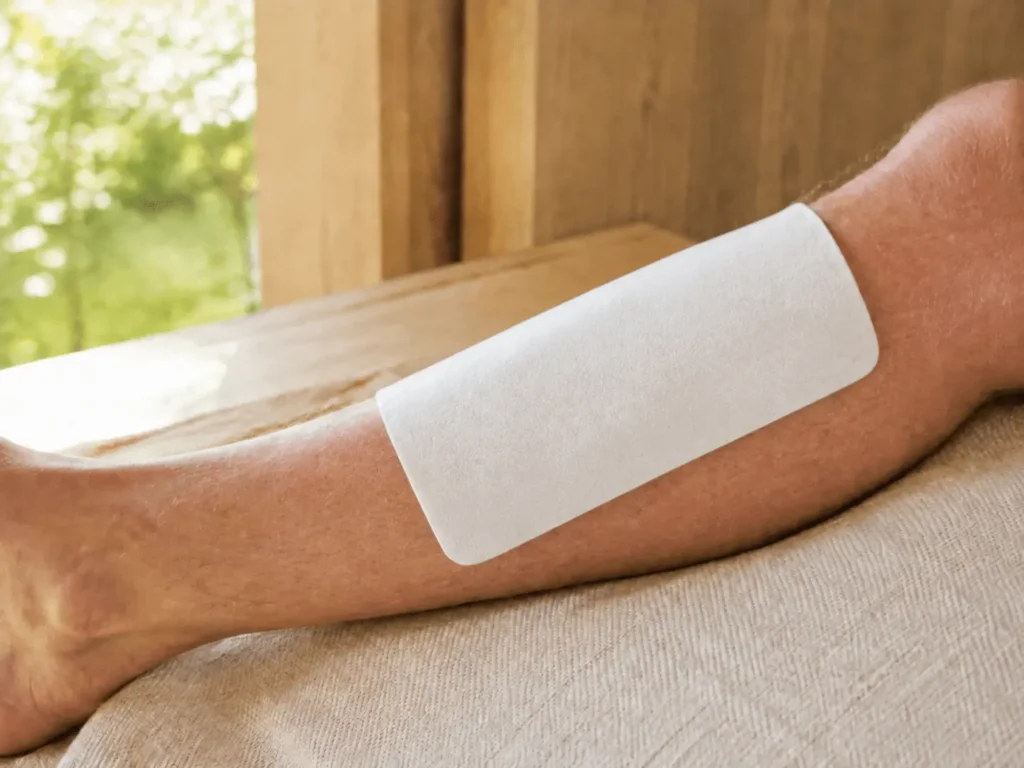
If a user chooses Smrekovit, we recommend using it as a stand-alone local approach and not routinely cooling the injured area with ice in between applications. This is particularly important when using Smrekovit 365 Prima together with the Smrekovit Kontakt compress, where we want the compress to remain on the affected area for as long as possible.
Frequently removing the compress for cooling and then reapplying the product also reduces consistency of use. Our practical approach is therefore simple: if we use Smrekovit, we use it regularly and without routinely alternating it with ice.
What if you have already cooled the injury?
If you already used ice immediately after the injury, this is not a reason why you could not use Smrekovit later. Previous cooling is not in itself an obstacle.
Once you begin using Smrekovit regularly, however, we generally do not recommend continuing to combine the two approaches repeatedly.
What about Smrekovit 365 Ekstra, which gives a cooling sensation?
Smrekovit 365 Ekstra contains menthol and camphor, so it creates a pronounced cooling sensation on the skin. This is not the same as cooling the injured tissue with ice or an ice pack.
For injuries, our basic practical choice is generally 365 Prima with the Kontakt compress. If the user does not want to use a compress or direct application is more practical, 365 Ekstra can also be an option. However, because it contains menthol and camphor, we do not recommend using Ekstra under the Kontakt compress.
Do not massage the product into a recent injury
In cases of sprains, partial tears, blows, haematomas and other recent soft-tissue injuries, we do not recommend intensively massaging the injured area. Apply the product evenly or use the Kontakt compress without rubbing it forcefully into the injured tissue.
A more detailed practical procedure for individual types of injuries is described in the instructions for using Smrekovit for injuries and overuse.
What do we do in practice after an injury?
For a recent injury, the most important thing is not to do as many different things as possible at the same time. First, the severity of the injury should be assessed, and then the injured area should be protected, loading adjusted and the development of the condition monitored.
First assess the severity of the injury
With a mild sprain, blow, strain or overuse injury, a conservative approach can often be started. If the problem is specifically an ankle sprain, more about the grades of injury, symptoms and course of recovery is described on the page Ankle sprain – symptoms and recovery.
If the injured part is visibly deformed, cannot be loaded normally, the pain is very severe, marked swelling develops rapidly, or numbness, tingling or a change in the colour of the limb occurs, medical assessment is needed.
Protect the injury and adjust loading
At first, do not force movements or activities that markedly increase the pain. However, this does not necessarily mean prolonged complete rest. Once the injured area allows movement, loading is generally reintroduced gradually to a level that is well tolerated.
For some injuries, mechanical support of the injured part and elevation of the limb may also be useful, especially when more pronounced swelling is present.
How do we use Smrekovit during this period?
In our practical approach, for injuries to muscles, ligaments and other soft tissues, the basic choice is Smrekovit 365 Prima together with the Smrekovit Kontakt compress. The compress allows longer contact of the product with the selected area and reduces its being rubbed off from the application site.
If possible, we use the compress for as much time as possible. When all-day use is not practical, users usually apply it at least overnight and apply the product several times during the day.
If you do not wish to use the compress, a practical option is repeated local application of Smrekovit 365 Prima or Smrekovit 365 Ekstra. Smrekovit 365 Ekstra is used without the Kontakt compress.
In our approach, without routine cooling and without massage
When Smrekovit is used regularly, we generally do not cool the injured area with ice. In recent sprains, blows, haematomas, partial tears and other soft-tissue injuries, we also do not recommend intensive massage of the injured tissue.
The situation is different with tired muscles after exertion, where there is no acute injury and gentle massage may be appropriate.
Monitor the trend, not just a single moment
In our practical guidance, we usually make the first assessment of the result after about one week of sufficiently regular use. We do not necessarily expect the problem to disappear within that time, but we look for a clear change – for example easier loading, less tenderness, better mobility or another noticeable sign of improvement.
If the condition is not improving, is getting worse, or the symptoms do not match the expected course of a mild injury, it is advisable to reassess the diagnosis or the cause of the problem.
Detailed instructions for sprains, blows, muscle injuries, periosteal problems, heel spurs and other overuse-related problems are collected on the page Instructions for using Smrekovit for injuries and overuse.
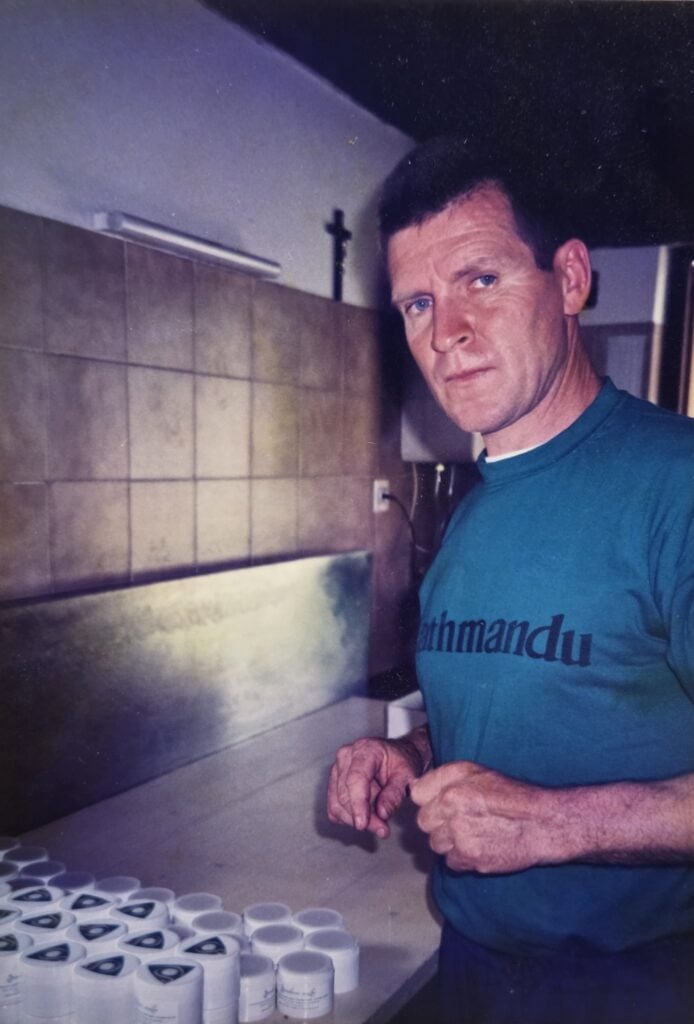
Ivo Konc: why we at Smrekovit have advised against ice for decades
Smrekovit’s position on cooling injuries did not arise from modern discussions about RICE. Ivo Konc had advised against routinely cooling injuries with ice since the beginnings of Smrekovit around 1990, primarily on the basis of his many years of practical work with athletes, injuries and the use of spruce resin products.
His reasoning was simple: after an injury, processes are triggered in the tissue that form part of the body’s natural response, so it seemed illogical to him to cool the injured area strongly and repeatedly with the aim of reducing that response as much as possible.
The comparison he used to explain his reasoning to users
“Why do you store steaks in the refrigerator rather than at room temperature? To slow down physiological processes so the steak stays fresh for longer. You do the same thing to an injury if you cool it with ice: you slow down physiological processes and the injury remains for much longer.”
This comparison was Ivo’s practical explanation of his view, not scientific proof of the effect of ice on healing. Today, it is interesting to place it alongside more modern findings: it is clear that ice can reduce pain in the short term, but it is much less clear that routine cooling improves the regeneration of injured tissue.
A position that has remained part of Smrekovit’s practical approach
After decades of advising users, we have not abandoned this approach. For injuries, we still generally recommend regular use of Smrekovit without simultaneous routine cooling with ice.
Today, we explain this position much more precisely than we once did: we distinguish between the short-term pain-relieving effect of cooling, its effect on swelling, and the question of what actually happens in injured tissue during healing.
Frequently asked questions about cooling with ice after an injury
Does ice help with an injury?
Ice can temporarily reduce pain immediately after an injury and may therefore have a symptomatic effect. It is much less clear, however, whether routine cooling improves the actual repair of injured tissue. There is no convincing evidence that using ice speeds up healing.
Does ice reduce swelling?
Cooling affects local temperature and blood flow and may, under certain circumstances, reduce the early response of the injured area. However, less swelling does not necessarily mean faster healing. More about why swelling occurs and when it requires additional attention is described on the page Swelling – causes, what helps and when to seek medical assessment.
Can ice slow down the healing of an injury?
Some experimental and animal studies suggest that more intensive or prolonged cooling may affect the inflammatory response and the course of regeneration. In humans, however, it cannot be claimed that every use of ice has been proven to prolong healing. We therefore distinguish between short-term cooling for pain relief and routine repeated cooling with the aim of speeding up recovery.
Why do we not recommend cooling with ice when using Smrekovit?
At Smrekovit, we generally do not recommend routine cooling of injuries with ice. This position is based on many years of practical experience and on our approach, in which the injured area is not alternated with intensive cooling when Smrekovit is used regularly. At the same time, current evidence does not confirm that routine cooling speeds up the regeneration of injured tissue.
What if I have already cooled the injury with ice?
Previous use of ice is not in itself an obstacle to using Smrekovit later. Once you begin using Smrekovit regularly, however, our practical approach generally does not recommend continuing to alternate it routinely with ice.
Is the cooling sensation of Smrekovit 365 Ekstra the same as cooling with ice?
No. Because of menthol and camphor, Smrekovit 365 Ekstra creates a cooling sensation on the skin, but this is not the same as lowering tissue temperature with ice or an ice pack. For injuries, Smrekovit 365 Ekstra is used without the Kontakt compress.
What is PEACE & LOVE and why is ice not used routinely in this approach?
PEACE & LOVE is a more modern framework for managing soft-tissue injuries that emphasizes early protection of the injured area followed by gradual loading, movement and active rehabilitation. The authors questioned routine cryotherapy primarily because of the lack of high-quality evidence that it improves the healing of injured tissue.
How should an ankle sprain be managed?
With a sprain, it is important to assess the severity of the injury, adjust loading and monitor swelling, stability and the ability to walk. In our practical approach, we do not recommend routine cooling. The grades of injury, warning signs and recovery are described in more detail on the page Ankle sprain – symptoms and recovery.
When is medical assessment needed after an injury?
Medical assessment is particularly needed in cases of obvious deformity, inability to bear weight normally on the limb, very severe pain, rapidly developing marked swelling, pronounced instability, or when numbness, tingling or a change in the colour of the limb occurs. A local approach cannot replace medical treatment of a fracture, dislocation or major ligament or tendon injury.