

Ankle sprain in brief
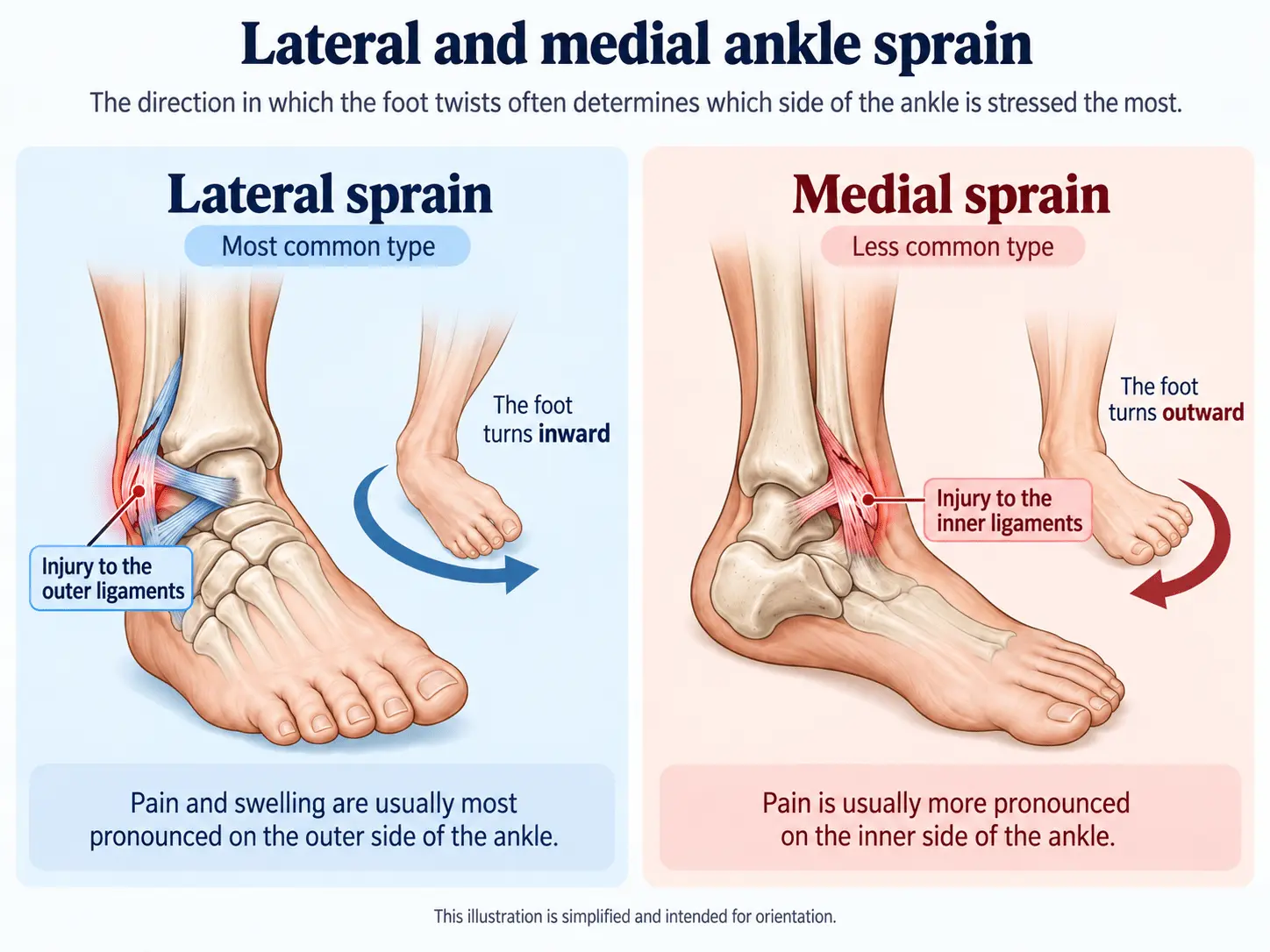
- The most common type is a sprain of the outer ligaments, which usually occurs when the foot twists inward.
- Typical symptoms include pain, swelling, tenderness, bruising and difficulty bearing weight on the injured leg.
- Severity varies considerably: in a mild sprain, the ligaments are mainly stretched, while in a more severe sprain they may be partially or completely torn.
- Recovery can take from a few weeks to several months, depending on the extent of the injury and the functional recovery of the joint.
- Medical assessment is especially important in cases of obvious deformity, inability to bear weight on the leg, very severe pain, marked swelling, or signs of impaired sensation or circulation.
- After the initial protection of the injury, gradually restoring movement and loading is important, as far as the ankle allows.
Table of contents
What is injured in an ankle sprain?
In an ankle sprain, the structures most commonly injured are the ligaments that connect the bones and stabilize the ankle joint. The injury occurs when the joint is suddenly forced beyond its normal range of motion and one or more ligaments are overstretched or torn.
Lateral sprain – injury to the outer ligaments
By far the most common type is a lateral ankle sprain. It usually occurs when the foot suddenly turns inward, placing a strong load on the ligaments on the outer side of the ankle.
This mechanism is common with an awkward landing, stepping on uneven ground or a rapid change of direction during sport. Pain and swelling are therefore often most pronounced around the outer ankle.
Medial sprain – injury to the inner ligaments
A medial sprain is much less common. It occurs when the foot twists in the opposite direction, placing greater strain on the ligaments on the inner side of the ankle.
Because the ligaments on the inner side of the joint are generally very strong, a more pronounced injury mechanism of this type should also raise the possibility of other ankle injuries and warrants somewhat greater attention when assessing severity.
In addition to a classic lateral or medial sprain, other ligament injuries around the ankle can also occur. The location of the pain and the way the injury happened can therefore help with orientation, but on their own they cannot reliably determine the extent of the injury.
Grades of ankle sprain
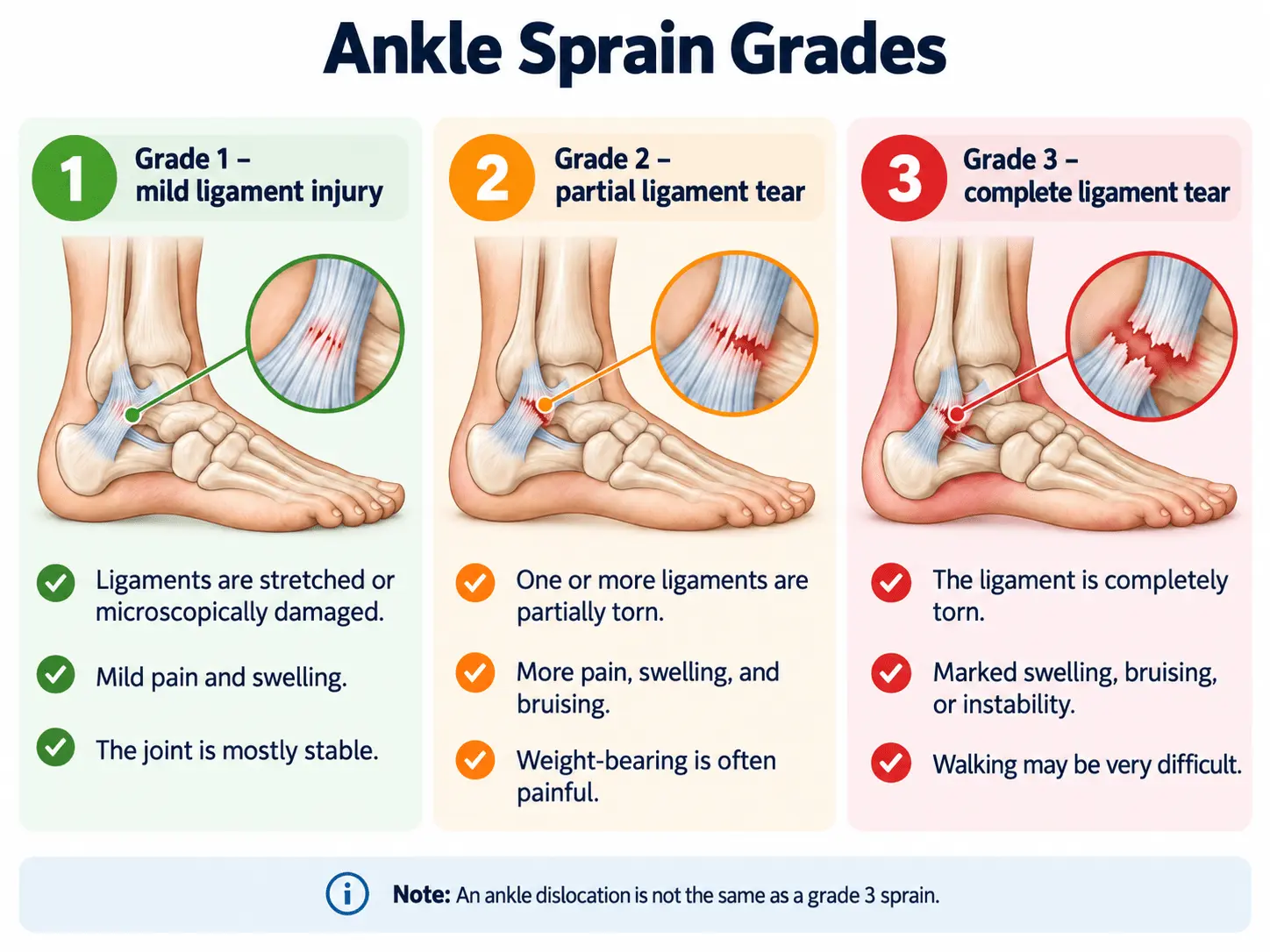
Ankle sprains are often divided into three grades according to the extent of ligament injury. This classification is useful for orientation, but the severity of the injury cannot always be reliably determined from the amount of pain or swelling alone.
Grade 1 sprain – mild ligament injury
In a grade 1 sprain, the ligaments are mainly stretched or microscopically damaged, without a major tear. Mild pain, tenderness and swelling are usually present, while the joint remains relatively stable. Walking is often still possible, although it may be uncomfortable.
Grade 2 sprain – partial ligament tear
In a grade 2 sprain, one or more ligaments are partially torn. Pain and swelling are generally more pronounced, bruising often develops, mobility is reduced, and bearing weight on the leg can be quite painful. A certain degree of joint instability may also be present.
Grade 3 sprain – complete ligament tear
In the most severe grade, the ligament is completely torn. The ankle may be markedly swollen and bruised, and the joint may be unstable. Weight bearing is often very difficult or initially impossible. Such an injury requires a more detailed assessment and a longer period of functional recovery.
An ankle dislocation is not the same as a grade 3 sprain. In a dislocation, the joint surfaces lose their normal alignment, so this is a different and more serious injury that requires urgent medical treatment. A dislocation may also be accompanied by ligament injuries and fractures.
The grade of the sprain also does not determine exactly how long an individual will need to recover. When returning to normal activities, the most important factors are pain, stability, mobility, strength and the ability to bear weight normally on the ankle.
Symptoms of an ankle sprain
The symptoms of an ankle sprain depend on which ligaments are injured and how extensive the injury is. The most common symptoms are pain, swelling and tenderness around the ankle. Problems may appear immediately or become more pronounced in the hours following the injury.
Most common signs of a sprain
- pain at the site of the injured ligaments, often on the outer side of the ankle,
- swelling around the ankle and sometimes also the foot,
- tenderness to touch in the injured area,
- bruising or a haematoma, which may develop gradually,
- limited mobility due to pain and swelling,
- pain when bearing weight or walking,
- and in more severe injuries, a feeling of instability or giving way of the ankle.
Swelling is a normal part of the tissue response to injury and on its own does not indicate how severe the sprain is. Even a very swollen ankle is not necessarily fractured, while mild swelling does not rule out a more significant ligament injury.
Can you still walk after an ankle sprain?
The ability to walk is useful information, but it is not enough to determine the severity of the injury. With a mild sprain, weight bearing is often possible immediately, while with a more severe injury it may be very painful or initially impossible.
If you cannot bear weight on the injured leg after the injury, the pain is severe or there is pain directly over the bone, further assessment is advisable because of the possibility of a fracture or another more serious injury.
When is medical assessment or an X-ray needed after an ankle sprain?
For most mild sprains, an X-ray is not necessary. After an injury, however, it is important to assess whether there could be a fracture, dislocation or another more serious injury.
When is medical assessment advisable?
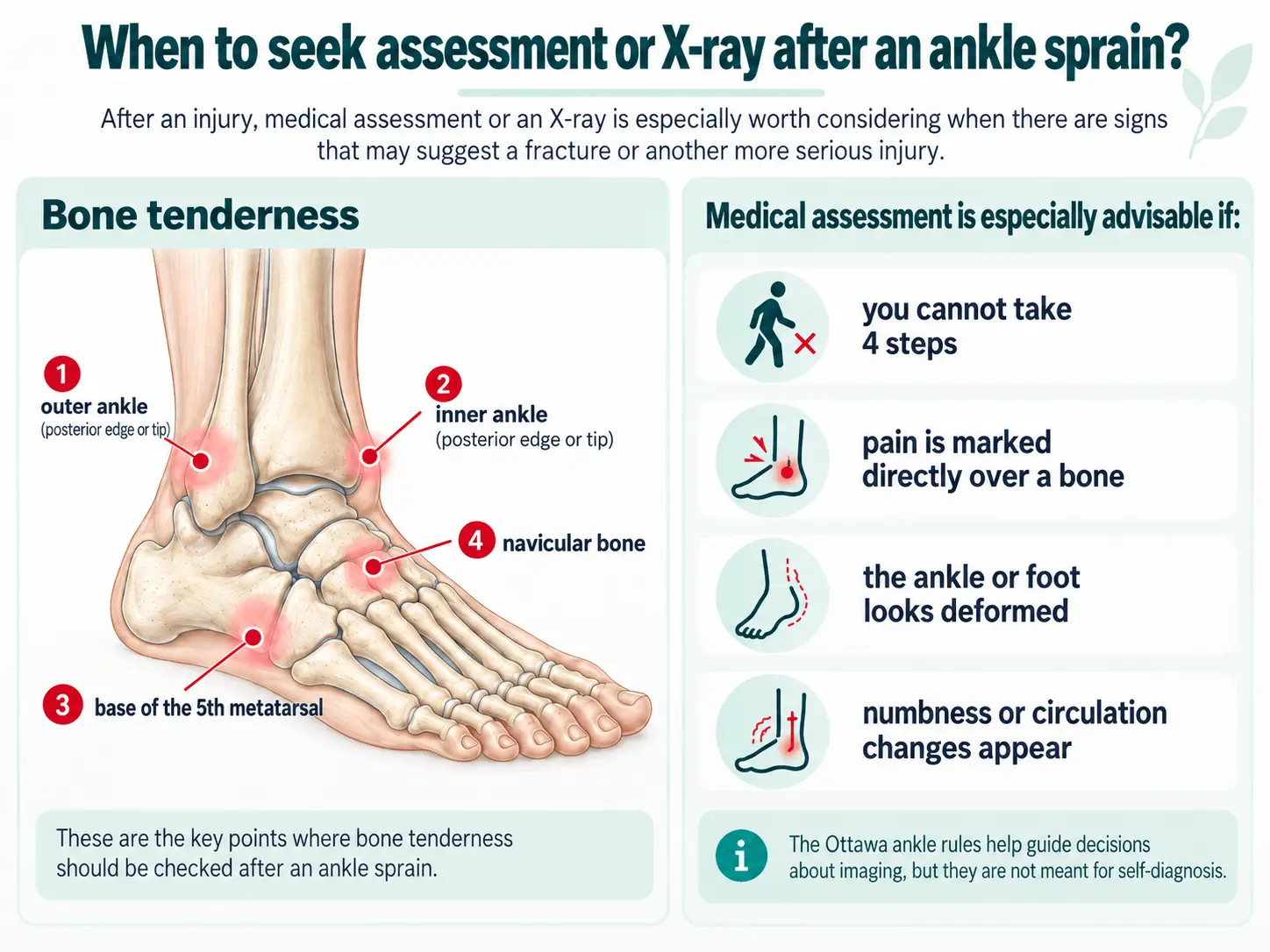
Medical assessment is especially advisable if:
- after the injury you cannot bear weight on the leg normally or take a few steps,
- the pain is very severe or is increasing instead of improving,
- there is marked pain directly over a bone,
- the ankle or foot is visibly deformed,
- there are sensory disturbances, marked paleness, a cold foot or other changes in circulation,
- there is an open injury or a larger wound,
- walking ability and the condition of the ankle do not improve over the following days.
When do doctors consider an X-ray?
When deciding whether an X-ray is needed, the Ottawa Ankle Rules are often used. These help assess the likelihood of a fracture after an acute injury.
An ankle X-ray is generally advisable mainly when there is pain in the ankle area together with marked bony tenderness along the posterior edge or at the tip of the outer or inner ankle bone, or if the injured person is unable to take four steps both immediately after the injury and during the examination.
If the pain is located more in the midfoot, tenderness over the base of the fifth metatarsal and over the navicular bone is also taken into account. A positive criterion does not mean that the bone is fractured, but rather that an X-ray is appropriate to rule out a fracture.
The Ottawa Ankle Rules are a clinical decision tool for imaging and are not intended for self-diagnosis. If the injury appears serious or the course is not as expected, the overall medical assessment is more important than any single criterion.
What helps in the first days after an ankle sprain?
In the first hours and days after an ankle sprain, the main goal is to protect the ankle from further injury, manage pain and gradually restore normal movement and loading. Prolonged complete rest is generally not necessary for a typical sprain.
Protect the ankle, but do not immobilize it unnecessarily
Immediately after the injury, reduce activities that clearly increase pain and avoid further twisting of the ankle. With a more severe sprain, a brace or other support may be temporarily useful, especially if walking without it is unstable or very painful.
Gradually return to loading
As pain allows, it is advisable to begin with gentle ankle movement and gradual loading of the leg. Start with shorter distances and try to walk as normally as possible. If you are limping markedly because of pain or the condition worsens significantly after loading, the load was probably too high.
During rest, you can elevate the leg, especially if swelling is pronounced. Elastic support or compression can give some people a greater sense of stability and comfort, but it must not impair circulation.
What about cooling with ice?
At Smrekovit, we do not recommend routine cooling with ice for an ankle sprain. Inflammation after an injury is not merely an unpleasant side effect, but part of the body’s early response that contributes to the repair of injured tissue. For this reason, systematic repeated cooling aimed at reducing the inflammatory response does not seem like a sensible approach to us.
Ice can reduce pain in the short term, but we therefore understand it mainly as a symptomatic measure, not as a way to speed up the healing of injured ligaments. If the pain is manageable, we generally avoid cooling in our approach. We explain why in more detail in the article Cooling with ice after an injury – does it help or can it slow down recovery?.
Do not massage a recently injured ankle
With a recent sprain, we do not recommend intensive massage of the injured ligaments and surrounding tissue. In the first few days, it is more important to protect the injury and then gradually restore movement and loading.
With a milder injury, it is useful to monitor mainly the trend over the following days: whether walking becomes easier, pain decreases, mobility improves and the ankle becomes increasingly reliable under load.
How long does recovery after an ankle sprain take?
Recovery time after an ankle sprain depends mainly on the extent of the ligament injury. With a mild sprain, walking and everyday activities may improve considerably within the first few weeks, while with a more severe injury, complete functional recovery can take several weeks or even several months.
In the first two weeks, the trend matters most
In the first few days, pain, swelling, limited mobility and difficulty bearing weight on the ankle are expected. With an uncomplicated sprain, however, there should gradually be a clear trend toward improvement over the following days: walking becomes easier, mobility increases, pain decreases and the ankle tolerates loading better.
With milder sprains, everyday function may already be considerably better after one to two weeks. This does not mean, however, that the injured ligaments are already fully healed at that point.
Recovery often takes several weeks
In many uncomplicated sprains, ankle function comes quite close to normal within approximately four to eight weeks. With more severe ligament injuries, marked instability or associated injuries, recovery may take significantly longer and last several months.
Even when walking is almost normal again, swelling, tenderness, reduced mobility or a feeling of insecurity in the joint may persist for some time. The disappearance of pain alone is therefore not enough to determine whether the ankle is ready for running, jumping and rapid changes of direction.
What do we observe when using Smrekovit?
An ankle sprain is one of the injuries for which we at Smrekovit have many years of practical experience, and users often report relatively rapid improvement in pain, mobility and the ability to bear weight.
In our practical experience, with some sprains a user may be able to walk considerably better or almost normally after about three days, and after about one week the improvement may be very pronounced.
These are observations from practical use and not a guaranteed recovery time. Nor do they mean that the injured ligament has anatomically healed within a few days. The speed of progress depends on the severity and extent of the injury, the time since the injury occurred, joint stability and the way the ankle is loaded.
In our approach, we therefore also use a practical seven-day checkpoint: within about one week, we want to see a clear change, for example less pain or tenderness, better mobility or easier weight bearing. If there is no such improvement or the condition is getting worse, it is advisable to reassess the injury and, if necessary, seek medical assessment.
When returning to activity, function matters more than the calendar
Regardless of how quickly the pain subsides, when returning to greater loads we do not rely only on the number of days since the injury. What matters most are normal walking, good mobility, restored strength, joint stability and the ability to tolerate loading without significant worsening of symptoms.
How do we approach ankle sprains at Smrekovit?
For an ankle sprain, we recommend starting local use of Smrekovit as soon as possible after the injury, once it has been assessed that the injury does not require urgent medical treatment. At the same time, the ankle should be protected from further twisting, and loading should be adjusted according to pain and joint stability.
First choice: Smrekovit 365 Prima and the Kontakt compress
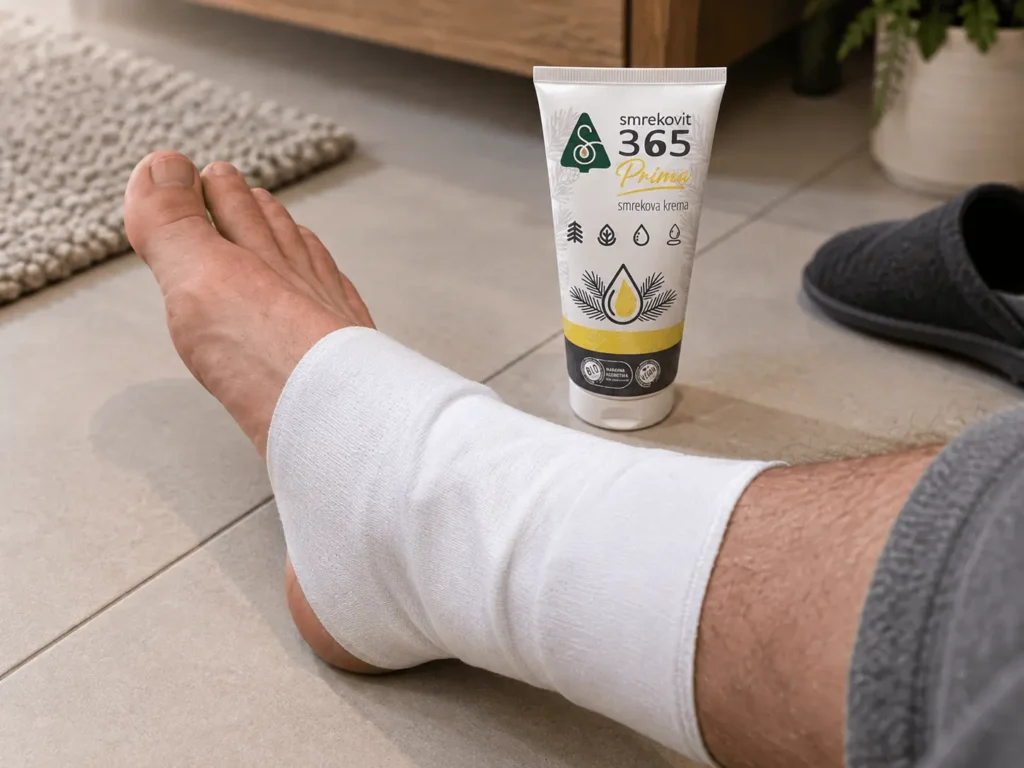
Our basic practical approach to an ankle sprain is Smrekovit 365 Prima together with the Smrekovit Kontakt compress. The cream is applied locally to the injured area, while the Kontakt compress allows longer contact of the product with the application site and reduces its rubbing off the skin.
With ankle sprains in particular, the use of the compress is, in our practical experience, especially important. If possible, we use it for as much time as possible. When all-day use is not practical, users usually apply it at least overnight and apply 365 Prima locally several times during the day.
If the Kontakt compress is not used
If the user chooses application without the compress, practical options are Smrekovit 365 Prima or Smrekovit 365 Ekstra. Because of menthol and camphor, Smrekovit 365 Ekstra provides a more pronounced cooling sensation on the skin and, for injuries, is used without the Kontakt compress.
Smrekovit Klasik can also be used, but because of its greasier base it is generally less practical for frequent application during the day than the creams from the 365 line.
Do not massage a recent sprain
With a recent sprain, the product should not be rubbed in with intensive massage. We do not want to place additional mechanical stress on the injured tissue, so the product is simply applied locally or used together with the Kontakt compress.
We also do not recommend routine cooling with ice in our approach. The reasons for this are explained in more detail in the section on the first days after injury and in the article Cooling with ice after an injury – does it help or can it slow down recovery?.
When should the approach be reassessed?
If, despite consistent use, there is no clear improvement within about one week or the condition is even getting worse, it does not make sense simply to continue with the same approach. At that point, the severity or nature of the injury should be reconsidered and, if necessary, a medical assessment should be performed.
Detailed application instructions and information on using the Kontakt compress can be found in the instructions for using Smrekovit for an ankle sprain.
Returning to walking, running and sport
After an ankle sprain, return to normal activities gradually and according to joint function, not only according to the number of days since the injury. The goal is to increase loading without a marked increase in pain, swelling or a feeling of instability.
First, normal walking
The first goal is to regain as normal a walking pattern as possible. If you can bear weight on the foot without significant pain, gradually increase the distance and try to walk without a pronounced limp.
If pain or swelling increases markedly after a longer walk, the load was probably too high. In that case, reduce the intensity for a while and then progress again gradually.
From brisk walking to running
Running should only be tried once normal and brisk walking are without significant pain or a feeling of the ankle giving way, and mobility has almost returned.
Start with a short, easy run on a flat and predictable surface. If the ankle tolerates this load well, you can gradually increase the duration and intensity.
If you are returning to regular running, it is also worth considering how the legs are loaded during running. You can read more about cadence, foot strike and gradually changing running patterns in the article Running technique and joint loading.
Running is not the same as returning to sport
Sports involving landings, rapid changes of direction and sudden twisting place much greater demands on the ankle than steady running. Before returning to such activities, mobility, strength, balance and the sense of stability should be restored as well as possible.
A good sign is being able to stand on the injured leg, perform calf raises, light hops and gradually also changes of direction without significant pain or uncertainty. For athletes, it is also important to be able to complete their usual training or its main movement demands without difficulty.
Do not judge only by whether the ankle still hurts
Pain may disappear before strength, balance and joint control have fully returned. This is why returning too early to demanding sports activity can be problematic even when the ankle already feels almost normal.

How to prevent another ankle sprain?
After an ankle sprain, the risk of another injury remains higher for some time, especially if strength, balance and ankle control are not fully restored. Preventing another sprain is therefore not just a matter of rest, but above all of gradually restoring joint function.
Train balance and ankle control
One of the most important things after a sprain is to restore proprioception, or the sense of joint position. A simple exercise is standing on one leg, which can gradually be made more difficult by increasing the duration, using a less stable surface or adding additional movements.
For athletes, it is also advisable to gradually add hops, landings and changes of direction, so that the ankle is retrained in the situations in which sprains often occur.
Restore the strength of the muscles around the ankle
The strength of the calf muscles and the muscles that help stabilize the foot and ankle is also important. Useful exercises may include calf raises, resisted foot movements and single-leg exercises.
The goal is not only the absence of pain, but also for the injured leg to lag behind the healthy one as little as possible in strength and control.
Increase loading gradually
A large increase in running volume, walking on uneven terrain or sports activity can load the ankle faster than it is able to adapt. It is therefore advisable to increase the demands gradually and monitor how the ankle responds even several hours after the activity.
A brace or taping can be useful when the risk is higher
In people who have already had several sprains or are returning to sports involving a lot of jumping and changes of direction, temporary use of a brace or taping may reduce the risk of another injury.
A brace does not replace restoring ankle strength, balance and control. In the long term, it is more important that the joint functions well again even without external support.
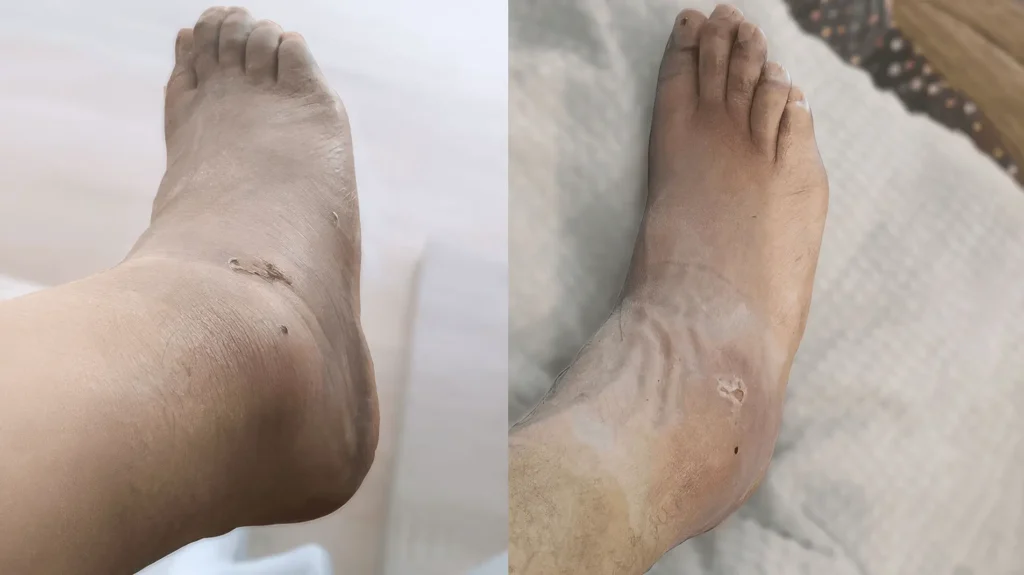
Documented case of a severe ankle injury
In addition to general recommendations, we also have a documented specific case of a severe ankle injury with dislocation, in which the course was followed with photographs, medical documentation and communication with the user.
Frequently asked questions about ankle sprains
How long does recovery after an ankle sprain take?
With a mild sprain, walking and everyday activities may improve considerably within one to two weeks, while more complete functional recovery often takes around four to eight weeks. With more severe ligament injuries, recovery may take several months.
Can I walk after an ankle sprain?
If walking does not cause significant pain and the ankle is sufficiently stable, gradual weight bearing is generally advisable. Try to walk as normally as possible and increase the load gradually. If you cannot bear weight on the leg or take a few steps, further assessment of the injury is advisable.
How do I know whether my ankle is only sprained or fractured?
This cannot be determined reliably from swelling or bruising alone. The possibility of a fracture is more strongly suggested by marked pain directly over a bone, inability to bear weight on the leg, deformity or a more severe injury mechanism. With such signs, medical assessment and an X-ray may be needed.
Is ice recommended for an ankle sprain?
Ice can reduce pain in the short term. At Smrekovit, however, we do not recommend routine cooling with ice, as we understand the inflammatory response as part of the early repair process of injured tissue. If the pain is manageable, we generally avoid cooling in our approach.
How long can swelling remain after an ankle sprain?
Swelling may persist longer than pain and, with more severe sprains, may remain noticeable for several weeks or even months. More important than the presence of swelling itself is the trend: whether it gradually improves together with pain, mobility and the ability to bear weight.
When can I start running again after an ankle sprain?
Running is advisable once normal and brisk walking are possible without significant pain or a feeling of instability and mobility has almost returned. Start with a short, easy run on a flat surface and then gradually increase the load.
What do we recommend at Smrekovit for an ankle sprain?
As our basic practical approach, we use Smrekovit 365 Prima together with the Smrekovit Kontakt compress. If you do not use the compress, Smrekovit 365 Prima or Smrekovit 365 Ekstra can also be used on their own. With a recent sprain, we do not intensively massage the injured area.
When should improvement become noticeable when using Smrekovit?
Based on our practical experience, with a sprain we want to see a clear improvement within about one week, for example less pain, better mobility or easier weight bearing. If there is no improvement or the condition is getting worse, it does not make sense simply to continue with the same approach; the injury should be reassessed.