
All about the problem, and the experience of people who use Smrekovit for nail fungus
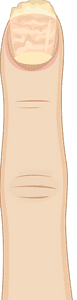
Toenail fungus or onychomycosis is a common condition that usually starts with a white or yellow spot under the top of the nail. As the fungal infection spreads, the nail discolours, thickens and the tip of the nail starts to crumble (it "cufies"). If left untreated, nail fungus can also infect the skin of the foot, which is known as Athlete's foot (Tinea Pedis).
Sometimes nail fungus has the appearance of being contagious and the result of poor hygiene. However, the truth is that as many as 10% adults in the Western world will get nail fungus at least once in their lifetime. For adults over 60 years of age, even 20%. Toenail fungus is much more common on the feet than on the hands. Nail fungi account for 50% of all nail diseases.
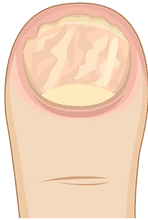
I use Sprukovite on a fungal nail which is healing slowly but beautifully. It is very soothing or completely cures my shoulder pain, so I am very grateful to have found out about you and have also already passed on to others.
Mariša, Polzela
[6] handwritten feedback received on an unknown date, kept in the Smrekovit archive
My boyfriend and I tried it for nail fungus and after just one week, we saw concrete results.
Petra Mahnič, Facebook
[77] Facebook feedback, received 24.2.2016, printed and stored in the Smrekovit archive
Types of nail fungi
There are several types of nail fungus, classified according to how the infection begins and progresses. The most common pathogens differ between these types. By far the most frequent form is distal subungual onychomycosis. The following main types can be distinguished:
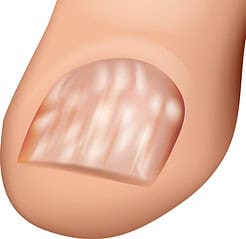
interlaminar nail fungus
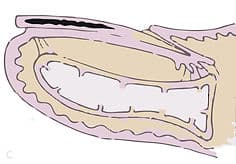
Interlayer nail fungi (interlayer onychomycosis) settle and grow between the layers of the nail. In this type of infection, the nail becomes milky white and stratified. It usually does not thicken and does not separate from the nail bed.
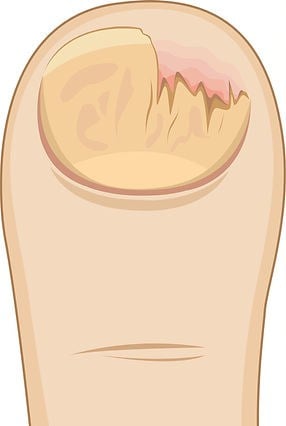
Distal subungual nail fungus
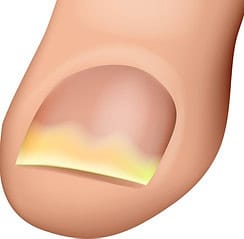
Distal subungual nail fungus (distal subungual onychomycosis) is the most common form of infection. They usually occur at the straight edge of the nail on the underside of the nail and spread towards the base. The nail becomes thick, yellow and brittle. The nail eventually separates from the nail bed. These nail fungi are more common on the feet than on the hands and most commonly start on the big toe. This form is caused by dermatophytes.
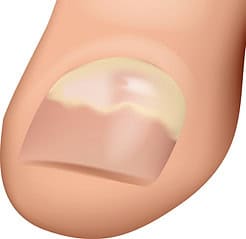
Proximal white toenail fungus
Proximal white subungual nail fungus (proximal white subungual onychomycosis) is a rare form of infection and occurs in people with immunocompromised immune systems, such as HIV patients. The fungus enters at the cuticle and spreads along the lunula. The nail turns whitish. The causative agents of this form are most often fungal.
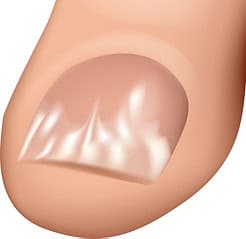
White superficial nail fungus
White superficial nail fungi (white superficial onychomycosis) is also a rare form of infection that can occur in otherwise healthy individuals. It is caused by dermatophytes growing on the top layer of the nail plate. They appear as pale, cloudy areas on the nail that slowly spread over the entire nail plate. The nail becomes soft and crumbly. This form of infection is more common in tropical climates.
Nail fungus caused by yeasts
Nail fungi caused by yeast are quite rare. Although Candida yeasts are better known as the causative agents of vaginal fungi, they are also normally present on the skin and in the intestines. The fungus can enter if the skin along the nail fold is damaged and inflamed. The nail will thicken and detach from the nail bed if the inflammation is not treated in time. This type of infection is more common on the fingers. The most common causative agents are Candida parapsilosis and Candida guilliermondii, the more commonly known Candida albicans rarely.
My neck vertebrae hurt so much that I couldn't turn my head. With twice daily lubrication with Smrekovit - morning and evening for 14 days, the pain has completely disappeared and does not recur anymore. It was the same with the pain in my knee. With the same treatment, the knee has fully healed. The swelling and pain in the wrist of my left hand was cured in the same way. Now I treat scabies and fungus on my feet- very effective but takes a little more time. Thank you for the very effective and universal remedy Sprukovit.
Konrad, Podgorci
[85] handwritten feedback received on an unknown date, kept in the Smrekovit archive
We have been using Smrek ointment for quite a few years. For all bumps, sprains and joint pain. They also relieve leg cramps. My husband had problems with fungal blisters on his toenails. With regular lubrication with Smrekovit, they have almost completely disappeared. He has been lubricating his nails for more than 6 months. (94)
Renata, Rovte
[94] handwritten feedback received on an unknown date, kept in the Smrekovit archive
Nail fungi and the most common causative agents
Dermatophytes
In 68%, nail fungi are caused by fungi belonging to the dermatophyte group. Of these, 91% is caused by the fungus Trichophyton Rubrum

Yeast
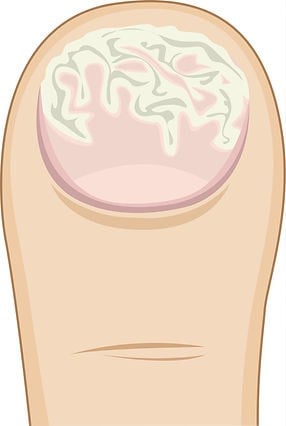
Nail fungi in 29% are caused by yeast infections, most commonly Candida Parapsilosis (42%) and Candida Guiliermondii (20%), less commonly Candida Albicans (14%) and others.
Molds
Toenail fungus is a rarer cause of nail fungus and is the causative agent in 3% of all infections.
Nail fungi by infectious agent
I regularly use Sprukovit , as it helps me tremendously with inflammatory wounds. I have used it to treat inflammatory ringworm, which is extremely painful, painful and of course unaesthetic. I tried the antibiotic ointment they prescribed earlier, but it didn't help. However, the spruce soothed the burning sensation immediately and within a few days the sores had healed and were no longer open (I've sent you pictures). When I have a recurrence, I will use your wonderful, already a little "miraculous" ointment again. Thank you from the bottom of my heart. I recommend it to everyone.
Darja, Ljubljana
[149] handwritten feedback, received 5.12.2019, stored in the Smrekovit archive
I finally found a cream that really helps. I have been battling with nail fungus for three years. A friend recommended your product to me. She lent me half a box and as I can see an improvement in my nails after only 25 days, I am very happy and hopefully I will get rid of the fungus.
Emilija, Bled
[101] handwritten feedback, received 6.8.2018, stored in the Smrekovit archive
I am familiar with your product Spruce Ointment from the days when it was not sold in the shops. It was first used by my mother for lower back pain. Now she uses it for difficult bowel movements. She has successfully relieved her tooth and gum problems.
I myself have had a positive experience with vaginal inflammation, itchy spots, and now I am treating fungus on the big toe. The change is already clearly visible in just over a month.
Even aphthae and the initial inflammation in the corner of the mouth disappear very quickly with this ointment.Andreja, Ljubljana
[108] handwritten feedback, received 3.2.2017, stored in the Smrekovit archive
Conditions that can be mistaken for nail fungus
However, an unusual-looking nail doesn't always have to be related to nail fungus. Other conditions can also cause a nail to look similar, so find out which ones:
- Dents and bumps on the nail are common and are usually a normal occurrence. They often worsen during pregnancy. A bump towards the centre of the nail is caused by biting of the nail or the cuticle adjacent to the nail. Some people develop such changes when treated with chemotherapy.
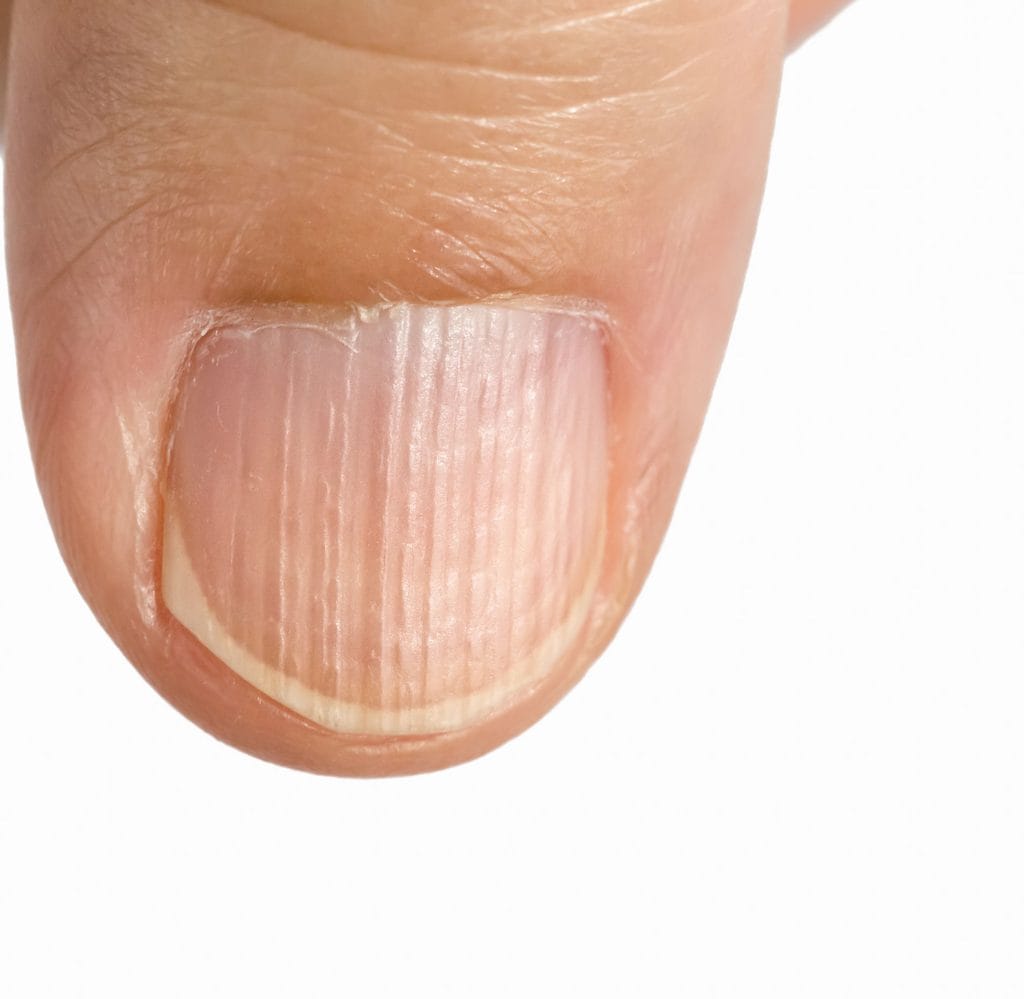
- <Brittle nails that eventually delaminate can also occur with prolonged exposure of the hands to water (for example, washing dishes without gloves), which can also resemble nail fungus.
- A white or yellow nail can be caused by onycholysis and not necessarily nail fungus. Onycholysis is the separation of the nail plate from the nail bed. The nail becomes light because there is air underneath it instead of being fused to the nail bed. Onycholysis is usually caused by trauma, but can be caused by constant and repeated minor stresses such as tapping with long nails. Onycholysis resolves on its own when a new nail grows in.
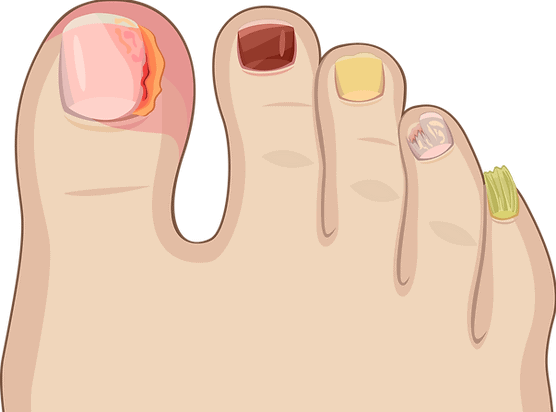
- A reddish or black nail is caused by a haematoma and is caused by a bump on the nail. It is not fungus on the nail but clotted blood between the nail plate and the nail bed. A healthy nail will eventually grow over the entire surface and the haematoma will disappear. If a black spot persists under the nail that is not due to a bump, consult a doctor to rule out the possibility of melanoma by biopsy.
- A green nail is also not a sign of nail fungus, but can be a sign of infection with a bacterium of the genus Pseudomonas. The infection is also accompanied by an unpleasant smell of the nail. The infection is usually cured spontaneously by clipping the nail.
- Lumps and dimples on the nails can be caused by scabies and occur frequently in people with the disease. Often the nail looks similar to toenail fungus and there is often a misdiagnosis.
- Swelling and redness of the foreskin is called paronychia or scarring and is quite common. It is an infection of the nail fold and is most often caused by bacteria. Prolonged inflammation can also allow the entry of yeasts of the genus Candida and secondary infection can occur, resulting in nail fungi in addition to the nail fungus.
I have used Spruce for nail fungus, neck warts, inflammation of the throat and throat, neck pain, sore thumb joint, dry skin on the hands and shins. The condition improved and returned to normal.
Zofka, Nova Gorica
[111] handwritten feedback, received 8.5.2017, stored in the Smrekovit archive
I have been using Sprukovite for 20 years for all forms of colds, nail fungus, muscle aches, stomach problems, aphthae, rheumatic problems, cold feet. It is very effective and of high quality and has been tested over the years...
The user wished to remain anonymous
[116] handwritten feedback received on 15.2.2017, stored in the Smrekovit archive
Early identification of nail fungi
Toenail fungi occur when fungi enter and remain in the nail through small lesions in the nail tissue (abrasions, wounds). Fungi need moisture to survive, so they stay in permanently moist places such as shoes, socks, surfaces of public showers, etc. Early identification is important as toenails grow very slowly and the smaller the infection at the time of treatment, the quicker the nail will look healthy again. As soon as you recognise toenail fungus, start the battle against it. They appear in the following steps:
Stage 1 infection
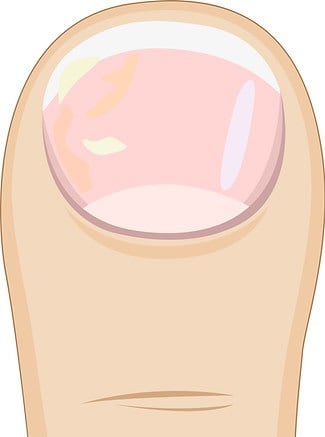
In the early stages, the infection can only be seen as a change in the colour or texture of the nail plate. Only a white or yellowish spot under the nail may appear. As this change is only cosmetic, many people overlook nail fungus at this stage and do not bother with the change. Many simply cover the change with nail varnish or avoid open shoes, which speeds up the spread of the infection. This stage is the best time to start the battle against fungi, as they can be easily suppressed.
Level 2 infection
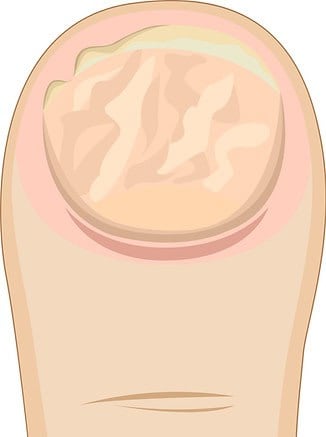
In the next stage of the infection, the toenail thickens and the pressure can make it difficult to wear shoes. Without treatment, the infection spreads from one spot to the entire nail plate or entire nail to adjacent nails. In this stage, the white or yellow spot that appeared in the first stage enlarges and eventually the whole nail turns yellow or white.
Level 3 infection
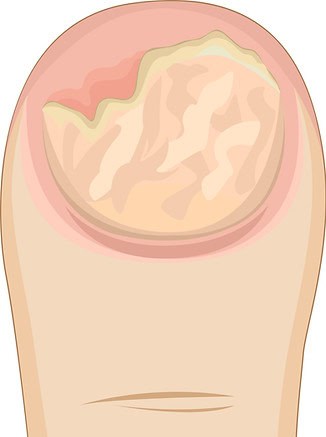
In the final, advanced stage, the nail becomes unusually thick and extremely brittle due to the extension of the infection, so that the nail plate is partially or completely separated from the nail bed. In this stage, the nail fungus spreads even to the skin around the nail and to neighbouring nails.
Nail fungus treatment time
The treatment time for nail fungus depends on the surface of the nail plate that is affected. Even when fungi have already been eliminated, the nail remains opaque and thickened to the eye, while the newly formed nail plate is healthy and transparent. It should be borne in mind that toenails grow very slowly, at around 1.5 mm per monthSo if half of the nail plate is affected, it will take about three months, but if the entire nail is infected, it may take more than half a yearfor it to grow back healthy and transparent.
Spruce is extremely effective for nail fungus and various wounds. A unique product and yet without chemistry.
Tatjana, Logatec
[118] handwritten feedback received on an unknown date, kept in the Smrekovit archive
I use Sprukovit when I have a sore throat or if my ears hurt. If it's a bit sore, it helps after one application, otherwise I repeat it again.
I also healed my thickened toenail.
I am now using it for the pain in my toenail, which has subsided, and I will let you know if it goes away.The user wished to remain anonymous
[121] handwritten feedback received on an unknown date, kept in the Smrekovit archive
Risk factors for nail fungus
- In otherwise healthy people, nail fungi usually appear with prolonged or repeated contact with moisture, where fungi tend to multiply. These are, for example, public showers in gyms, swimming pools.
- Visits to beauty salons where regular disinfection of pedicure equipment is not taken care of can also cause nail fungus to appear.
- Although nail fungi are not highly contagious, they can be passed from person to person if there is constant contact with an infected person or if the same nail care products are used in the same household.
- Athletes are more susceptible because they wear sports shoes that are constantly wet. Also, many sports put chronic stress on the nails, weakening them and making them more susceptible to nail fungus. If you have athlete's foot (tinea pedis), the chance of a nail infection is much higher.
- <A weakened immune system due to HIV infection, taking steroid and immunosuppressant drugs or old age also increases the chance of nail fungus.
I use Smrekovit when my children have colds. I put it on them and in two days, if it is just a cold, they are usually cured.
We also used it for fungus on the feet, which disappeared after two weeks. We also use it for shoulder and neck pain. We are very satisfied with your products.Alan, Jesenice
[122] handwritten feedback, received 27.11.2018, stored in the Smrekovit archive
Your product and your instructions have been very successful in eliminating the fungus on my toenail. Thank you very much, I am very grateful, as medicinal chemistry did not help me.
The user wished to remain anonymous
[123] electronic feedback received on 4.7.2017, stored in the Smrekovit archive
HOW TO PREVENT NAIL FUNGUS?
If someone close to you has nail fungus, it’s advisable to follow these preventive measures:
- Socks and shoes: change your socks and shoes regularly. Change socks every day. It is advisable to allow time for one pair of shoes to dry when sweating and to use another, dry pair of shoes in the meantime. This is because toenail fungi need a moist environment to develop. You can also use shoe spray disinfectant. Shoes should be comfortable as constant pressure on the nails will cause chronic damage to the nail and make it more susceptible to nail fungi. Don't lend your shoes and socks.
- Hygiene and care: regular clipping of the nails is very important. Cut them so that the free edge of the nail plate does not dig into the cuticle at the sides. Do not interfere with the cuticle. Also do not bite the nails and cuticles on the hands. If you tend to sweat profusely or often have fungus between your toes, use foot powder, which prevents sweating and disinfects the feet. <Nail polish or artificial nails are a risk factor for toenail fungus, as a layer of moisture can linger underneath and contribute to fungal growth. For nail care, choose salons that sterilise nail care utensils, as otherwise infection can be passed from client to client.
- When you are in environments where there is a higher risk of developing nail fungus (swimming pools, saunas, public toilets in campsites, etc.), use Smrekovit 365 spruce cream as a preventive treatment.
- Check your nails and feet regularly and treat them early. The sooner you start using Smrekovit 365 spruce cream when fungus appears, the shorter the time it will take to get healthy nails again.

-

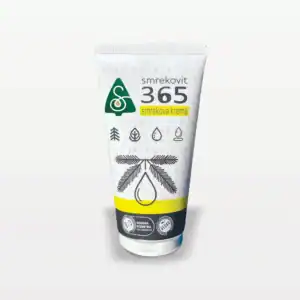
Smrekovit 365 spruce resin cream
14,00 €
I have been using spruce for a few years. The products are great. I rub my shoulders and spine. The product is practical for everything. I have also used it for fungus on my feet and it helps. It took longer but it was effective. I have tried many other creams and they did not work.
Terezija, Brežice
[112] handwritten feedback received on 7.4.2017, stored in the Smrekovit archive
I have used Sprukovit spruce ointment for itchy and burning soles. I rubbed it on my soles every evening and the itching was very soothing. It also helps me a lot with scabs between the toes..
Ivanka Udir, Zgornja Besnica
[18] handwritten feedback received on 12.5.2015, stored in the Smrekovit archive
Spruce resin and nail fungus
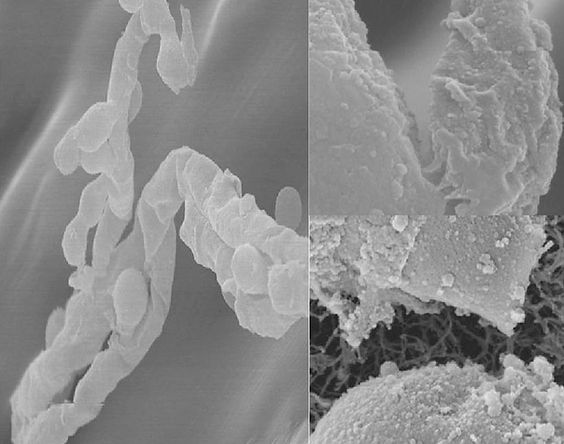
The study (Sipponen et al., 2013) involved 20 subjects who had nail fungus as a result of dermatophyte infection (mycological fungal culture test). With once-daily application of a spruce resin preparation, the spruce resin preparation used was clinically effective in 14 subjects at the end of the several-month study.
The same researchers also tested the antifungal effect of the spruce resin ointment in vitro (in the laboratory) on fungal cultures. The study showed that spruce resin had a strong antifungal effect against all tested dermatophytes of the genus Trichophyton, the most common cause of nail fungi (in 68%). Spruce resin caused hyphal and cell wall damage to the tested fungi.
Shortly after you started your production, I heard about you somewhere. Both my husband and I find the Sprukovit products very helpful and we are very happy with them. I put it on my lower back, shoulders, neck, legs and calves at night before going to bed and it makes it easier for me to sleep. <The fungus on my feet has disappeared. The gingivitis was cured the very next day. I don't even try other products anymore. Everyone in our family uses them.
Marija, Radomlje
[73] handwritten feedback, received 21.3.2016, stored in the Smrekovit archive
My puppy had problems with tips on his right paw. Every three or four months it would recur. He was given various medications by the vet, after which there was a momentary improvement, then it recurred again. My friend mentioned Smrekovit, which he has been using himself, and I put it on his paw every time we came in from a walk. First I washed his paws and then I put the grease on. Soon I noticed that the wound had healed and he was not licking anymore. Since then the problem has not recurred for 4-5 months.
The user wished to remain anonymous
[89] handwritten feedback received on an unknown date, kept in the Smrekovit archive
Frequently asked questions
Why does nail fungus develop?
Nail fungus occurs when the nail becomes infected with fungi — most commonly dermatophytes (in over two-thirds of cases), yeasts in about one-third, and only rarely moulds. The main risk factors include prolonged exposure of the nails to moisture, such as in public showers or swimming pools, as well as pedicures performed with unsterilised tools or sharing footwear. In yeast infections, especially those caused by Candida parapsilosis, the infection often begins at the cuticle.
What helps against nail fungus, and how can it be removed?
Since spruce resin has strong antifungal properties, we recommend using Smrekovit 365 spruce cream. Apply the cream to a clean, dry nail and cover it with two strips of white microporous tape. Replace the dressing once or twice daily. As the nail grows, the new section will appear clear and healthy again — but keep in mind that toenails grow very slowly.
How long does nail fungus last?
When treated properly, recovery depends mainly on how quickly the nail grows. Toenails grow on average about 1.5 mm per month, so you can roughly calculate the treatment time. For example, if the entire 15 mm nail plate of the middle toe is infected, complete recovery will take around 10 months. Without treatment, nail fungus does not disappear on its own.
Does nail fungus hurt?
In the early stages, nail fungus is usually painless. However, if the infection spreads to the entire nail and surrounding skin, it can become painful. That’s why it’s important to take the condition seriously and begin treatment as soon as possible.
What does nail fungus look like?
As the infection progresses, the nail becomes dull, yellow, greenish, or brownish in colour. It thickens and eventually separates from the nail bed. The infection usually begins as a small yellowish spot beneath the tip of the nail.