
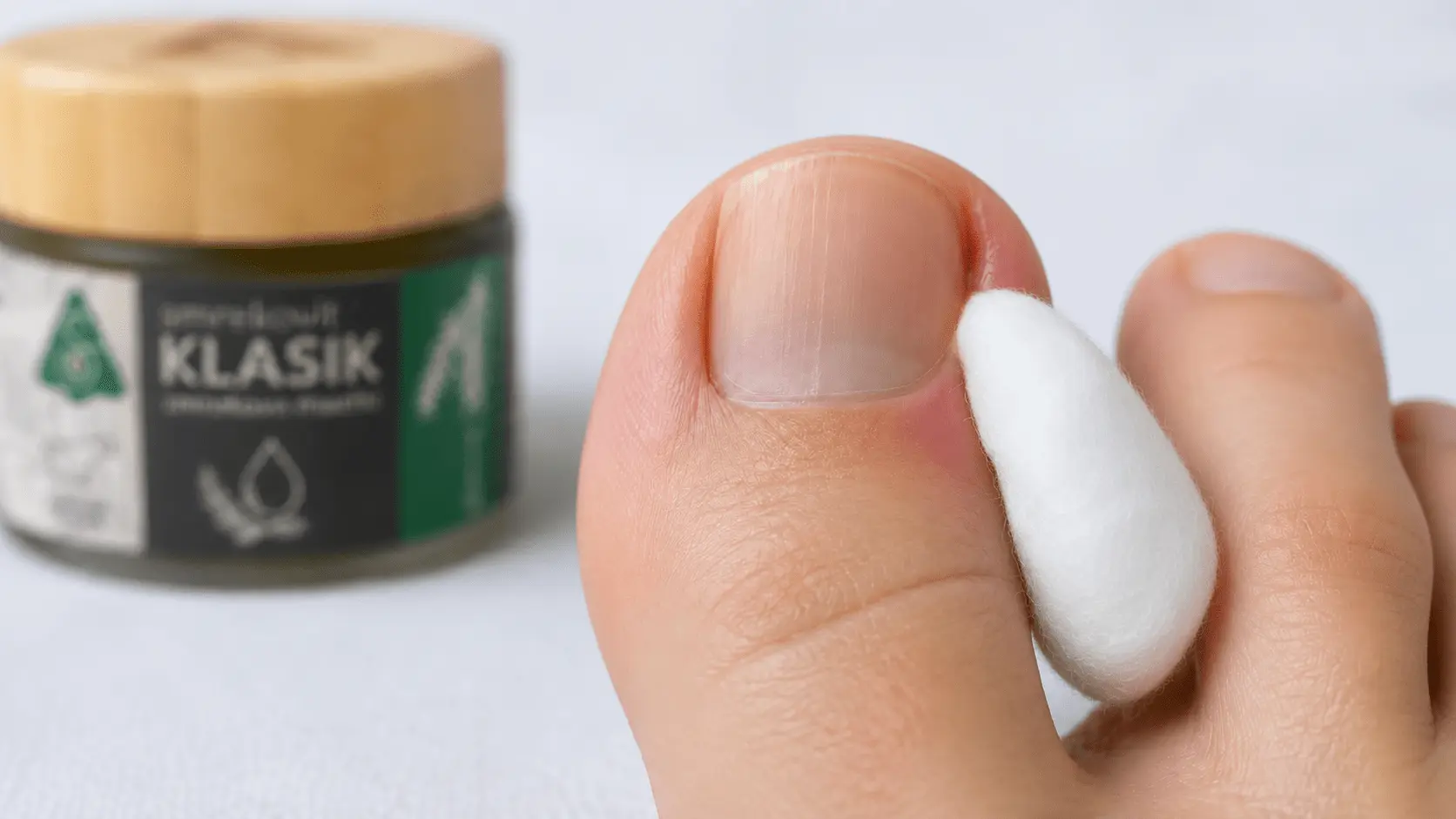
An ingrown toenail occurs when the edge of the nail begins to grow into the surrounding skin. It most commonly affects the big toe. At first, you may only feel pressure or pain, but later redness, swelling and sometimes pus can develop.
At Smrekovit, we have encountered this problem for many years while advising users. In our practical experience, an ingrown toenail is one of the conditions where local problems around the nail can calm down relatively quickly. However, it is important to understand one key distinction: calming the inflammation around the nail is not the same as eliminating the cause of the ingrown nail.
This distinction is important when deciding when home care makes sense and when it is better to consider professional treatment or a procedure.
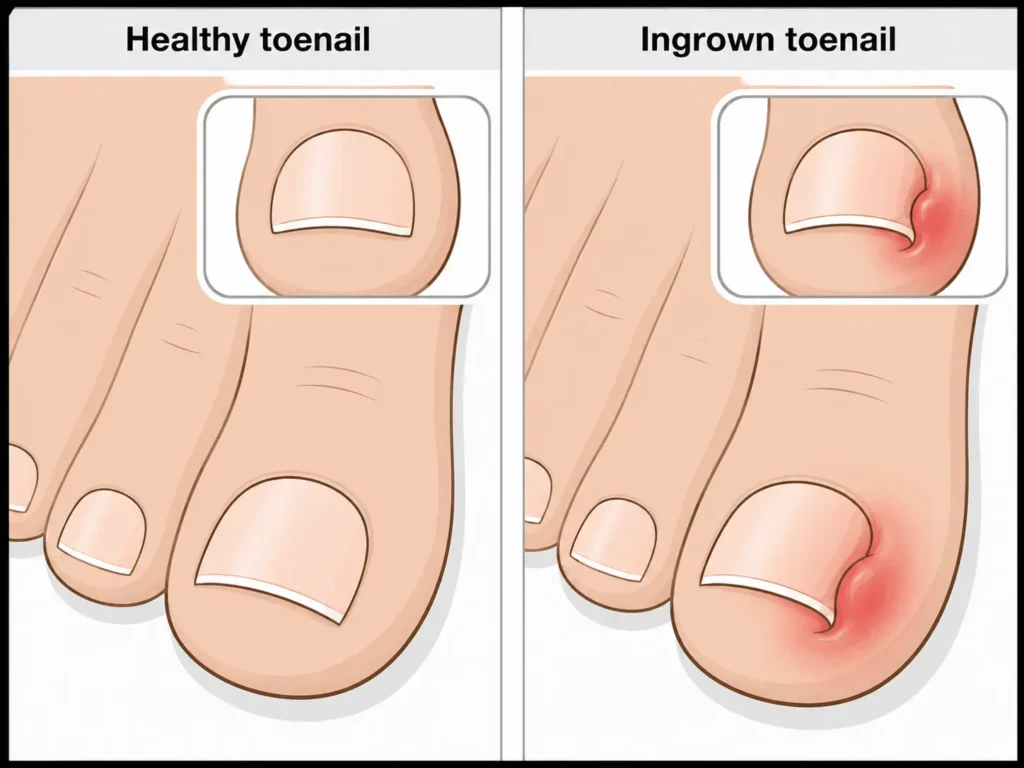
Ingrown toenail at a glance
- The edge of the nail on the big toe is most commonly affected.
- Typical signs are pain, tenderness, redness and swelling along the edge of the nail.
- If the area becomes more severely inflamed, pus may also appear.
- It is important to reduce pressure on the toe and prevent further irritation.
- Based on our practical experience at Smrekovit, we often treat local problems with Smrekovit Klasik or Smrekovit 365 Prima applied to a cotton pad.
- If the nail continues to grow into the skin, the problem may recur even after the inflammation has completely subsided.
- In cases of recurring ingrown toenails, correction or removal of the problematic edge of the nail may be necessary.
What does it actually mean when a toenail becomes ingrown?
A toenail normally grows forward along the nail bed. With an ingrown toenail, however, one of its side edges begins to press into or grow into the skin next to the nail.
At first, the problem may be quite mild. The toe may be sensitive mainly when pressure is applied or when wearing tighter shoes. If the edge of the nail continues to dig into the skin, the area becomes increasingly irritated. Pain, swelling and redness develop, and in more pronounced inflammation there may also be discharge or pus.
The big toe is most commonly affected, but nails on other toes can also become ingrown.
Why does the nail start growing into the skin?
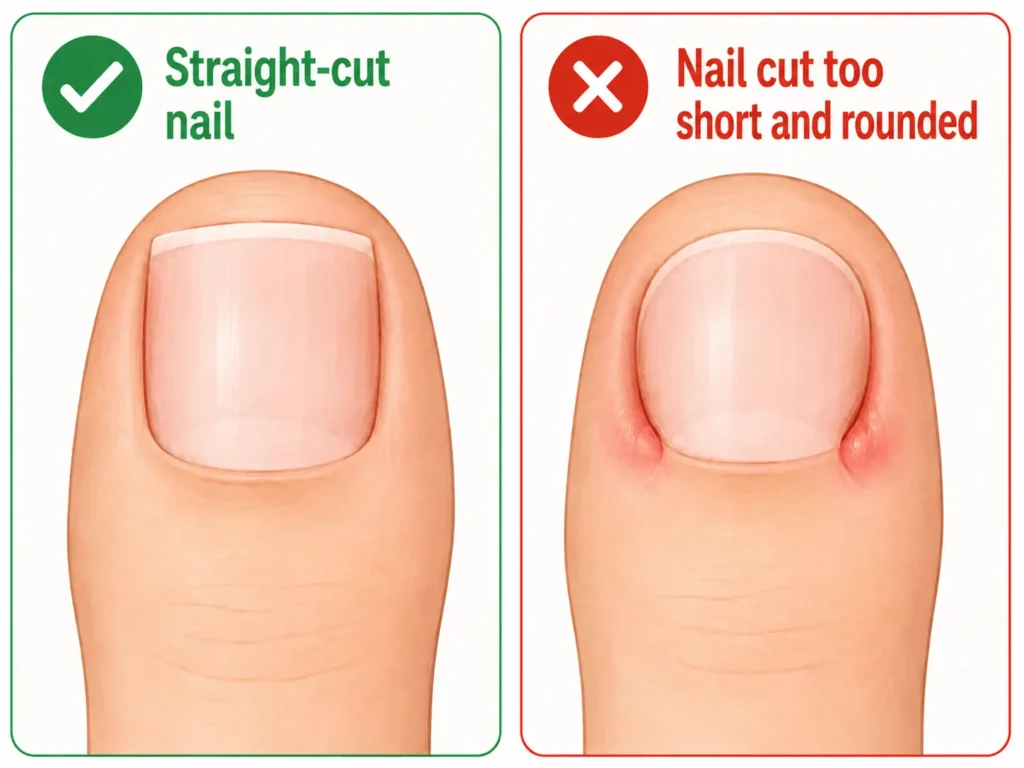
A common reason is the way the nails are trimmed. If the corners of the nail are cut very deeply or the sides are rounded too much, the edge of the nail may, as it continues to grow, start pressing into the skin.
Tight footwear that presses the toes together, an injury to the nail or simply the shape of the nail and toe can also contribute to the problem. In some people, ingrown nails therefore keep recurring despite relatively careful care.
That is why, with a recurring ingrown toenail, it is not enough to look only at the inflamed area of skin. It always makes sense to ask: why is the nail growing into the tissue at this particular spot in the first place?
Inflammation and the cause of the ingrown nail are two different problems
In our experience, this is the most important thing to understand about an ingrown toenail.
When the edge of the nail digs into the skin, it causes local irritation and may also lead to inflammation. If the area calms down, the pain and redness disappear, and it can feel as though the problem has been solved.
However, if the same edge of the nail is still growing toward the skin, the problem may return after some time.
Local treatment can help with what is happening around the nail, but it cannot change the direction in which the nail grows. With a one-time problem, calming the inflammation may be enough. With recurring ingrown toenails, however, the mechanical cause should also be considered.
Is the problem really an ingrown toenail?
Not every change in a toenail is caused by ingrowing. A typical sign of an ingrown toenail is that the problem develops along the side edge of the nail, where it presses into or digs into the surrounding skin. There may be tenderness when pressure is applied, redness and swelling.
If, however, the nail is mainly changing colour, becoming yellowish, thickened or brittle, it is also worth considering a fungal infection. You can read more about this in the article Nail fungus: how to recognize it and what you can do.
Our practical experience with Smrekovit for ingrown toenails
When advising users, we consider ingrown toenails one of the more responsive local problems. In our practical experience, regular local use often helps reduce pain, redness and inflammation around the nail relatively quickly.
We most commonly recommend Smrekovit Klasik or Smrekovit 365 Prima.
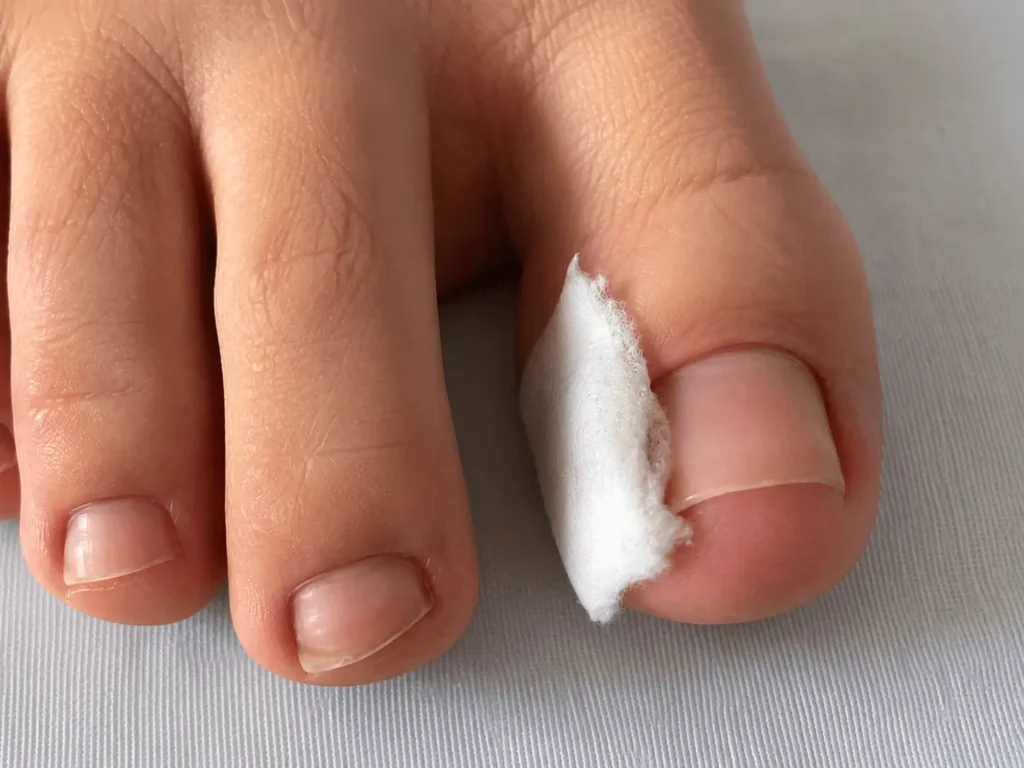
Apply the product to a small cotton pad and place it directly on the affected area next to the nail. Then secure the pad so that it remains in contact with the skin for as long as possible.
With this method, occasional application alone is not the main point. Longer contact between the product and the affected area is important, which is why a cotton pad has proven to be a very simple method in our practice.
If pus is present, in our practical experience we use the same procedure. However, if the condition worsens, the redness spreads, the pain increases significantly or fever develops, we recommend seeing a doctor.
The exact method of use is also described in our practical instructions for soft-tissue inflammation and ingrown toenails.
What else can we do besides local application?
First, it makes sense to reduce additional irritation. If the toe is squeezed in a narrow shoe all day, it is difficult to expect the sensitive area to calm down quickly. During this time, sufficiently wide and comfortable footwear is therefore more appropriate.
It is also not a good idea to keep trimming the painful edge of the nail every day, poke under the nail or try to forcibly remove the part that is digging into the skin. This can cause a new injury and further irritate the area.
When trimming the nail in the future, it is generally advisable to cut it more straight across and avoid cutting deeply into the corners at the sides.
What if there is pus around the nail?
Pus means that the area is no longer only mechanically irritated, but that more pronounced local inflammation and possibly an infection are present.
With our users, we also use Smrekovit Klasik or 365 Prima on a cotton pad in such cases. According to our practical observations, the area often gradually clears and calms down.
However, it is important to monitor the overall condition. Do not delay seeing a doctor if:
- the redness spreads away from the nail,
- the swelling increases rapidly,
- the pain keeps getting worse,
- fever or a general feeling of illness develops,
- the condition does not begin to improve despite care.
Extra caution with diabetes
With diabetes, greater caution is needed when dealing with foot problems. Due to reduced sensation, a person may notice a wound or other change later, while circulation problems can further slow healing in some people.
For this reason, we would not manage a severely inflamed ingrown toenail in a person with diabetes at home for long, especially if an open wound has already developed or pus is present.
More about the specifics of wound care and diabetic foot is described in our practical instructions for wounds and healing.
When is a procedure necessary?
If the inflammation settles down and the nail then grows normally past the problematic area, an additional procedure is often not necessary.
It is different if the same edge of the nail repeatedly grows into the skin. In that case, local care mainly addresses the consequence, while the mechanical cause remains.
If the nail continues to grow into the tissue even after it has grown out, or if the problem keeps recurring, partial removal of the problematic edge of the nail may be considered. In persistent recurrent cases, a partial matrixectomy may also be performed, permanently preventing the problematic part of the nail from growing back and leaving the nail slightly narrower.
From our conversations with users, we have noticed that fear of having part of the nail removed is often much greater than the actual difficulty of the procedure and recovery.
What should you do after part of the nail has been removed?
After part or all of the nail has been removed, the resulting area should be treated as a wound.
Based on our practical experience, for such wounds we primarily use Smrekovit Klasik on sterile non-woven gauze, which is placed directly on the nail bed. The instructions provided by the healthcare professional who performed the procedure should also be followed.
A detailed dressing procedure is described in our instructions for wounds, surgical wounds and nail removal.
How can you reduce the chance of an ingrown toenail recurring?
There is no complete protection, especially in people whose nail shape makes them more prone to ingrowing. However, a few simple measures can reduce the chance of recurrence:
- do not cut the nail too short,
- trim it mainly straight across and do not cut deeply into the corners,
- avoid footwear that constantly puts pressure on the toes,
- do not keep cutting the painful edge deeper and deeper,
- if the problem keeps returning in the same place, consider professional treatment of the underlying cause.
With a recurring ingrown toenail, it is more important in the long term to address the reason why it keeps ingrowing than to repeatedly calm its consequences.
Pogosta vprašanja o vraščenem nohtu
Can an ingrown toenail go away on its own?
With mild, early-stage ingrowing, the problem may settle down, especially if pressure on the toe is reduced and the nail is allowed to grow past the problematic area. If the edge of the nail continues to dig into the skin, the problem often recurs.
Is pus around an ingrown toenail dangerous?
Pus indicates more pronounced local inflammation and possibly an infection. If the condition is settling quickly, it can be monitored. If the redness spreads, swelling increases, pain gets worse, fever develops or you feel generally unwell, we recommend seeing a doctor.
Can Smrekovit cure an ingrown toenail?
Smrekovit cannot change the direction in which the nail grows. According to our practical experience, however, local use often helps calm the problems in the inflamed area around the nail. If the mechanical cause remains, the problem may recur.
Which Smrekovit do we use for an ingrown toenail?
We most commonly use Smrekovit Klasik or Smrekovit 365 Prima on a small cotton pad, which is secured directly next to the affected edge of the nail.
When is it better to see a doctor?
Especially if the condition is getting worse, the redness or swelling is spreading, the pain is severe, fever develops or the problem does not begin to improve despite appropriate home care. With diabetes, we are especially cautious with any wounds or inflammation of the foot.
The most important thing about an ingrown toenail
With an ingrown toenail, we do not look only at the nail or only at the inflammation. These are two related issues.
First, we want to calm the painful and inflamed area. Then we check whether the nail continues to grow normally once the inflammation has settled.
If the problem does not recur, no further action may be necessary. However, if the same edge of the nail repeatedly grows into the skin, simply repeating local care is not the best long-term solution. In that case, it makes sense to address the mechanical cause as well.
We use the same approach when advising Smrekovit users: we recommend the product where, based on our practical experience, it can help with local problems, while at the same time we do not expect it to change something that cannot be corrected by local application.
For detailed instructions on how to use Smrekovit for an ingrown toenail, see our practical instructions for using Smrekovit products for local inflammation.