

Candida in brief
- The presence of Candida does not automatically mean disease. Candida yeasts can form part of the normal microbiota without causing symptoms.
- Candidiasis means an actual infection. The most common forms are local infections, for example in the mouth or vagina.
- Invasive candidiasis is very different from the claimed “chronic systemic Candida”. It is a rare and serious infection seen mainly in severely ill or immunocompromised people.
- Fatigue, bloating, “brain fog” and similar general symptoms do not by themselves prove Candida. Candidiasis also cannot be reliably diagnosed with a saliva test or bioresonance.
- Diagnosis depends on the site of infection. Typical symptoms, examination and, when needed, appropriate laboratory tests are used.
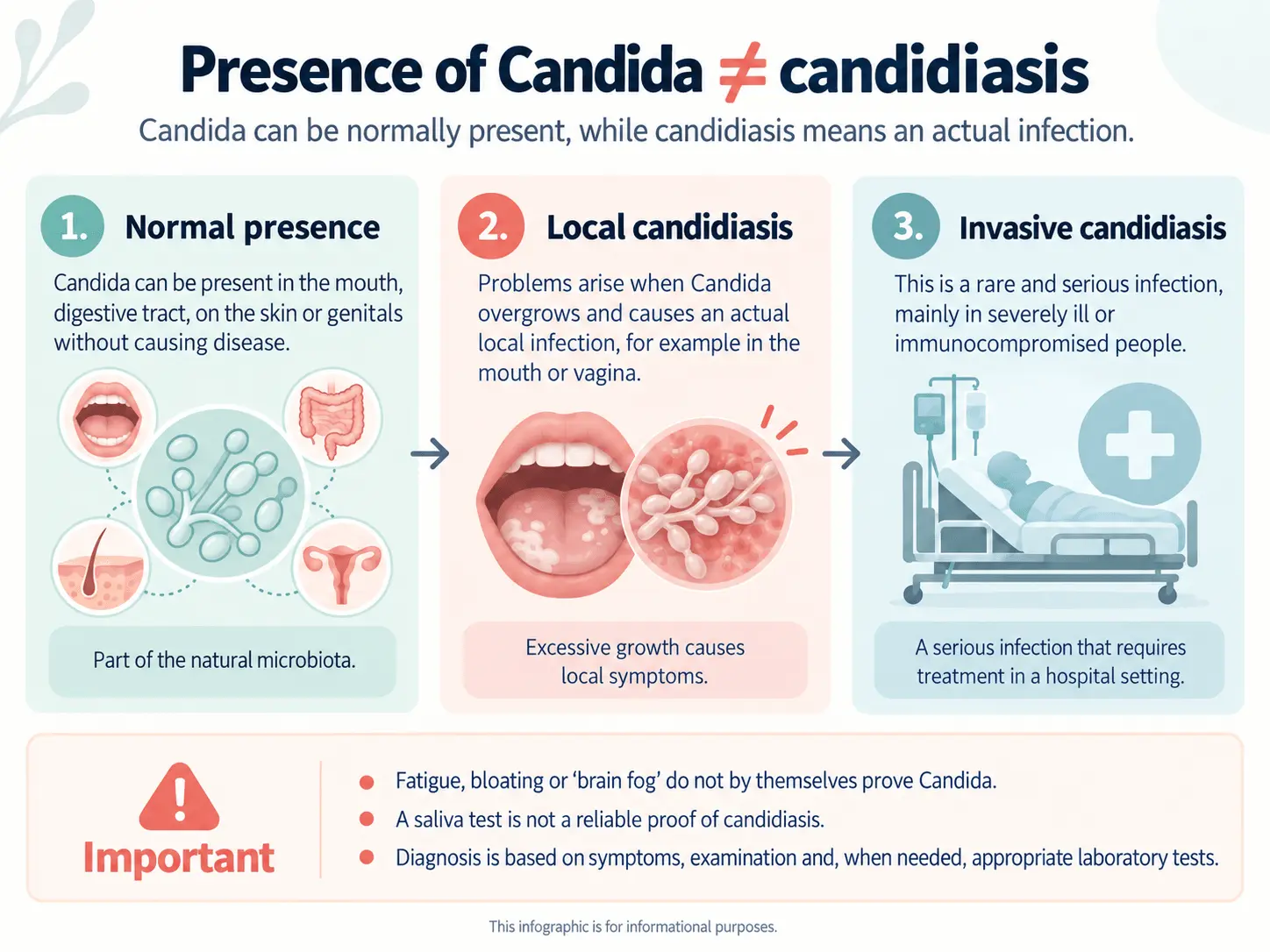
Table of Contents
What is Candida and when does its presence indicate disease?
Candida is a genus of yeasts, of which Candida albicans is the most common in humans. These yeasts can normally live on the skin and in the mouth, digestive tract and vagina without causing any problems. The presence of Candida alone therefore does not mean disease.
Candidiasis occurs when Candida overgrows and causes an actual infection. Most commonly this is a local infection, for example in the mouth or vagina. Symptoms therefore depend mainly on which part of the body is affected.
The presence of Candida is not the same as a diagnosis of candidiasis
This distinction also matters when interpreting laboratory results. Candida may be present at some body sites in people without symptoms, so a positive swab or detection of the yeast does not always mean that Candida is causing the problem. The result has to be considered together with the symptoms, the sampling site and the clinical examination.
The same principle applies to the digestive tract. Finding Candida in the gut does not by itself mean that a person has “intestinal Candida” or that Candida explains fatigue, bloating, headaches, mood changes or other non-specific symptoms. Much more evidence is needed before such a conclusion can be made.
Candida in the mouth and on the tongue – how to recognize oral candidiasis
Oral candidiasis, or oral thrush, is a fungal infection of the mouth most commonly caused by Candida albicans. Typical signs include white patches on the tongue, inner cheeks, palate or throat, often accompanied by redness, tenderness or a burning sensation.
What does Candida on the tongue look like?
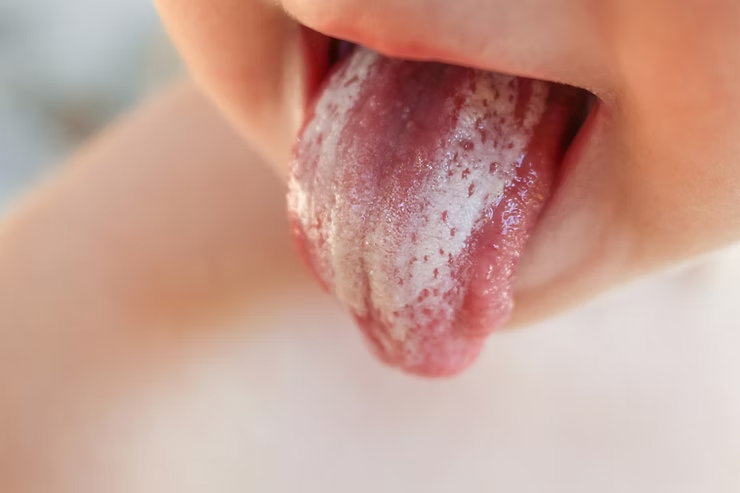
The white patches of oral thrush may have a creamy appearance. When wiped away, they can leave a red and tender surface underneath that may bleed slightly. Other symptoms may include an unpleasant or reduced sense of taste, a cotton-like feeling in the mouth and cracks at the corners of the lips.
Not every white coating on the tongue is Candida. A white tongue can have many other causes. Persistent white patches in the mouth that cannot be wiped away are not typical of oral thrush and should be assessed by a doctor or dentist.
Who is more likely to develop oral candidiasis?
Oral candidiasis is relatively uncommon in healthy adults. It occurs more often in babies, denture wearers and people who have recently taken antibiotics, use inhaled corticosteroids, have diabetes, dry mouth or a weakened immune system.
Medical assessment is appropriate if the problem keeps returning, does not improve with appropriate treatment, or if swallowing becomes painful or difficult. Pain on swallowing may indicate involvement of the oesophagus, which is different from ordinary oral thrush.
Vaginal Candida and Candida on the penis
Genital candidiasis is a local fungal infection. In women it most commonly affects the vulva and vagina, while in men it usually affects the glans penis and the area beneath the foreskin. Symptoms can be uncomfortable, but they are not specific enough on their own to establish a reliable diagnosis.
Vaginal candidiasis
Typical symptoms include itching, burning, redness and soreness of the vulva or vagina. Pain during sex, discomfort when urinating and abnormal vaginal discharge may also occur. The discharge is often white and thick, but its appearance alone does not prove candidiasis.
Similar symptoms can also be caused by other forms of vaginitis and some sexually transmitted infections. If symptoms occur for the first time, keep returning, do not resolve after appropriate treatment or the diagnosis is uncertain, medical assessment and, when needed, laboratory confirmation are appropriate.
Candida on the penis
In men, Candida can cause inflammation of the glans penis, or balanitis. Symptoms may include redness, itching, burning and tenderness of the glans or skin beneath the foreskin, sometimes with whitish discharge or deposits. More pronounced inflammation can make retracting the foreskin uncomfortable or difficult.
Similar symptoms in men are not specific to Candida either. Persistent or recurrent inflammation should be assessed, particularly when other conditions or risk factors such as diabetes or weakened immunity are present.
Is genital Candida sexually transmitted?
Candidiasis is not classified as a typical sexually transmitted infection. Candida can normally be present on the body, and infection usually develops when the local balance changes and the yeast overgrows. Sex can trigger or worsen symptoms in some people and transmission between partners can occur, but treatment of a partner without symptoms is generally not necessary.
Systemic Candida – what the term actually means
The term “systemic Candida” is used in very different ways online. Medicine recognises a serious condition called invasive candidiasis. In this condition Candida enters the bloodstream or internal organs; Candida infection of the bloodstream is called candidemia.
This is not the same as assuming that an otherwise healthy person has “systemic Candida” because of fatigue, bloating, headaches, difficulty concentrating or other non-specific symptoms.
Invasive candidiasis is a serious infection
Invasive candidiasis occurs mainly in people who are already seriously ill or hospitalised. Risk is increased by factors such as prolonged intensive care, central venous catheters, broad-spectrum antibiotics, major abdominal surgery, chemotherapy, neutropenia, transplantation and haemodialysis.
Common signs include fever and chills that do not improve with treatment for a suspected bacterial infection. If Candida affects individual organs, additional symptoms may depend on the organ involved.
| Feature | Invasive candidiasis | Claimed “chronic systemic Candida” |
|---|---|---|
| What does it mean? | A documented invasive fungal infection of the bloodstream or internal organs. | A broad explanation in which various non-specific symptoms are attributed to Candida. |
| Who typically develops it? | Mainly severely ill, hospitalised or immunocompromised people and other high-risk groups. | It is often claimed in otherwise healthy people on the basis of general symptoms. |
| What are the signs? | Fever and chills are common; other symptoms depend on the site of infection. | Fatigue, bloating, “brain fog”, headaches and similar complaints that can have many different causes. |
| How is it diagnosed? | By medical assessment and appropriate laboratory testing; candidemia is primarily diagnosed with blood cultures. | Symptom lists, bioresonance or saliva tests do not establish such a diagnosis. |
| What happens next? | Systemic antifungal treatment under medical supervision is required. | With non-specific symptoms, the actual cause should be investigated rather than automatically treating presumed Candida. |
Why does this distinction matter?
This does not deny systemic Candida infections – they exist and can be very serious. The problem is that a term describing a genuine invasive infection is also used for a completely different collection of everyday symptoms, from which Candida is then inferred without appropriate diagnostic evidence.
Fatigue, digestive problems or difficulty concentrating can be real and deserve attention, but by themselves they do not reveal their cause.
Does Candida cause fatigue, bloating and “brain fog”?
Fatigue, bloating, headaches, poor concentration, mood changes and similar complaints are often attributed online to “Candida overgrowth” or “Candida syndrome”. These symptoms can be entirely real, but they are highly non-specific and do not by themselves reveal their cause.
The symptom may be real while the explanation is wrong
There is no reliable medical basis for diagnosing presumed chronic or systemic Candida in an otherwise healthy person from such a symptom list. The same complaints occur in many other conditions, ranging from dietary and functional digestive problems to sleep disorders, deficiencies, medicines, hormonal disorders and many other causes.
A long symptom checklist is therefore not a useful diagnostic test. If almost everyone can recognise themselves in it, it mainly shows that the selected symptoms are common – not that Candida is their cause.
What does research show about so-called “Candida syndrome”?
The idea that Candida causes a broad range of systemic symptoms in otherwise healthy people has been studied for decades, but the results have not provided a reliable basis for such a diagnosis. In one well-controlled trial, the antifungal drug nystatin did not reduce systemic or psychological symptoms significantly more than placebo, although it performed better for local vaginal symptoms as expected.
Other studies have reported different findings, so it would not be accurate to claim that the question has been completely settled. However, current evidence does not justify treating fatigue, bloating or “brain fog” by themselves as proof of Candida overgrowth.
What if I feel better on a “Candida diet”?
That still does not prove that Candida was the cause. Such diets often reduce sugar, alcohol, white flour and highly processed foods at the same time, changing the overall diet considerably. Feeling better can therefore have many other explanations.
Candida test – how candidiasis is actually diagnosed
There is no single universal test for Candida. The diagnostic method depends on where the infection is suspected. Oral candidiasis can often be recognised by examining the mouth, vaginal candidiasis is assessed using a sample of vaginal discharge, while suspected invasive infection requires completely different investigations.
The question “Do I have Candida?” is therefore not specific enough without knowing the site and type of symptoms. Even detecting Candida does not always mean disease, because the yeast can be present at some body sites without causing symptoms.
| Suspected form of candidiasis | How is it usually diagnosed? | Important limitation |
|---|---|---|
| Candida in the mouth or throat | Clinical examination and, when needed, a sample for microscopic or laboratory testing. | The appearance may be sufficient for an initial assessment, but not every white coating is Candida. |
| Vaginal candidiasis | Microscopic examination of vaginal discharge, culture or another appropriate laboratory test. | Candida may be present in the vagina without symptoms, so a positive result alone is not an indication for treatment. |
| Oesophageal candidiasis | Endoscopy when required; in some situations treatment may also be started on clinical grounds. | This is different from ordinary oral thrush. |
| Invasive candidiasis | Blood cultures or a sample from the infected site, together with other investigations according to the clinical situation. | A single negative test does not always rule out infection; diagnosis takes place in a medical setting. |
Is there a blood test for Candida?
Yes, but blood tests are not a general screening test for presumed “chronic Candida” in a healthy person. Blood cultures are primarily used when invasive candidiasis or candidemia is suspected, usually in people with relevant symptoms and risk factors.
Additional laboratory tests also exist, but they are used in specific clinical situations and have their own limitations. Results therefore need to be interpreted together with symptoms, examination and individual risk.
Does a private “Candida test” make sense?
It depends on what the test actually measures and why it is being performed. Before paying for one, it is worth checking which sample is analysed, which method is used and which clinical question the result is supposed to answer. A test without a clear link to a specific form of candidiasis may produce a result that is difficult or impossible to interpret meaningfully.
Candida saliva test – why a glass of water is not a diagnostic test
A simple “Candida test” circulates online in which a person is told to spit into a glass of water in the morning and watch for strings hanging from the saliva, cloudiness in the water or saliva sinking towards the bottom. These changes are then interpreted as signs of “Candida overgrowth”.
This is not a validated diagnostic method for candidiasis. There are no established diagnostic criteria based on the appearance of saliva in a glass of water that can show whether someone has oral, intestinal, vaginal or systemic candidiasis. Strings, cloudiness or sinking saliva therefore cannot establish the diagnosis.
This does not mean saliva is never analysed in medicine
It is important to distinguish the home glass-of-water test from laboratory examination of a saliva sample. In the investigation or diagnosis of oral candidiasis, saliva or another oral specimen can be examined microscopically or cultured on appropriate media. In that situation, Candida is actually being detected or measured using a laboratory method.
Even laboratory detection of Candida in the mouth does not automatically mean disease. Candida may also be present in the oral cavity of people without oral candidiasis, so the result has to be interpreted together with the appearance of the lesions, symptoms and clinical examination.
Why does the home test seem so convincing?
Because it produces something a person can see with their own eyes. The problem is that a visible change is not necessarily diagnostically specific. A useful test needs known performance in people with and without confirmed disease and clearly defined criteria for a positive and negative result.
The glass-of-water saliva test is therefore not a sound basis for starting antifungal treatment, following a strict “Candida diet” or concluding that Candida is responsible for non-specific symptoms.
Candida, skin and nail fungus – not every fungal infection is Candida
Candida can also cause skin infections, particularly in warm, moist areas where skin rubs against skin, such as beneath the breasts, in the groin, armpits or between the fingers. The skin may become intensely red and macerated, sometimes with small lesions around the edge of the rash.
However, not every fungal-looking skin problem is candidiasis. Similar changes can be caused by dermatophytes, other fungi, dermatitis, psoriasis or bacterial infections, so appearance alone is not always enough for a reliable diagnosis.
Fungal nail infections are not synonymous with Candida
This is especially important with nails. Fungal nail infection, or onychomycosis, is most commonly caused by dermatophytes. Moulds and yeasts, including Candida, can also cause it, but Candida is only one of several possible causes.
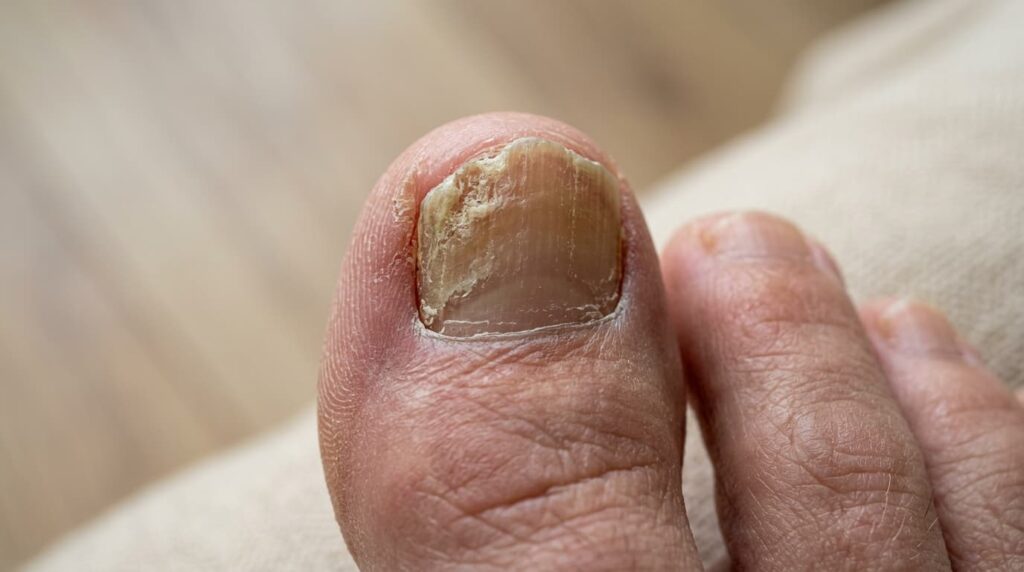
A thickened, yellow or crumbling nail therefore does not mean that a person has “Candida”. Nail trauma, psoriasis and other nail disorders can look similar. Read more about recognition and progression in our article on fungal nail infections.
If the nail problem is in fact fungal and you are looking for practical information on using Smrekovit, see our instructions for fungal nail infections.
What actually helps with candidiasis?
Confirmed candidiasis is primarily treated with antifungal medication. The choice of treatment and route depend mainly on the part of the body affected, the severity of the infection and the person’s overall health.
Treatment depends on the site of infection
- Oral candidiasis: mild infections are usually treated with topical antifungal medicines used inside the mouth; more severe infections may require systemic treatment.
- Vaginal candidiasis: treatment usually involves topical antifungal preparations or an appropriate oral antifungal medicine.
- Skin candidiasis: topical antifungal treatment is often used, together with measures to reduce moisture and irritation in the affected area.
- Invasive candidiasis: requires hospital treatment with systemic antifungal medication.
A positive result alone does not always need treatment
Because Candida can normally be present in the body, the goal is not to eliminate every trace of the yeast. The important question is whether there is an actual infection that explains the symptoms. This is particularly relevant with vaginal samples, where Candida can also be found in women without any symptoms.
What about diet, probiotics and home remedies?
Dietary changes may improve how an individual feels, but a “Candida diet” is not a substitute for treating confirmed candidiasis. Feeling better after changing the diet also does not prove that Candida was the cause of the symptoms.
With recurrent or persistent candidiasis, it is more useful to reassess the diagnosis, Candida species and possible risk factors than to keep trying new “antifungal” diets and home tests.
Spruce resin and Candida – what does the research show?
Spruce resin and some related resin substances have been studied against Candida albicans in laboratory experiments. The findings are interesting but not uniform: activity depends strongly on formulation, concentration and the testing method.
It is equally important to understand what these studies do not show: they were not clinical trials of candidiasis treatment in humans, and they did not test Smrekovit as a finished product.
| Study | What was tested? | What was found with Candida? |
|---|---|---|
| Rautio et al., 2011 | Purified Picea abies spruce resin at different concentrations using agar diffusion. | Most tested Candida species were not clearly inhibited, although the same resin was strongly active against dermatophytes. |
| Sipponen and Laitinen, 2011 | Rosin-based material in an ointment system in which C. albicans was in direct contact with the material. | The viability of C. albicans decreased depending on concentration and contact time. |
| Haapakorva et al., 2017 | An aqueous emulsion prepared from aged Picea abies spruce resin. | It strongly inhibited or reduced C. albicans and C. tropicalis in laboratory systems. |
| Park and Lee, 2026 | Approximately 99% pure abietic acid isolated from pine rosin. | Abietic acid inhibited the growth of C. albicans in a liquid laboratory system, with a fungicidal effect observed at higher concentrations. |
Why do the results differ so much between studies?
One important explanation is the solubility of resin acids and direct contact with the fungal cell. Resin compounds are poorly soluble in water, so an assay requiring them to diffuse from an ointment through aqueous agar may show much less activity than direct-contact systems or appropriately formulated emulsions.
Candida illustrates this difference well: activity was mostly weak in agar diffusion, while much stronger anti-yeast activity was observed in direct-contact and emulsion systems.
What can we actually conclude from these studies?
The studies show that spruce resin, related rosin materials and individual resin acids can have laboratory activity against some Candida species. They also show clearly that the effect is not universal and that formulation can strongly influence the result.
These findings do not directly demonstrate that spruce resin treats candidiasis in humans or that the finished Smrekovit product has the same effect. That would require appropriate testing of the specific product and clinical studies in humans.
Smrekovit and Candida – what we know and what we do not
Laboratory studies of spruce resin and resin acids against Candida are interesting, but they cannot automatically be transferred to the finished Smrekovit product. Resin, an isolated resin acid and a formulated cream, capsule or oral spray are not the same test system, and we do not have clinical studies of Smrekovit in candidiasis.
Smrekovit is not our first choice for vaginal or penile candidiasis
This is an area where our practical experience differs considerably from that with many other fungal skin problems. In vaginal candidiasis and candidiasis of the penis, conventional antifungal medicines often perform better than Smrekovit in our experience.
We therefore do not recommend Smrekovit automatically simply because the problem is fungal. If candidiasis has been confirmed, it makes sense to follow standard antifungal treatment first.
Skin folds: a short practical trial may be reasonable
With fungal changes in moist skin folds, for example beneath the breasts, our experience is less consistent than with fungal infections between the toes, on other skin areas or on the nails. Smrekovit 365 Prima can be tried, but the response should be assessed pragmatically.
If at least a small positive change appears within a few days, use can be continued. If there is no change at all after approximately 3–7 days, continuing usually makes little sense. More detail is available in our instructions for Candida and fungal changes in skin folds.
What if “Candida” is simply an explanation for stomach or abdominal symptoms?
It is important to separate the real problem from the explanation given for its cause. A person may have bloating, digestive irritation, a burning or painful stomach and other symptoms even when there is no good evidence that Candida is responsible. A questionable explanation does not mean the symptoms themselves are not real.
If pain, burning or irritation in the stomach area is the main problem, it is more useful to start with the actual symptoms; possible causes are discussed on our page about stomach pain. For more widespread abdominal pain, bloating or other abdominal symptoms, see our overview of abdominal pain.
With such stomach and digestive complaints, Smrekovit Intus can be tried according to the actual symptoms rather than the label “Candida”. In our practical experience, people who respond well often notice the first clear change within a few days to about one week.
For a fair final assessment, we recommend using one complete package. If there is no clear change by then, continuing usually makes little sense in our experience. More detailed practical guidance is available in our instructions for the stomach, intestines and urinary tract.
What about problems in the mouth?
If the problem is genuine oral candidiasis or thrush, Smrekovit Oris is not a substitute for standard antifungal treatment. The situation is different when a problem has been labelled “Candida” but is actually, for example, a mouth ulcer, an irritated throat or inflamed gums.
For these local problems, Smrekovit Oris can be used according to the actual problem in the mouth, not because it is assumed to treat Candida. In our practical experience, when mouth ulcers, sore throat or inflamed gums respond well, the first clear change is often noticeable within one to two days.
If there is no clear response, there is little reason to continue for weeks simply because someone labelled the problem “Candida”. Practical local-use guidance is available in our instructions for the mouth, throat and ENT area.
Important: improvement while using Smrekovit Intus or Oris is not a diagnostic test for Candida. It only shows that the particular symptoms changed during use – not what caused them.
When is medical assessment needed for Candida?
Most local Candida infections are not dangerous, but medical assessment is advisable when the diagnosis is uncertain, symptoms keep returning or they do not respond to standard treatment. In particular, not every white tongue, vaginal discharge or non-specific digestive symptom should be labelled “Candida”.
For Candida in the mouth
Medical assessment is advisable if white patches and soreness persist or recur, and especially if there is pain or difficulty when swallowing. These symptoms may indicate that the problem is not limited to the mouth.
A lower threshold for assessment is also appropriate in people with a weakened immune system or when oral candidiasis repeatedly returns without an obvious explanation.
For vaginal or genital candidiasis
Medical assessment is useful if you are unsure whether candidiasis is actually the cause, if symptoms are severe or if they do not improve after antifungal treatment. Similar symptoms can occur with other vaginal and genital conditions.
Further investigation is particularly important with recurrent infections, during pregnancy, and in people with diabetes, a weakened immune system or other conditions that increase the risk of a complicated infection.
When should invasive candidiasis be considered?
Invasive candidiasis is very different from what is often described as “chronic systemic Candida”. It occurs mainly in seriously ill and hospitalised patients, for example after major surgery, with central venous catheters, intensive medical treatment or severe immune suppression.
In such a patient, persistent fever and chills, especially when they do not respond to antibacterial treatment, require prompt medical assessment. Diagnosis relies on appropriate laboratory testing – not a saliva test, bioresonance or a list of non-specific symptoms.
Frequently asked questions about Candida
Does the presence of Candida mean I have candidiasis?
No. Candida can normally be present in the mouth, digestive tract, on the skin and in the genital area. Candidiasis means that the yeast has overgrown and is causing an actual infection or characteristic symptoms.
Is the Candida saliva test reliable?
No. The home test in which saliva is spat into a glass of water and strings, cloudiness or sinking are observed is not a validated diagnostic test for candidiasis. Laboratory testing of an oral sample is something entirely different.
Can a blood test detect Candida?
When invasive candidiasis is suspected, blood cultures and other laboratory tests may be used. This is not the same as a general blood test for presumed “chronic systemic Candida” in an otherwise healthy person with non-specific symptoms.
What does Candida on the tongue look like?
Oral candidiasis commonly causes whitish patches on the tongue or other oral surfaces, often together with redness, soreness or burning. Not every white tongue is caused by Candida, however, and several other conditions can look similar.
Can Candida cause fatigue, bloating and “brain fog”?
These symptoms are real but highly non-specific and do not by themselves demonstrate candidiasis. Current evidence does not support diagnosing “systemic Candida” solely from such a list of symptoms.
Is vaginal Candida sexually transmitted?
Vaginal candidiasis is generally not considered a classic sexually transmitted infection. Candida can be part of the normal microbiota, with symptoms developing when it overgrows. An asymptomatic partner generally does not require treatment.
Can Candida occur on the penis?
Yes. Candida can cause inflammation of the glans, or balanitis, with redness, itching, burning or deposits. Because other conditions can cause similar symptoms, persistent or recurrent problems should be medically assessed.
Is fungal nail infection the same as Candida?
No. Fungal nail infections are most commonly caused by dermatophytes, although yeasts including Candida and other fungi may also be involved. The appearance of the nail alone therefore cannot establish that Candida is the cause.
Does Smrekovit help with Candida?
Laboratory studies show that spruce resin and some resin acids can be active against Candida albicans in certain test systems, but this does not demonstrate clinical efficacy of Smrekovit in candidiasis. In confirmed vaginal or penile candidiasis, conventional antifungal medicines often perform better in our practical experience.