
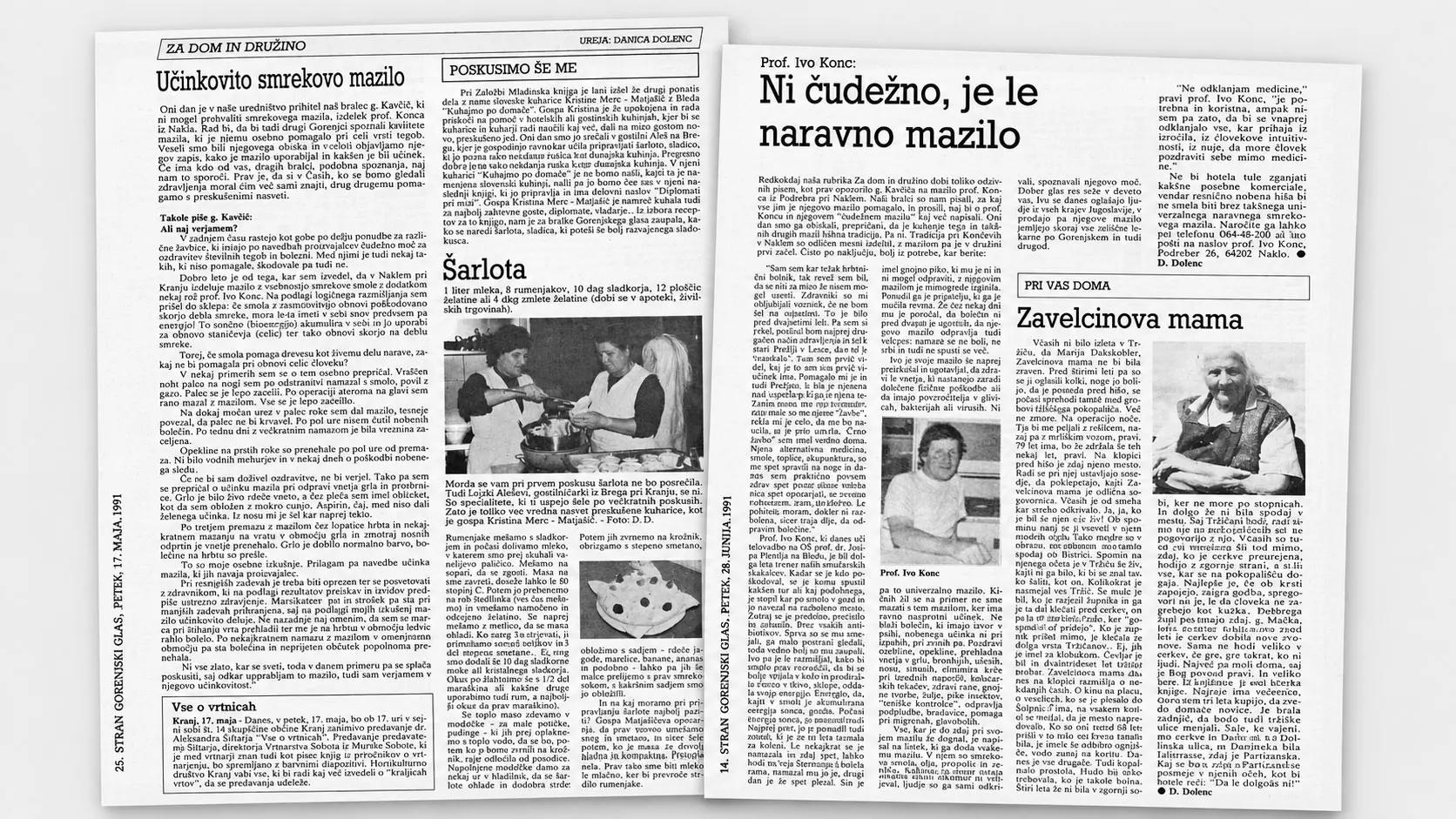
On 17 May 1991, the Slovenian newspaper Gorenjski glas published a reader’s letter by Mr Kavčič in its Za dom in družino (Home and Family) section. Under the heading “Should I Believe It?”, he recounted his personal experiences with a spruce resin ointment made at the time by Ivo Konc from Naklo.
Readers’ reactions prompted journalist Danica Dolenc to visit Ivo Konc. Her article “Not a Miracle, Just a Natural Ointment” appeared on 28 June 1991. Both historical pieces are reproduced below in chronological order.
A note on these historical sources: The 1991 articles contain personal accounts, contemporary explanations of resin, health-related claims and a description of the ointment as it was made at the time. They are published as archival documents, not as current instructions, proof of efficacy or descriptions of today’s Smrekovit products. Line-end hyphenation has been removed without changing the substance of the statements.
Reader's letter: “Effective Spruce Resin Ointment” (17 May 1991)
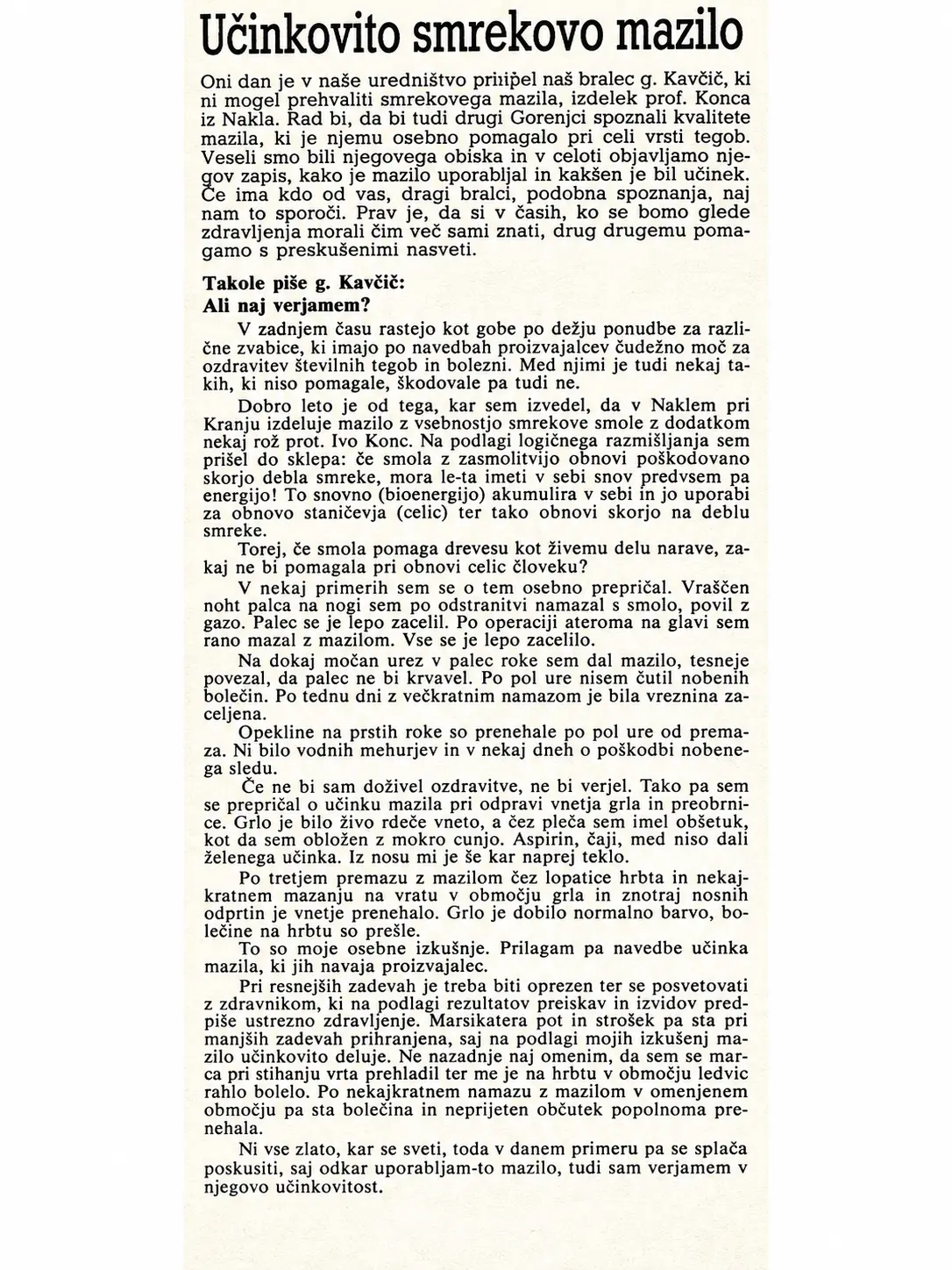
Published in Gorenjski glas on 17 May 1991, p. 25. The original is also available as a PDF.
Gorenjski glas, Friday, 17 May 1991, p. 25, “Home and Family” section.
View the original newspaper page (PDF)
The other day, a reader of ours, Mr Kavčič, hurried into the editorial office, full of praise for the spruce resin ointment made by Professor Konc from Naklo. He wanted other people in the Gorenjska region to learn about an ointment that, in his own experience, had helped him with a wide range of complaints. We were pleased by his visit and are publishing his account in full, describing how he used the ointment and what he experienced. If any of our dear readers have had similar experiences, please let us know. At a time when we may have to find more ways to look after our own health, it is right that we help one another by sharing tried-and-tested advice.
Mr Kavčič writes:
Should I believe it?
These days, offers for all sorts of little remedies promising miraculous cures for numerous ailments and illnesses are springing up like mushrooms after rain. Some have done no good, although they have not done any harm either.
Just over a year ago I learned that Professor Ivo Konc in Naklo near Kranj was making an ointment containing spruce resin with the addition of certain plants. I reasoned that, if resin seals and restores damage to the bark of a spruce tree, it must contain some substance and, above all, energy. It stores the sun’s energy (bioenergy) and uses it to renew tissue (cells), thereby restoring the tree’s bark.
So, if resin helps a tree as a living part of nature, why should it not help renew human cells?
I became personally convinced of this in several instances. After an ingrown toenail on my big toe had been removed, I applied the resin and covered the area with gauze. The toe healed nicely. After an operation to remove an atheroma from my head, I applied the ointment to the wound. That too healed well.
I put some ointment on quite a deep cut on my thumb and bandaged it tightly enough to stop the bleeding. After half an hour I could no longer feel any pain. With repeated applications, the cut had healed after a week.
Burns on my fingers stopped hurting half an hour after I applied the ointment. No blisters appeared, and within a few days there was no trace of the injury.
Had I not experienced the recovery myself, I would not have believed it. I also became convinced of the ointment’s effect when I had an inflamed throat and pleurisy. My throat was bright red and inflamed, and across my back I felt as though I were wrapped in a wet cloth. Aspirin, teas and honey did not bring the desired relief. My nose kept running.
After applying the ointment for a third time across my shoulder blades and several times to my neck around my throat and inside my nostrils, the inflammation subsided. My throat returned to its normal colour and the pain in my back went away.
These are my personal experiences. I am also enclosing the claims about the ointment’s effects provided by its maker.
With more serious conditions, one must be careful and consult a doctor, who can prescribe appropriate treatment based on examinations and test results. In minor cases, however, some journeys and expenses may be avoided because, in my experience, the ointment works effectively. I should also mention that, while digging over my garden in March, I caught a chill and felt a slight pain in the back around my kidneys. After applying the ointment there several times, both the pain and the discomfort disappeared completely.
All that glitters is not gold, but in this case it is worth a try. Since I began using this ointment, I too have come to believe in its effectiveness.
Interview with Ivo Konc: “It's not a miracle, just a natural ointment” (28 June 1991)
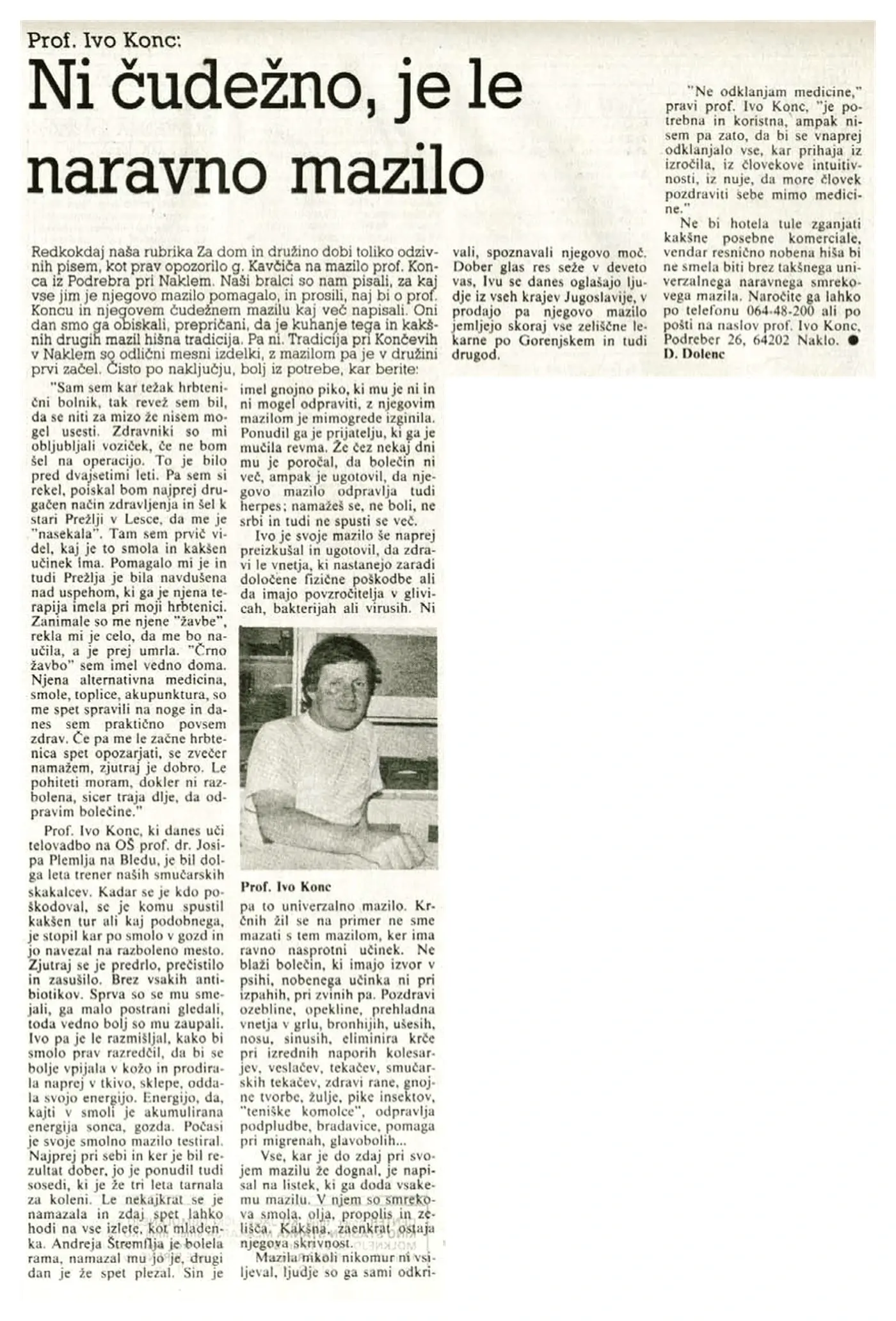
Interview with Ivo Konc in Gorenjski glas, 28 June 1991, p. 14; by D. Dolenc.
Gorenjski glas, Friday, 28 June 1991, p. 14. Author: D. Dolenc.
View the original newspaper page (PDF)
Our Home and Family section rarely receives as many letters as it did following Mr Kavčič’s account of Professor Konc’s ointment from Podreber near Naklo. Readers told us about the problems for which they believed the ointment had helped them and asked us to write more about Professor Konc and his “miraculous” ointment. We visited him, assuming that making this and other ointments was a long-standing family tradition. It was not. The Konc family in Naklo was traditionally known for its excellent meat products; Ivo was the first in the family to begin making an ointment. It happened quite by chance, or rather out of necessity. Read on:
“I have suffered severely from spinal problems. I was in such a state that I could not even sit down at the table. Doctors told me I would end up in a wheelchair unless I had an operation. That was twenty years ago. I decided to look for a different approach first and went to an elderly woman known as Prežlja in Lesce, who treated me by her traditional method. That was where I first saw what resin was and what effect it could have. It helped me, and Prežlja herself was delighted by the result of her treatment on my back. I was interested in her remedies; she even said she would teach me, but she died before she could. I always kept her ‘black ointment’ at home. Her alternative treatments, resin, thermal baths and acupuncture, got me back on my feet, and today I am practically well. If my back starts troubling me again, I apply the ointment in the evening and feel better in the morning. I must do it early, before the pain becomes severe, otherwise it takes longer to settle.”
Professor Ivo Konc, who at the time taught physical education at the Josip Plemelj primary school in Bled, had coached Slovenian ski jumpers for many years. When someone was injured, developed a boil or had a similar problem, he would go into the forest for resin and apply it to the affected area. By morning, he said, it would open, clear and dry up, without antibiotics. At first people laughed at him and looked at him askance, but gradually they came to trust him. Ivo wondered how to dilute resin so that it would absorb into the skin better, penetrate the tissues and joints, and release its energy. Energy, yes: he believed the resin stored the energy of the sun and forest. He gradually tried out his resin ointment, first on himself. Encouraged by the result, he offered it to a neighbour who had complained about her knees for three years. After a few applications, she said she could once again go on outings like a young woman. Climber Andrej Štremfelj had a painful shoulder; Ivo applied the ointment and the next day he was climbing again. His son had a persistent suppurating spot which, according to the article, soon disappeared. A friend with rheumatism reported that the pain had gone after a few days and also claimed that the ointment helped with herpes: applied early, he said, the area did not hurt or itch and no outbreak followed.
Ivo continued testing his ointment and concluded that it treated only inflammations arising from particular physical injuries or caused by fungi, bacteria or viruses. It was not, however, a universal ointment. Varicose veins, for example, should not be treated with this ointment, because it has the opposite effect. It does not relieve pain of psychological origin, nor does it help with dislocations, although it does with sprains. It heals frostbite, burns, cold-related inflammations of the throat, bronchi, ears, nose and sinuses; eliminates cramps during intense exertion among cyclists, rowers, runners and cross-country skiers; heals wounds, suppurating lesions, blisters, insect bites and tennis elbow; removes bruises and warts; and helps with migraines and headaches.
Everything he had learned about his ointment so far was written on a leaflet included with each jar. According to the report, the ointment at the time contained spruce resin, oils, propolis and herbs. Which particular herbs remained his secret.
He never pushed his ointment on anyone; people discovered it themselves and shared their experiences. Word travelled far. People from across Yugoslavia were contacting Ivo, and almost all herbal pharmacies in the Gorenjska region, as well as elsewhere, had begun selling his ointment.
“I do not reject medicine,” Professor Ivo Konc said. “It is necessary and beneficial, but I do not think we should automatically reject everything that comes from tradition, human intuition or the need to find ways to help ourselves outside conventional medicine.”
I would not want to turn this into a commercial, but I truly believe no home should be without such a universal natural spruce resin ointment. It can be ordered by calling 064-48-200 or by writing to Professor Ivo Konc, Podreber 26, 64202 Naklo.
D. Dolenc
What do these two articles tell us about the origins of Smrekovit?
Together, these newspaper articles show that Ivo Konc’s ointment was already being discussed publicly in 1991. The May piece is a reader’s personal testimony; the June article is a journalist’s profile of Ivo Konc, the beginnings of his work and how resin was understood at the time.
For the later milestones in the family’s history, visit our About Us page. You can also read the 2024 interview about Ivo Konc’s life and work.