At the beginning of October , the Forestry Institute held an educational seminar on non-timber forest products entitled Something Healthy, Sweet and Edible from the Forest. We were invited to conduct a workshop on conifer resin as one of these valuable resources.

To the coniferous forest for resin for indoor use
The seminar participants learned that spruce resin , as well as resin from other coniferous trees, had already been used in the Stone Age. In 2007, Finnish archaeology students discovered a piece of the oldest known chewing gum , made of spruce resin, in a coniferous forest near Helsinki. The find dates back 5000 years before Christ. “It looked like a dirty piece of modern chewing gum,” said Sarah Pickin, one of the discoverers, at the time. Professor Trevor Brown of the University of Derby added that people in the Stone Age relieved sore throats and inflamed gums by chewing resin from the trees of the coniferous forest.
Stone Age people used the trees of the coniferous forest to relieve sore throats and inflamed gums," noted Prof Trevor Brown of the University of Derby.
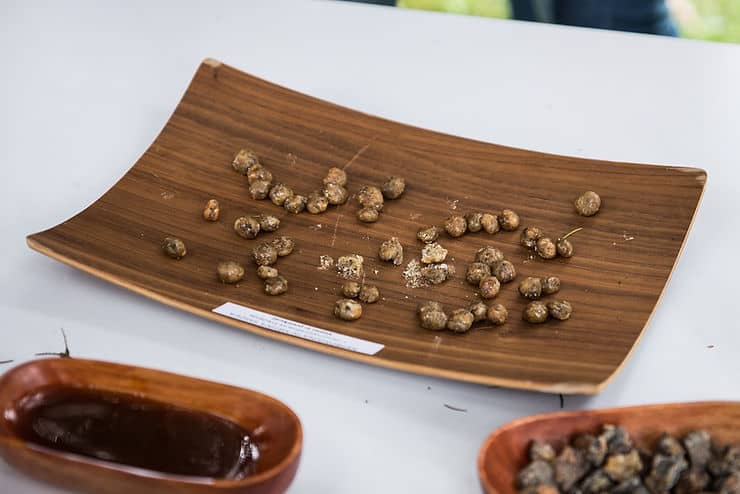
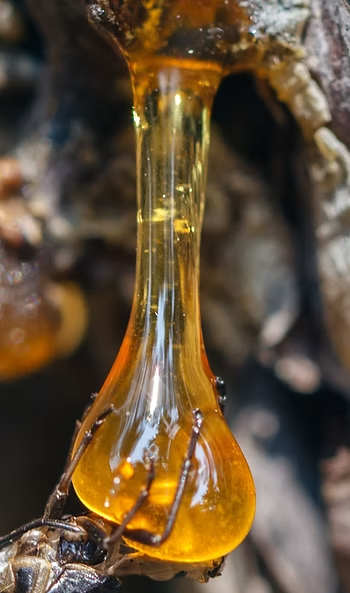
Our workshop took place in a small coniferous forest, where I showed the participants on a nearby spruce tree exactly the kind of resinthat must be found if you want to treat sore throats, inflamed gums or mouth ulcers by chewing resin in nature, just as the ancient Nordic peoples once did—when you don’t have a Smrekovit oral spray at hand. The participants also had the chance to try chewing the resin themselves. When you enter a coniferous forest, you need to select the right type of spruce resinfor chewing. Spruce and pine trees provide resin in three forms : translucent and liquid, translucent and hardened, and opaque and partially hardened.
Chewing the resin
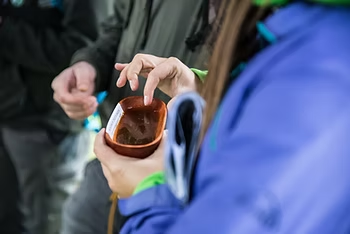
The likelihood of developing a heel spur increases with translucent and liquid resin , it will glue your teeth together. This can be useful if you want to pull out a tooth or remove a crown. If you take translucent and solidified resin , it will crumble in your mouth and cannot be chewed. The correct choice is opaque and partially hardened resin. When you put it in your mouth, you should not chew it right away, but gently nibble it with your incisors until it reacts with saliva and gradually becomes like chewing gum. Once it does, you can chew it for a very long time. Some bits may stick to your teeth, but that is not a problem. In this way, in addition to soothing sore throats and other oral problems, you can also successfully treat irritation of the stomach and intestinal lining that causes Abdominal pain, especially when you don’t have Smrekovit capsules at hand.
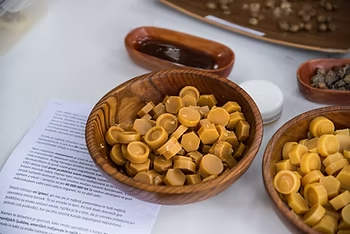
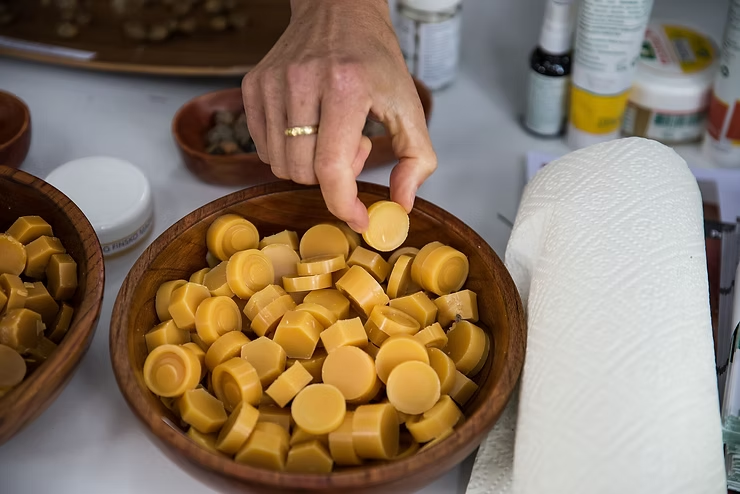
The coniferous forest provided chewing gum not only to the ancient Nordic peoples, as the workshop participants learned, but also to the Native Americans. They too chewed resin, and European immigrants adopted the habit from them. In 1848, John B. Curtis, inspired by their example, made the first commercial chewing gum from spruce resin and beeswax. For the workshop, I prepared chewing gum in the same way, but without added flavors, so that participants could taste the forest in all its bitterness. Because of the cold temperatures during the seminar, the gum was quite hard andhad to be warmed in the mouth and chewed slowly before it became like real chewing gum.
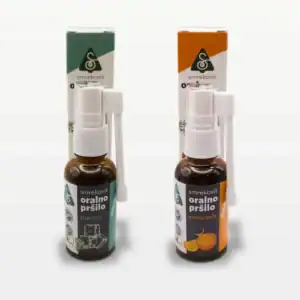
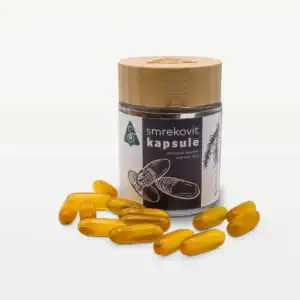
I then briefly presented Spruce products for internal use, which of course taste much better than the chewing gum they tested, These are Sprukovit oral spray, used in sore throats, gingivitis and mouth ulcers. The effect is very fast. One to two days, even for aphthae that otherwise last for weeks. Smrekovit capsules and are used for virtually all stomach and intestinal problems: gastritis, gastric and duodenal wounds, helicobacter pylori infection, irritable bowel syndrome, chronic inflammatory bowel disease and on and on. The effect is also within a few days, or a few weeks for wounds and helicobacter pylori infections.
-

Smrekovit oral spray
10,00 € -
Smrekovit Capsules 50+ (food supplement)
10,00 €
To coniferous forests for resin for outdoor use
Native Americans used resin not only for chewing, but also for treating wounds and joint diseases. For this purpose, the most useful in nature is the transparent and fluid form of resin , which is easiest to find on pine. Folk medicine in Slovenia also knows the use of raw resin. For example, Mrs. Prežla from Radovljica treated a wide variety of conditions—wounds, joint and back pain—by lightly cutting the skin with a knife and applying a poultice of black resin to keep it warm. This method was extremely effective, and it was through her that my father first became acquainted with the remarkable healing power of resin.
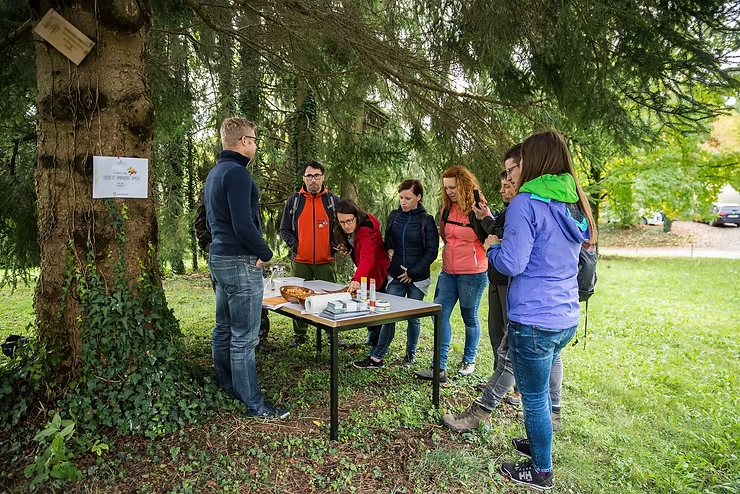
In the Nordic countries, people traditionally made an ointment from butter and spruce resin, which gave the resin new usefulness, as the butter made it spreadable and non-sticky. For our workshop, we prepared such a traditional Finnish ointment. We heated the butter and resin in a beaker over an alcohol burner—though the wind gave us some trouble—and poured the mixture into a small container. This produced a much more practical remedy for wounds and injuries in nature than sticky liquid resin, especially when you don’t have Smrekovit Klasik or Smrekovit 365 at hand. To collect translucent resin lumps like the ones we used, you have to go into a coniferous forest, to pine or spruce trees. This traditional Finnish spruce ointment also formed the basis of research by Finnish scientist Siponen and his colleagues(link to this research series), who since 2007 have conducted a series of studies on its wound-healing effects. Their results proved incomparably more successful
than conventional medical approaches. Our examples also confirm the results of these studies.
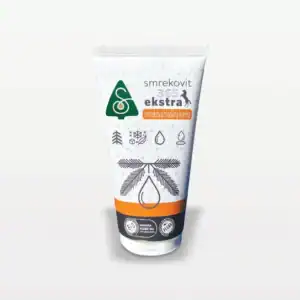
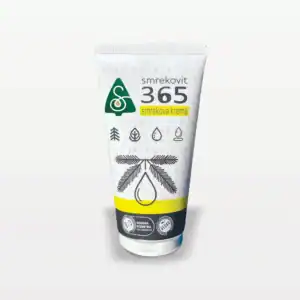
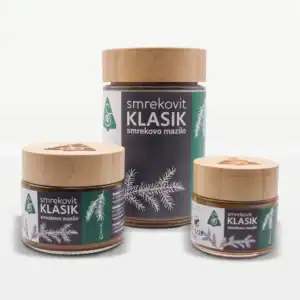
Smrekovit was initially developed for external use and for wound treatment. Smrekovit Klasik spruce resin ointment , the first spruce ointment on the market in this part of Europe , was developed by my father in 1990because of his own back problems. Later came Smrekovit Extra, a spruce ointment with a cooling effect, and finally the spruce creams Smrekovit 365 and Smrekovit 365 Extra. For practically all problems requiring external use, we recommend the latter 365 creams (sciatica, arthrosis, nail fungus, skin fungus, and more). We recommend Smrekovit Klasik spruce ointment specifically for wounds and whenever internal use is required.
-
Smrekovit 365 Ekstra – spruce cream with a cooling effect
14,00 € -
Smrekovit 365 spruce resin cream
14,00 € -
Smrekovit Klasik spruce resin ointment
Price range: 6,00 € through 35,00 €
Conifer resin
I told the workshop participants that spruce resin is the most healing natural substance I have ever encountered in my life. It is made up of more than 80 different organic compounds, and its effect is most likely due to the synergism of several substances present in the resin.
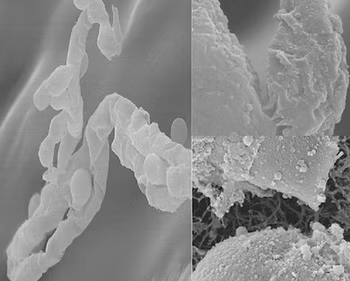
Its precise mechanism is only known in its fungicidal action, where scientists have observed its effects on fungal hyphae under an electron microscope. In addition to its extremely strong antimicrobial activity—effective against all dermatophytes and all gram-negative bacteria, including MRSA and VRE, as shown by the Finnish researchers mentioned above—it also acts against virtually all inflammations, probably by influencing the local immune response, although this mechanism has not yet been fully investigated. These properties also explain why resin is such a powerful natural preservative. As a curiosity, I mentioned the case of a mosquito trapped in resin—amber—in which, even after 40 million years , whole cell organelles were still preserved and visible under a microscope.
The seminar was very interesting. During the breaks when it was not our turn to teach, I had the opportunity to learn a lot about mushrooms and truffles, acorn coffee and the antioxidant in white fir extract.