
What helps with sciatica?
With sciatica, the main goal is to reduce irritation of the nerve and maintain as much normal movement as possible. Complete rest is generally not recommended; most people benefit more from gradually returning to everyday activities and moving within a range that does not significantly worsen the symptoms.
Key points at a glance
- Stay moderately active. Short walks and frequent changes of position are generally better than prolonged lying down or sitting.
- Adjust activities to your symptoms. Temporarily reduce movements and positions that clearly increase pain down the leg.
- Heat or cooling may help with comfort. Choose whichever feels better to you; there is no universal rule of “heat or cold”.
- Medicines are not equally effective for all forms of sciatica. It is sensible to discuss suitable pain relief with a doctor or pharmacist, especially if symptoms are severe or long-lasting.
- Exercises are not the same for everyone. Gentle, individually adapted exercises are sensible, provided they do not increase pain down the leg.
Most cases gradually improve without surgery, although symptoms can last for several weeks. More important than speed is the overall trend: pain and function should improve over time rather than steadily worsen.
If marked or progressive leg weakness, numbness around the perineal area, or problems with passing urine or stool occur, urgent medical assessment is needed.
Table of contents
How to recognize sciatica?
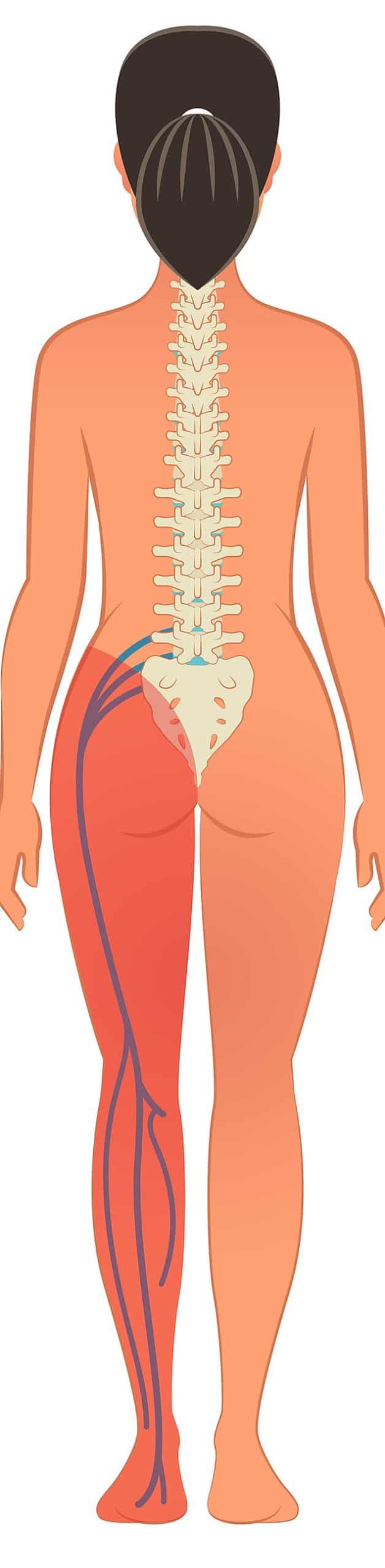
Sciatica is a term for pain and other nerve-related symptoms caused by irritation or pressure on a nerve root in the lower part of the spine. A typical feature is that the symptoms spread from the buttock or lower back down the leg.
Lower back pain may be present, but it is not necessarily the most pronounced symptom. With true sciatica, pain in the leg can even be stronger than pain in the back.
Typical symptoms of sciatica
- pain in the buttock that spreads down the leg,
- sharp, burning or electric shock-like pain,
- tingling or pins and needles in the leg or foot,
- numbness in part of the leg or foot,
- in some cases, a feeling of weakness in the leg.
Symptoms are most often more pronounced on one side. The path of the pain depends on which nerve root is affected, so it does not spread in exactly the same way in everyone.
How do people usually describe sciatica?
Descriptions such as “it pulls down my leg”, “it burns”, “it feels like electricity” or “the tingling goes all the way to my foot” are quite typical of sciatica. The pain may change when sitting, standing up, bending, coughing or sneezing.
Is every pain down the leg sciatica?
No. Pain from the lower back or buttock can also spread into the leg without irritation of a nerve root. With so-called referred pain, the pain is often more diffuse and typical nerve-related symptoms such as tingling, numbness or muscle weakness are generally absent.
Pain in the buttock, hip or thigh therefore does not necessarily mean sciatica. Similar symptoms can also be caused by muscles, joints and other tissues around the spine and hip.
Does the lower back also have to hurt with sciatica?
Not necessarily. Some people have pronounced lower back pain, while in others pain down the leg is the dominant symptom. Sciatica is characterised more by the direction in which the pain spreads and by the presence of nerve-related symptoms than by the intensity of lower back pain itself.
If progressive leg weakness, symptoms in both legs, loss of sensation around the perineal area or changes in bladder or bowel function occur, this is no longer a situation for ordinary self-care and urgent medical assessment is required.

What causes sciatica?
Sciatica is caused by irritation or pressure on one of the nerve roots in the lumbar or sacral part of the spine. The most common cause is a herniated intervertebral disc, although similar symptoms can also be caused by other changes that reduce the space available for the nerves.
Most common cause: a herniated disc
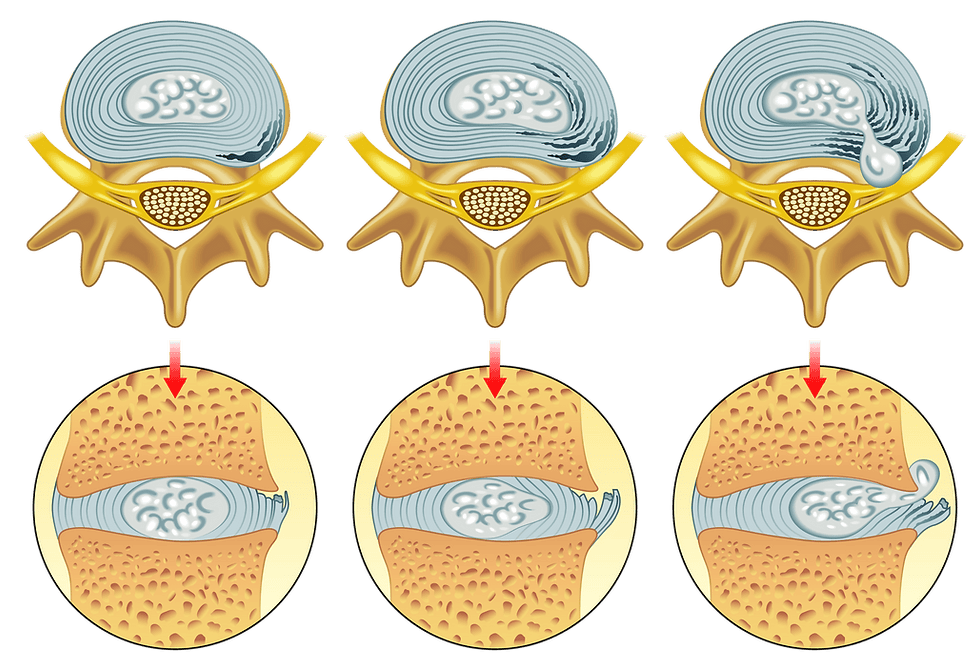
Intervertebral discs act as flexible cushions between the vertebrae. If part of a disc bulges or is pushed outward, it can come into contact with a nearby nerve root. Mechanical pressure is not the only factor involved – inflammatory processes around the affected disc can further irritate the nerve root.
A herniated disc is the most common single cause of sciatica. This does not mean, however, that every herniated disc causes pain. Changes in the intervertebral discs are also common in people without symptoms, so it is important that imaging findings correspond with the actual pattern of pain and neurological signs.
Narrowing of the space for the nerves
With spinal stenosis or narrowing of the openings through which the nerves leave the spine, there is less space for the nerve root. Such changes become more common with age and may be associated with wear of the intervertebral discs, joints and other degenerative changes in the spine.
Vertebral slippage
Sciatica can also occur with spondylolisthesis, when one vertebra shifts relative to the adjacent vertebra and thereby reduces the space available for the nerve root.
Less common causes
More rarely, radicular symptoms may be caused by injury, infection, inflammatory disease or a mass in the spinal region. This is why it is important to pay attention to an unusual course, general malaise, fever, unexplained weight loss or rapidly progressing neurological symptoms.
What about the piriformis muscle and a “pinched nerve in the buttock”?
Pain in the buttock and down the leg is not always caused by a nerve root in the spine. More rarely, the sciatic nerve can also be irritated outside the spine, for example in the deep buttock region. Such problems can mimic sciatica, but they are not the same as typical lumbosacral radicular pain.
The location of the pain alone therefore does not reliably indicate where its cause lies. The pattern of pain, any tingling or numbness, muscle strength and the clinical examination are important.
How is sciatica treated?
Treatment of sciatica depends on the cause, the severity of the symptoms and how long they have been present. For most people, treatment begins with a non-surgical approach: adapting activities, gradually staying active and, if needed, using medication to manage pain. Surgery is required only in a smaller proportion of patients.
Movement and physiotherapy
Prolonged bed rest is generally not recommended for sciatica. It is more sensible to remain as active as possible, change position frequently and gradually return to normal activities.
If symptoms persist or limit movement, physiotherapy with individually adapted exercises may help. No single exercise is suitable for all forms of sciatica, so what matters most is how the symptoms respond during movement.
Which medicines are used for sciatica?
For more severe pain, medicines may be used to relieve symptoms, but their effectiveness in sciatica is not equally well established across all drug groups. For non-steroidal anti-inflammatory drugs, which include some commonly used painkillers, evidence of benefit in sciatica is limited, and possible side effects also need to be taken into account.
For this reason, especially with more severe or long-lasting symptoms, it is sensible to discuss the choice of medication with a doctor or pharmacist. This is particularly important in people with stomach, kidney or heart disease, those taking other medicines, or older adults.
Which medicines are not routinely recommended?
Current guidelines for the treatment of sciatica do not recommend the routine use of gabapentinoids and other antiepileptic medicines, oral corticosteroids or benzodiazepines, because there is insufficient evidence of benefit and there are potential risks. Opioids are also not recommended for the treatment of chronic sciatica.
When may an epidural injection be considered?
In acute and very severe sciatica, a specialist may in some cases consider an epidural injection of a local anaesthetic and corticosteroid. This is not a usual first-line measure for milder symptoms, but an option for more severe symptoms when specialist treatment is required.
When is surgery needed?
Surgery is not needed in most people. Surgical decompression of the nerve root may be considered when non-surgical treatment does not improve pain or function and imaging shows a change that corresponds with the symptoms.
With rapidly progressing muscle weakness or signs of serious nerve compression, more urgent specialist assessment may be required.
Is an MRI always needed for sciatica?
No. Imaging of the spine is generally not needed immediately in a typical course of sciatica. MRI is more appropriate when the result would influence further treatment, for example before a specialist procedure or when there is suspicion of a more serious cause of the symptoms.
Smrekovit for sciatica – practical instructions for use
Among Smrekovit users who contact us because of pain spreading from the buttock or lower back down the leg, we do not focus local application only on the area where the pain is strongest. If the pattern of symptoms suggests an origin in the spine, we always include the spine in our practical method of use.
This is one of the most common differences between our practical approach and spontaneous use: the person feels pain in the leg and therefore applies the product only to the leg. Based on our many years of experience, with this type of pattern it is more important to also include the area from which the symptoms may originate.
Where should it be applied?
For symptoms that extend down the leg, our practical instructions recommend application over a broader area of the spine – from the upper part of the buttocks or the beginning of the gluteal cleft upward along the back. We do not try to identify an individual vertebra or a single precise point.
If the pain spreads markedly through the buttock and leg, the product may also be applied to these areas as needed, but we do not leave out the spine simply because the pain is stronger in the leg.
365 Prima and the Kontakt compress
Our basic practical approach for this type of problem is Smrekovit 365 Prima together with the Smrekovit Kontakt compress. The entire 17 × 24 cm compress is placed lengthwise along the spine, with its longer side parallel to the spine.
For the first application, use enough cream to thoroughly saturate the cotton part of the compress. For subsequent applications, less is usually needed because the compress is already saturated.

Ointment or cream for sciatica?
Users often search for an “ointment for sciatica”. With Smrekovit, Smrekovit Klasik can also be used, but because of its greasier and more persistent base it is less practical for application over a larger area of the back. For this type of use, we therefore generally prefer 365 Prima cream.
If the user does not want to use the Kontakt compress, one practical option is also Smrekovit 365 Ekstra, which is used on its own and applied several times a day. Because it contains menthol and camphor, it gives a cooling sensation on application.
Most common mistake: applying only to the leg
If the pain travels through the buttock, thigh or calf, it is understandable that the user applies the product mainly there. In our practice, however, this is one of the most common mistakes with problems that we suspect originate in the lumbar spine.
For local use, we therefore take a broader approach: the spinal area is the main area of application, while painful areas along the leg can be included additionally.
This section describes our practical method of using Smrekovit products and is based on many years of experience in advising users. It does not replace diagnosis or treatment of the underlying cause of sciatica.
How long does sciatica last?
The duration of sciatica varies considerably and depends mainly on the cause and the degree of nerve root irritation. In many people, the condition begins to improve gradually within a few weeks, although pain, tingling or numbness may persist longer in some cases.
As a rough guide, sciatica often begins to settle within about 4–6 weeks. This is not a deadline by which the problem must necessarily disappear, as recovery from more pronounced symptoms can take several months.
The trend matters more than the number of days
When monitoring sciatica, it is not realistic to expect the pain to be less every single day. Symptoms can fluctuate depending on activity, sitting, movement and body position. What matters more is that, over a longer period, both the pain and the ability to move or carry out everyday activities are improving.
Why can tingling or numbness last longer?
Nerve tissue can take longer to settle after irritation than the pain itself. It is therefore possible for the pain to be significantly reduced while tingling or altered sensation in part of the leg persists for some time.
If sensation or muscle strength is gradually improving, this is a different situation from symptoms that are spreading or becoming more severe.
What if sciatica lasts for more than a few weeks?
If there is no clear improvement after several weeks or the pain is still significantly limiting everyday activities, professional assessment is advisable. Depending on the clinical picture, physiotherapy, adjustment of treatment or further diagnostic testing may then be considered.
If new or progressive muscle weakness, symptoms in both legs, loss of sensation around the perineal area, or problems with bladder or bowel function occur at any time, it is not sensible to wait for the usual course of recovery and urgent medical assessment is required.
Movement, exercises, and heat or cooling for sciatica
With sciatica, complete rest is generally not the best choice. Although movement can be uncomfortable in the acute phase, it is usually sensible to maintain as much everyday activity as the symptoms allow and to avoid prolonged lying down or sitting in particular.
Is walking recommended for sciatica?
Short walks are a suitable way for many people to stay active. It is better to walk a shorter distance several times than to persist with a long walk after which the pain down the leg clearly increases.
The aim is not to “push through the pain”, but to find an amount of movement that you can tolerate without a marked and lasting worsening of symptoms.
What about sitting?
Staying in the same position for a long time can worsen symptoms. If you have to sit a lot, it makes sense to change position frequently, stand up occasionally and walk around. There is no single perfect position for everyone with sciatica – changing positions often is more useful.
Which exercises help with sciatica?
There is no single exercise that is suitable for every case of sciatica. The choice depends on the cause of the problem, mobility and, above all, on how the symptoms respond to a particular movement. One person may tolerate spinal extension better, while another may respond better to a different type of movement.
For this reason, we do not recommend one universal exercise on this page. To begin with, gentle movement, walking and exercises that do not cause a clear spread or increase of pain down the leg are more appropriate. With longer-lasting or more pronounced symptoms, it is sensible to adapt the exercises together with a physiotherapist.
Heat or cooling for sciatica?
There is no general rule that heat is always better for sciatica or that cooling is always better. Heat may temporarily reduce the feeling of tension and pain and is pleasant for many people. If cooling feels better to you, it can be used for short-term symptom relief.
Both approaches are mainly intended to improve comfort, not to remove the cause of nerve irritation. Do not place hot or cold packs directly on the skin, and take particular care in areas with reduced sensation.
When should you stop an exercise?
Mild discomfort during movement does not by itself mean that you are causing harm. It is different, however, if the pain clearly increases during the exercise, starts to spread farther down the leg, or if new or stronger tingling, numbness or weakness appears. In that case, stop the exercise and adjust the approach.
The goal of movement is not to find a “miracle exercise”, but to gradually maintain function and return to normal activities in a way that your body tolerates well.
When should you see a doctor for sciatica, and when is it urgent?
Most cases of sciatica improve gradually and do not require urgent treatment. It is important, however, to recognise signs where it is not sensible to wait for the usual course or to continue with self-care alone.
When is an examination advisable?
An examination is advisable if the pain is very severe, if it significantly limits walking, sleep or everyday activities, or if there is no clear trend toward improvement after several weeks.
Professional assessment is also recommended if more pronounced numbness develops, weakness in the leg recurs, or if the diagnosis is unclear and it is not certain that the problem really is sciatica.
Progressive leg weakness
If the leg is becoming noticeably weaker, the foot starts to catch or drag, or it becomes increasingly difficult to stand on your toes or heel, more prompt medical assessment is needed. Progressive muscle weakness is a more important warning sign than the intensity of pain alone.
When is urgent help needed?
Rarely, severe pressure on the nerves in the lower spine can cause cauda equina syndrome. This is an emergency in which prompt medical treatment is important.
Seek urgent medical help especially if pain in the lower back or legs is accompanied by:
- new loss or a marked change of sensation around the perineum, genitals or anus,
- new problems with urination, such as being unable to start urinating, urinary retention or loss of bladder control,
- loss of bowel control,
- marked weakness or numbness in both legs.
With these signs, it is not appropriate to wait and see whether the condition improves on its own or to continue only with exercises or local approaches.
Other warning signs
Additional caution is needed if the pain occurs together with fever or general malaise, after a major injury, in someone with a known cancer diagnosis, or if severe pain rapidly worsens without a clear reason.
Such signs do not necessarily mean that a serious condition is present, but they are a reason to consider other possible causes of the pain in addition to ordinary sciatica.
Why does sciatica have a special place in the Smrekovit story?
Back problems and pain spreading down the leg have a special place in the Smrekovit story. It was from Ivo Konc’s personal experience with such problems that the development of the first spruce resin ointment began more than three decades ago.
This history is also why we have been advising users on back problems and pain spreading down the leg for many years. Over time, an individual experience developed into a practical method of use, which we now describe separately from the medical explanation of sciatica.
In the video below, Ivo Konc talks about his experience and the beginnings of Smrekovit.
User experiences with sciatica
Below are individual comments from Smrekovit users who described their experience with sciatica or pain that spread from the lower back or buttock down the leg. These are personal experiences of individual users; the course and outcome may not be the same for others.
I use Smrekovit twice a day to relieve back and hip pain. I make sure I use it before every job - gardening. When my daughter suffered from sciatica, she applied the ointment, and after three days her condition improved and the pain did not return.
Franja Šara, Ptuj
[31] handwritten feedback received on an unknown date, kept in the Smrekovit archive
For my joints, back and legs, I use Smrekovit. I had severe sciatica and applied it three times a day. It helped tremendously.
Ida, Zasip
[97] handwritten feedback received on an unknown date, kept in the Smrekovit archive
I have sciatica for more than twenty years in the left leg and lower spine. Surgery is not possible. Weather changes are very painful. Then I massage all the parts with Smrekovit and wrap them warmly and the pain subsides. I am happy with the products because they ease my pain.
Silvana, Branik
[102] handwritten feedback received on 7.5.2018, stored in the Smrekovit archive
I've had sciatica in my right leg for three weeks. It hurts so much that I cannot describe it. I have also started to rub my foot and I have to say that it helps a lot. At least I can walk normally now. The pain in my leg has subsided so that I can sleep.
Ana, Dolenjske toplice
[106] handwritten feedback received on an unknown date, kept in the Smrekovit archive
You can find more user experiences here →
Frequently asked questions about sciatica
What is sciatica?
Sciatica is a term for pain and other nerve-related symptoms caused by irritation or pressure on a nerve root in the lower part of the spine. The symptoms typically spread through the buttock and down the leg and may be accompanied by tingling, numbness or weakness. More is explained in the section How to recognise sciatica?.
Is sciatica the same as nerve inflammation?
The term “nerve inflammation” is often used in everyday language for sciatica, but it is not entirely precise. With sciatica, the nerve root may be mechanically compressed and at the same time chemically or inflammatory irritated, for example because of a herniated intervertebral disc. Sciatica is therefore not necessarily simply a classic “inflammation of the nerve”.
What helps with sciatica?
For most people, it is important to remain moderately active, change positions frequently and gradually return to normal activities. Pain-relieving medicines may be used when needed, while physiotherapy and individually adapted exercises may also be helpful for longer-lasting symptoms. Treatment also depends on the cause. More is explained in the section How is sciatica treated?.
How long does sciatica last?
In many people, sciatica begins to improve gradually within a few weeks. A common rough guide is about 4–6 weeks, although recovery may take several months in some cases. More important than the exact number of days is the long-term trend toward improvement. More is explained in the section How long does sciatica last?.
Is walking recommended for sciatica?
Short walks are a suitable way for many people to stay active. It is better to start with shorter distances and monitor how the symptoms respond than to persist with a long walk after which the pain becomes markedly and persistently worse. Prolonged bed rest is generally not recommended.
Is heat or cooling better for sciatica?
There is no universal rule. Heat is pleasant for many people and may temporarily reduce the feeling of tension and pain, while some people prefer cooling. Both are mainly forms of symptomatic relief, not ways of removing the cause of sciatica. More is explained in the section Movement, exercises, and heat or cooling for sciatica.
Is there one best exercise for sciatica?
No. Sciatica has different causes and people do not all respond to individual movements in the same way. An exercise that suits one person may worsen symptoms in another. It is therefore more important to choose movements that do not increase pain down the leg and, with more severe or long-lasting symptoms, to adapt exercises together with a physiotherapist.
Which ointment or cream should be used for sciatica?
An ointment or cream cannot remove a herniated disc or another mechanical cause of nerve root irritation. With local use of Smrekovit for this type of symptom pattern, we do not focus only on the painful leg, but also include the lower back or spinal area. We most commonly use Smrekovit 365 Prima, either on its own or together with the Kontakt compress. More about our practical approach is explained in the section Smrekovit for sciatica – practical approach.
Can sciatica go away on its own?
Yes. Many cases of sciatica improve gradually without surgery. This does not mean, however, that every case should simply be left to resolve on its own. If symptoms persist, significantly limit everyday activities or become worse, professional assessment is advisable.
When should you see a doctor for sciatica?
An examination is advisable for severe or long-lasting pain, marked numbness or weakness, and when there is no clear improvement after several weeks. Urgent medical help is needed, however, with new numbness around the perineal area, new problems with urination or bowel function, and marked or progressive weakness, especially if both legs are affected. More is explained in the section When should you see a doctor for sciatica, and when is it urgent?.