

Stomach pain in brief
- Stomach pain is most often felt in the upper abdomen or the area below the breastbone, although pain in this region does not always originate from the stomach.
- Common accompanying symptoms include burning pain, pressure, fullness, nausea, bloating or feeling full unusually quickly.
- The relationship with food can be important: symptoms may occur after eating, on an empty stomach or at night, which can help when considering possible causes.
- Common causes include irritation or inflammation of the stomach lining, a stomach or duodenal ulcer, Helicobacter pylori infection and functional digestive disorders.
- Medical assessment is particularly important if the pain is sudden or severe, if there is vomiting of blood, black stools, unexplained weight loss, repeated vomiting or pain that persists or becomes worse.
- With milder symptoms, it is useful to observe when the pain occurs, what seems to trigger it and which other symptoms accompany it, as the location of the pain alone is often not enough to determine the cause.
Table of contents
Where is the stomach located and where is pain usually felt?
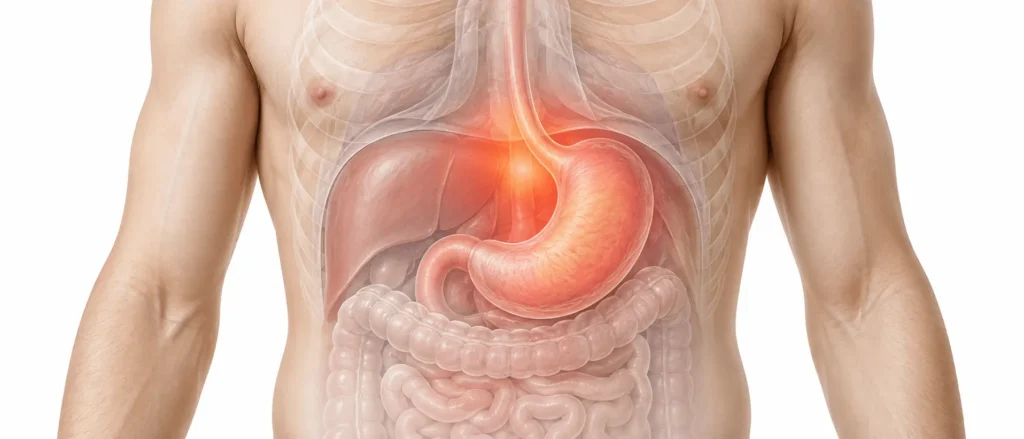
The stomach is located mainly in the upper abdomen, slightly more towards the centre and left side. Problems originating from the stomach are therefore most often felt in the upper central abdomen, below the breastbone, and sometimes slightly further to the left.
The pain may be burning, dull, pressing or cramp-like. Some people describe pressure, irritation, an uncomfortable feeling of fullness or nausea. Symptoms may be related to food and can appear after eating, on an empty stomach or at night.
It is important to remember that not every pain in this area necessarily comes from the stomach. Similar symptoms may also arise from the oesophagus, duodenum, gallbladder, pancreas or other organs in the upper abdomen.
That is why it is important to consider not only where the pain is felt, but also when it occurs, how long it lasts, whether it is related to food and which other symptoms accompany it. These details often help to judge whether the stomach is the likely source of the problem.
If the pain is not limited to the stomach area or occurs elsewhere in the abdomen, also read the broader overview of abdominal pain.
What can cause stomach pain?
Pain in the stomach area can have several possible causes. Sometimes the problem is temporary irritation or a functional disorder, while in other cases there may be inflammation or damage to the stomach or duodenal lining. The cause usually cannot be determined reliably from the location and intensity of pain alone.
Inflammation or irritation of the stomach lining
In gastritis, the stomach lining is inflamed or irritated. Symptoms may include burning or dull pain in the upper abdomen, nausea, fullness and feeling full unusually quickly. Gastritis can have different causes, including Helicobacter pylori infection, certain medicines, alcohol and other factors that damage the protective stomach lining.
Stomach or duodenal ulcer
When damage to the lining becomes deeper, a peptic ulcer may develop. Pain is usually felt in the upper abdomen and may be related to meals or an empty stomach. Ulcers are commonly associated with Helicobacter pylori infection or prolonged use of non-steroidal anti-inflammatory drugs.
Helicobacter pylori infection
Helicobacter pylori is a bacterium that can live in the stomach lining for many years. Many infected people have no symptoms, while in others it is associated with chronic gastritis and peptic ulcers. Infection cannot be diagnosed from symptoms alone.
Medicines, alcohol and other irritants
The stomach lining can be irritated particularly by non-steroidal anti-inflammatory drugs such as ibuprofen, naproxen or aspirin. Larger amounts of alcohol and smoking may also worsen symptoms. If pain occurs while medicines are being taken regularly, this is important information to discuss with a doctor or pharmacist.
Functional dyspepsia
Sometimes pain, burning, fullness or early satiety are present even though investigations do not reveal a clear structural disease. These symptoms may be part of a functional gastrointestinal disorder. The symptoms are real and may be influenced by diet, gastrointestinal sensitivity, stomach motility and psychological stress.
Reflux is not exactly the same as stomach pain
In reflux, stomach contents flow back into the oesophagus. The typical symptom is heartburn or a burning sensation behind the breastbone, although discomfort may also be felt in the upper abdomen. This is why people often describe reflux as a “stomach problem”, even though the oesophagus is the main site of irritation.
Because different causes can produce very similar symptoms, it is useful to consider when the pain began, its relationship with food, how long it lasts, medicines being taken and any accompanying symptoms.
Stomach pain after eating, on an empty stomach or at night
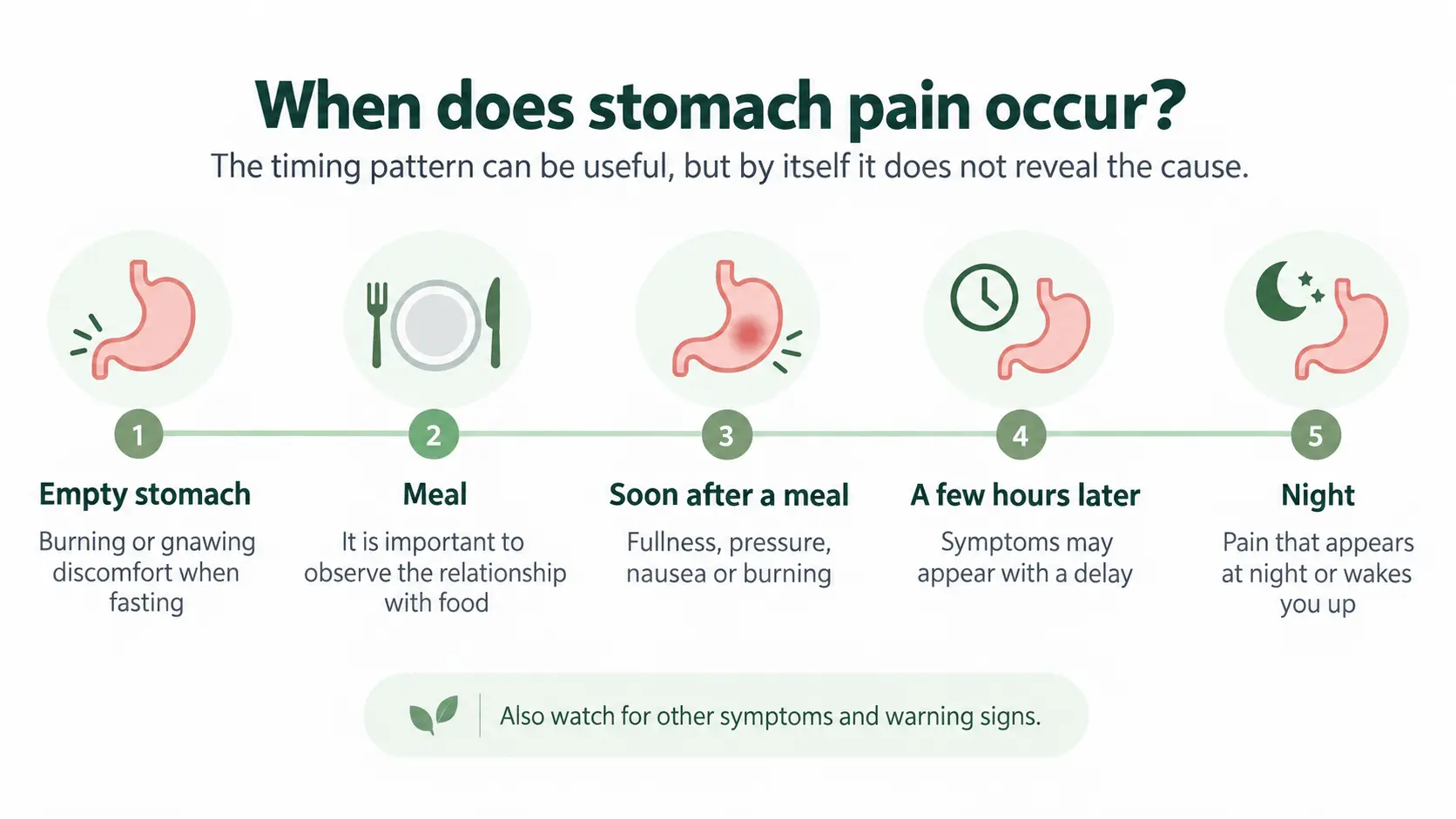
With pain in the upper abdomen, it can be useful to notice when it occurs in relation to meals. The timing alone cannot identify the cause, but together with other symptoms it may provide useful clues.
Stomach pain after eating
If pain, burning, pressure or uncomfortable fullness develops soon after a meal, it may be associated with irritation of the stomach lining, functional dyspepsia or reflux. In some people, symptoms are triggered particularly by large or fatty meals, alcohol, coffee or certain foods.
Pain after eating does not necessarily come from the stomach. If it occurs mainly after fatty meals, is severe, or spreads towards the right upper abdomen or the back, other organs in the upper abdomen may also need to be considered.
Pain on an empty stomach
Some people notice that symptoms become more pronounced when the stomach has been empty for a longer period. They may describe a burning or gnawing pain in the upper central abdomen that temporarily improves or changes after eating. This pattern can occur with several upper gastrointestinal conditions and is not enough on its own to distinguish between gastritis, an ulcer and functional disorders.
Stomach pain at night
Pain that wakes a person during the night is an important detail. It may occur with stomach or duodenal disorders, but also with reflux, particularly when symptoms become worse while lying down.
If night-time pain keeps returning, becomes more severe or is accompanied by weight loss, vomiting, black stools or other warning signs, medical assessment is advisable.
A simple symptom diary can help
With recurring symptoms, it can be useful to record for a few days when meals were eaten, what was eaten, when the pain began, how long it lasted and which other symptoms were present. This pattern is often more informative than simply saying that the stomach hurts.
Burning, pressure and stomach cramps
People describe discomfort in the stomach area in very different ways. Some notice burning or irritation, others mainly pressure, tightness or uncomfortable fullness, while others describe cramps. The type of sensation can provide useful clues, but it cannot reliably identify the cause on its own.
Burning in the stomach area
A burning sensation in the upper central abdomen may occur with irritation or inflammation of the stomach lining, an ulcer or other upper gastrointestinal problems. If the burning rises behind the breastbone or towards the throat, it may be more typical of reflux, where stomach contents move back into the oesophagus.
It is useful to notice whether the burning occurs after eating, on an empty stomach, at night or after certain foods, alcohol or medicines. This relationship is often more informative than the intensity of the sensation alone.
Pressure, tightness and fullness
A feeling that the stomach is heavy, tense or full after only a small amount of food may occur with functional dyspepsia and other conditions involving altered stomach sensation or emptying. It may be accompanied by belching, bloating, nausea or early satiety.
If fullness is persistent, becomes more pronounced or causes a person to eat substantially less than usual, medical assessment is advisable, particularly if it is accompanied by weight loss, repeated vomiting or other warning signs.
Stomach cramps
People often use the term “stomach cramps” for many different types of abdominal pain. Cramp-like sensations can occur with stomach problems, but recurrent cramps spread across a larger part of the abdomen are often not specific to the stomach and may also originate from the intestines.
With cramps, it is therefore especially useful to notice where exactly the pain is located, whether it moves and whether it is accompanied by diarrhoea, constipation, bloating, vomiting or fever. These associated symptoms may point towards a different cause from typical upper abdominal pain.
Regardless of how the discomfort is described, sudden severe pain, rapidly worsening pain, bleeding, black stools, fainting or persistent vomiting require prompt medical assessment.
Pain in the pit of the stomach that radiates to the back
Pain in the upper central abdomen, below the breastbone, that radiates towards the back is not specific to the stomach. This pattern may occur with stomach or duodenal problems, but it can also originate from other organs in the upper abdomen.
When can the stomach or duodenum be the source?
Irritation of the stomach lining or a peptic ulcer usually causes discomfort in the upper central abdomen. In some people, the pain may also extend towards the back. Useful accompanying clues include its relationship with meals, burning, nausea, early satiety and symptoms occurring on an empty stomach or during the night.
Radiation to the back alone is not enough to conclude that an ulcer or another stomach disorder is present.
Other organs can cause a similar pattern
Severe upper abdominal pain that radiates clearly through to the back may also originate from the pancreas. Gallbladder pain is more often felt in the right upper abdomen, but it may spread towards the back or right shoulder blade.
Pain originating in the chest can sometimes also be felt in the upper abdomen. For this reason, new or unusual pain should be considered in the context of the whole symptom pattern rather than only where it feels strongest.
When is urgent medical assessment needed?
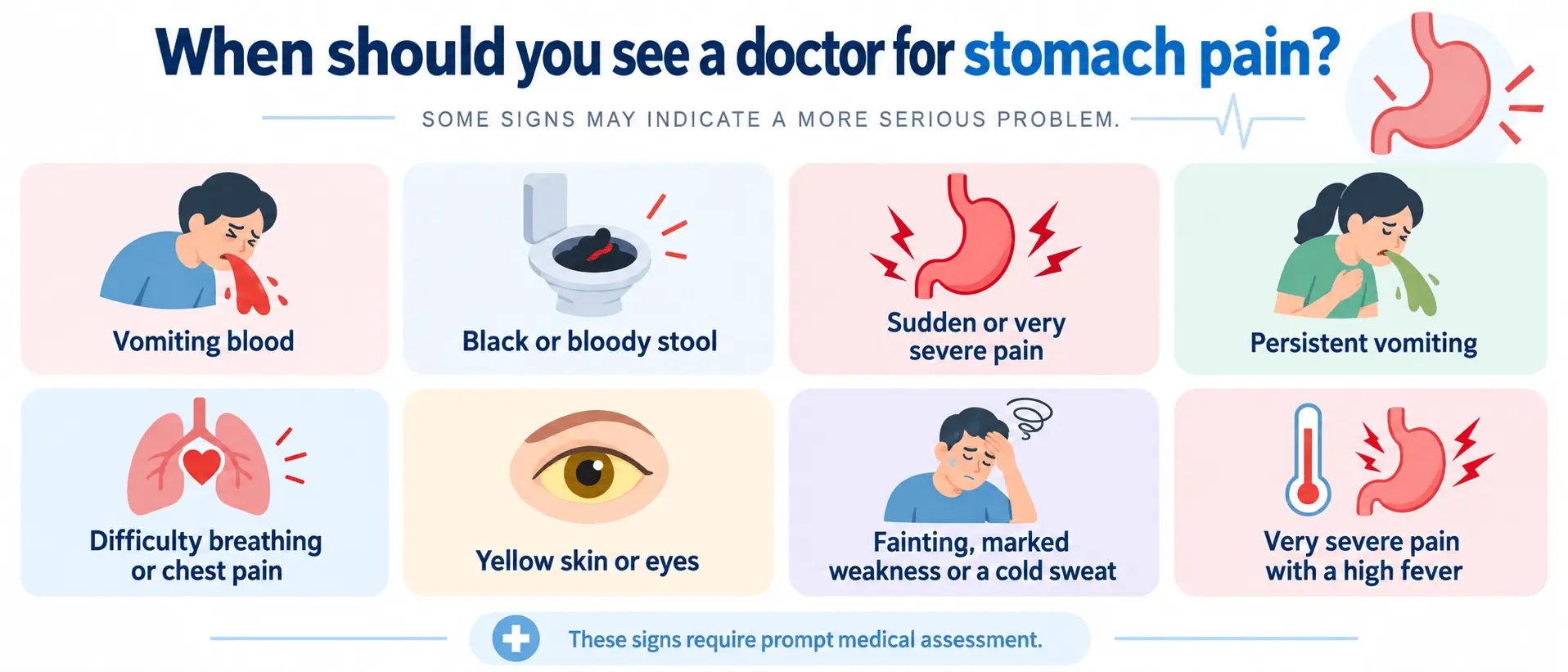
Prompt medical assessment is needed if the pain is sudden, very severe or rapidly worsening, particularly when accompanied by persistent vomiting, fever, marked weakness, fainting, yellowing of the skin or eyes, vomiting blood, black stools, chest pain, difficulty breathing or a cold sweat.
Even if the pain is not severe, medical assessment is advisable when it persists, keeps returning or changes in character.
When is medical assessment needed for stomach pain?
Most short-lived and mild stomach complaints are not emergencies. However, it is important to recognise situations in which pain may indicate bleeding, acute inflammation or another condition requiring prompt medical assessment.
Seek medical help immediately
Urgent medical assessment is particularly important if there is:
- vomiting blood or material resembling coffee grounds,
- black, tarry or bloody stools,
- sudden or very severe pain, especially if it is rapidly worsening,
- a very painful or markedly tender abdomen,
- persistent vomiting with inability to keep fluids down,
- pain accompanied by fainting, marked weakness or a cold sweat,
- difficulty breathing or chest pain,
- yellowing of the skin or whites of the eyes,
- very severe pain accompanied by a high fever.
When should you arrange an assessment even if the pain is not severe?
Medical assessment is also advisable when symptoms are less dramatic but persist, recur frequently or change over time. Important signs include:
- unexplained weight loss,
- persistent loss of appetite or marked early satiety,
- recurrent vomiting or frequent nausea,
- difficulty swallowing,
- recurrent night-time pain that wakes you from sleep,
- symptoms that do not improve despite dietary changes and other basic measures,
- a new pattern of pain that differs from your usual symptoms.
Duration matters, but it is not the only factor
With mild pain, it may be reasonable to observe how symptoms develop for a while, but the number of days alone should not determine whether assessment is needed. The severity of pain, associated symptoms and any change in pattern may be more important than duration alone.
If you are unsure whether the symptoms are still consistent with a minor digestive problem, it is safer to have the cause assessed, particularly when symptoms keep returning or gradually worsen.
What helps with stomach pain?
What makes sense for stomach pain depends mainly on its cause. With recurring symptoms, the aim should not only be to reduce the immediate discomfort, but also to understand what triggers the symptoms, when they occur and whether their pattern is changing.
Start by checking obvious triggers
If symptoms repeatedly occur after certain foods, large or very fatty meals, alcohol or larger amounts of coffee, it can be useful to reduce these triggers for a while and observe whether anything changes. Some people tolerate smaller, more frequent meals better, particularly when fullness, pressure or nausea develop after eating.
Medicines are also important. Non-steroidal anti-inflammatory drugs such as ibuprofen, naproxen and aspirin can irritate the stomach lining and increase the risk of ulcers. If you use them regularly and have stomach symptoms, this is important information to discuss with a doctor or pharmacist.
Daily habits also matter with heartburn and reflux
If symptoms include heartburn or reflux, it is useful to notice whether they become worse after large evening meals, lying down immediately after eating or particular foods. For some people, changing the timing and size of meals can substantially reduce how often symptoms occur.
How we approach the use of Smrekovit Intus
Smrekovit Intus is a food supplement containing spruce resin in softgel capsules. When a user decides to try it, we recommend starting with the actual recommended daily dose: 2 capsules in the morning and 2 capsules in the evening. The recommended daily dose contains 825 mg of spruce resin.
Based on our practical experience, there is no major difference between taking the capsules with food or without food. In theory, taking them on an empty stomach might be slightly preferable, but this does not suit everyone, so we mainly recommend a routine that the user can follow consistently and comfortably.
The most common mistake at the beginning is using too low a dose. If a user wants to assess fairly whether they notice any difference, it therefore makes sense to use the recommended dose consistently for a period rather than reducing it after only a few capsules.
If there is a noticeable difference, users usually notice it relatively quickly
One of the most important observations from our practical experience is that when users notice a change, it usually becomes apparent within a few days or approximately one week.
We therefore take a pragmatic approach. One pack is a reasonable initial trial. If the user notices no clear change in their symptoms after that, there is generally little reason to continue for months simply in the hope that a result will eventually appear. If the difference is clear, they may choose to continue using it.
Recurring symptoms still require an understanding of the cause
Even when a person notices improvement with a particular approach, this does not necessarily explain why the symptoms developed. With frequent recurrence, it may therefore be appropriate to investigate Helicobacter pylori, medicines or other possible causes.
When an infection, ulcer or another disease has been confirmed, appropriate medical treatment takes priority. The Smrekovit practical approach should not be used as a reason to delay medical assessment when it is needed.
If you would like to try Smrekovit Intus, first read our detailed instructions for use with stomach and digestive problems →

Smrekovit users’ experiences with stomach problems
Over more than three decades, we have received a large number of comments and experiences from Smrekovit users. Below are three summaries of genuine individual experiences relating to stomach problems and the internal use of Smrekovit.
These are individual experiences and the same course or result cannot be expected for every user. Older accounts refer to Smrekovit capsules; the product is now called Smrekovit Intus.
Summary of a user experience: a user with chronic gastritis took 2 capsules in the morning and 2 in the evening during the first week. She reported noticing a marked improvement very quickly and later gradually reduced the amount. She also specifically noted that the gastritis had not disappeared and that she still needed to follow an appropriate diet.
Anonymous user
[164] user feedback received on 28 February 2025, retained in the Smrekovit archive
Summary of a user experience: a user with gastritis described severe stomach pain after a rotavirus infection. After seven days of using Smrekovit capsules, he noticed an improvement.
Anonymous user
[146] handwritten user feedback received on 11 February 2018, retained in the Smrekovit archive
Summary of a user experience: Gregor Zevnik reported that his family has used Smrekovit for many years. When he experiences stomach pain or a burning sensation, he takes Smrekovit before going to bed and again in the morning.
Gregor Zevnik, Kranj
[144] handwritten user feedback received on 11 September 2017, retained in the Smrekovit archive
Frequently asked questions about stomach pain
What helps with stomach pain?
It depends on the cause. It can be useful to observe the relationship with food, alcohol, coffee, medicines and stress, and to reduce obvious triggers temporarily. With recurring symptoms, identifying the cause is also important, especially if the pain becomes worse or other symptoms appear.
Why does my stomach hurt after eating?
Pain, burning or uncomfortable fullness after eating may occur with irritation of the stomach lining, functional dyspepsia or reflux. Large or very fatty meals may also trigger symptoms. Pain after eating, however, does not always originate from the stomach.
What does stomach pain on an empty stomach mean?
Some people notice burning or gnawing pain mainly when the stomach has been empty for a longer period. This pattern can occur with several upper gastrointestinal conditions and cannot by itself distinguish between gastritis, an ulcer and functional disorders.
Can stomach pain radiate to the back?
Yes. Pain in the upper abdomen can sometimes be felt towards the back. However, this pattern is not specific to the stomach. Problems involving the duodenum, pancreas or gallbladder can produce a similar pattern, so new or pronounced pain should be assessed in the context of other symptoms.
Can stress cause stomach pain?
Stress can influence pain perception, gastrointestinal motility and the intensity of functional digestive symptoms. This does not mean that the pain is “only psychological”. Persistent or recurring symptoms still deserve consideration of other possible causes.
When should stomach pain be medically assessed?
Prompt medical attention is needed for very severe or sudden pain, vomiting blood, black stools, persistent vomiting, fainting, difficulty breathing or chest pain. Assessment is also advisable for recurring symptoms, unexplained weight loss, loss of appetite or marked early satiety.
How is Smrekovit Intus used?
The recommended daily dose is 2 capsules in the morning and 2 capsules in the evening. Based on our practical experience, there is no major difference between taking the capsules with food or without food. Consistent use and following the recommended dose are more important.
How long does it make sense to try Smrekovit Intus?
Our practical approach is based on the observation that when users notice a change, it usually becomes apparent relatively quickly. One pack is therefore a reasonable initial trial. If no clear difference is noticed, we generally do not recommend continuing indefinitely.