
Natural conifer resin
Pine resin – origin, composition and use
Pine resin is a natural resin produced by trees of the genus Pinus. It belongs to the broader world of conifer resins, which means it shares some features with spruce resin, but it is not the same material. This page explains its origin, composition, traditional use, research context and safety considerations.
What is pine resin?
Pine resin is a natural resinous exudate produced by trees of the genus Pinus. The tree releases it as part of its defence system, especially when the bark, branches or trunk are damaged. The resin helps seal the injured area and contains numerous volatile and non-volatile compounds typical of conifer resins.
Fresh pine resin can be sticky, aromatic and relatively soft. Over time, it changes as volatile constituents evaporate, as the material is exposed to air and as natural ageing takes place. It becomes thicker, less fluid and often harder. Pine resin is therefore not always the same material: its composition depends on the pine species, the age of the resin, environmental conditions and how the resin was formed.
Pine resin is related to spruce resin because both belong to the broader group of conifer resins, but it is not the same material. They differ in tree origin, composition, the balance between volatile and non-volatile compounds and accompanying substances. Pine resin should therefore be treated as its own material, not as another name for spruce resin.
Contents
Pine resin is not always the same material
When we speak about pine resin, we may be referring to fresh resin exudate, naturally aged resin or material in which the balance between volatile and non-volatile fractions has already changed substantially. All of these materials originate from pine resin, but they are not chemically identical.
The main differences arise through the evaporation of volatile terpenes, oxidation, exposure to air, light, time and environmental conditions. When interpreting pine resin, it is therefore important to know whether the material is fresh, soft and aromatic, or drier, harder and richer in non-volatile resin substances.
Fresh pine resin
Sticky · aromatic · richer in volatile compounds
Fresh pine resin is usually softer, stickier and strongly aromatic. It contains more volatile terpenes, which contribute substantially to the characteristic smell of resin and turpentine.
This material changes naturally over time. Volatile constituents gradually evaporate, while the resin becomes thicker and less fluid.
Aged pine resin
Thicker · less volatile · more resinous
When pine resin remains exposed to air, light and environmental conditions for a longer period, its appearance and composition change. It becomes harder, less fluid and less strongly aromatic than fresh resin.
In this type of resin, the relative proportion of non-volatile resin constituents is higher, so it should be distinguished from fresh resin exudate.
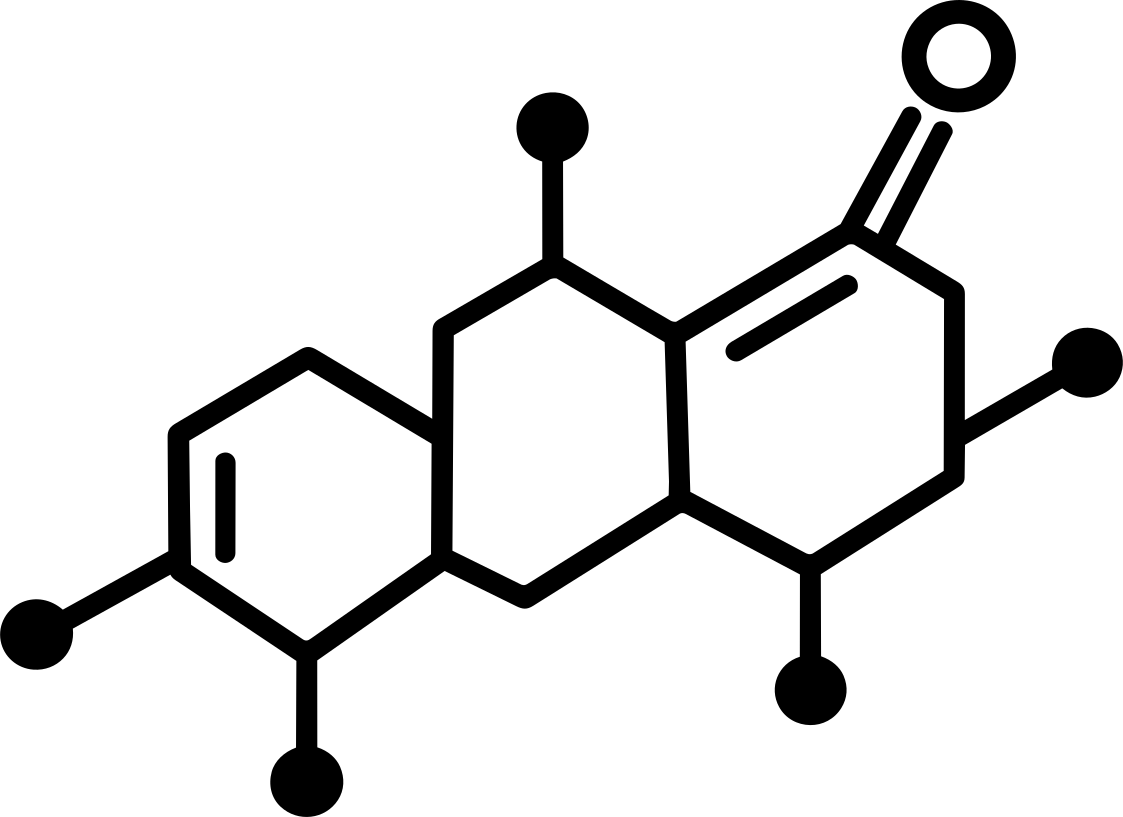
The non-volatile resin fraction
Resin acids · less aromatic · more persistent
The non-volatile fraction of pine resin is the part of the resin material that remains more persistent after most volatile constituents have been lost. Resin acids and related non-volatile compounds play an important role in this fraction.
This fraction is important for understanding the chemical relationship between conifer resins, but it should not be equated with whole fresh pine resin, which also contains volatile aromatic constituents.
What does pine resin contain?
Pine resin is a complex natural mixture of volatile and non-volatile compounds. In fresh resin, volatile terpenes are especially important because they contribute to its characteristic aroma, while the thicker non-volatile fraction contains resin acids and related compounds.
Its composition is not fixed. It varies with pine species, resin age, the part of the tree, environmental conditions and whether the material is fresh resin exudate or more aged resin material. Pine resin therefore cannot be described by one single active compound or one chemical formula.
Volatile terpenes
Volatile terpenes are the more easily evaporating constituents of pine resin. They contribute substantially to its characteristic smell and to the aromatic nature of fresh resin.
Their proportion decreases with exposure to air and over time. Fresh pine resin is therefore usually more strongly aromatic than older, harder and less volatile resin material.
Resin acids
Resin acids are an important part of the non-volatile fraction of pine resin. They belong to the compounds that remain more persistent even after some of the volatile constituents have been lost.
This resin-acid fraction is important for understanding the relationship between different conifer resins. However, this does not mean that pine, spruce and other resins are the same material.
Natural variability
Pine resin is not a standardised substance with an identical composition in every case. It varies between pine species, individual trees, growing conditions and between fresh and aged resin.
When interpreting research, it is therefore important to check what material was actually used. Findings from one resin sample cannot automatically be applied to every pine resin.
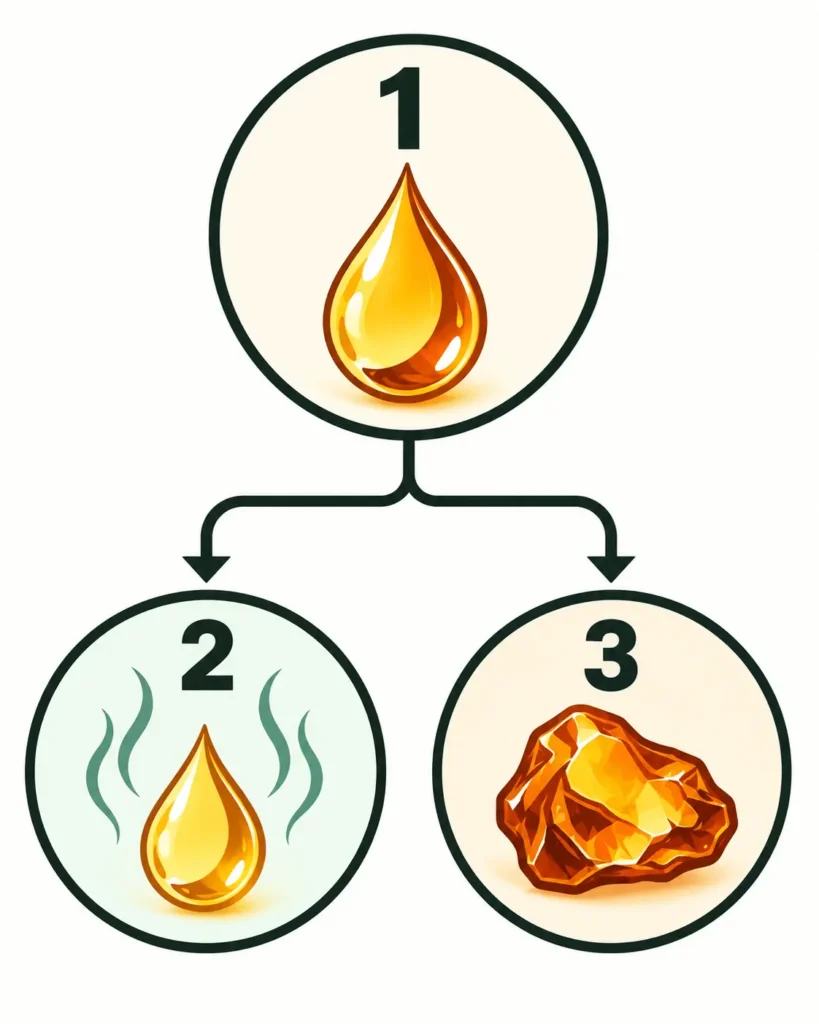
Pine resin, turpentine or the non-volatile resin fraction?
Pine resin, turpentine and the non-volatile resin fraction are not the same material. They are all related to natural pine resin, but they describe different parts or forms of the resin material. For this reason they should not be used interchangeably when discussing composition, use or research.
-
Whole pine resin
The natural resinous exudate of the tree, containing both volatile aromatic constituents and a thicker non-volatile resin fraction. -
The volatile aromatic fraction
The part associated with the characteristic smell of fresh pine resin and with the concept of turpentine. This fraction evaporates more easily and decreases over time. -
The non-volatile resin fraction
The thicker and more persistent part of the resin, in which resin acids and related non-volatile compounds play an important role.
This distinction matters because findings from the volatile fraction, the non-volatile fraction or individual resin acids cannot automatically be attributed to whole pine resin.
How does pine resin differ from spruce resin?
Pine resin and spruce resin are related natural conifer resins, but they are not the same material. Both are produced as part of the tree's defence system and both contain volatile aromatic compounds as well as non-volatile resin constituents. However, they differ in tree origin, natural composition, the proportions of individual compounds and accompanying substances.
Pine resin should therefore not be treated as another name for spruce resin. It is more accurate to understand them as two related conifer resins that share part of the same chemical space, while each retains its own natural profile.
| Comparison | Pine resin | Spruce resin |
|---|---|---|
| Tree origin | Trees of the genus Pinus | Spruce trees, mainly the genus Picea |
| Group | Conifer resin | Conifer resin |
| Volatile fraction | Aromatic compounds associated with the smell of pine resin and turpentine | Aromatic compounds characteristic of spruce resin |
| Non-volatile fraction | Resin acids and related non-volatile compounds | Resin acids and other non-volatile resin constituents |
| Main difference | Different tree origin and different natural proportions of compounds | Different tree origin and its own characteristic resin profile |
The shared term “conifer resin” therefore indicates relationship, not identity. The same applies when interpreting research: findings about one resin cannot automatically be transferred to another.
Pine resin within the broader tradition of tree resins
Pine resin has a place within the broader tradition of using tree resins, but historical sources require caution. Older records often use general terms such as resin, tree resin, conifer resin, resin coating or resin preparation without always clearly identifying the tree species or the exact method of preparation.
For this reason, not every traditional reference to “resin” should automatically be attributed to pine resin. In some cases it may have been pine resin, in others spruce, fir, larch or another tree resin, and in some cases boiled, mixed or otherwise prepared resin materials.
Practical use of resinous materials
In traditional settings, tree resins were valued mainly for their stickiness, water-repellent character, aroma and persistence after hardening. They were therefore used in coatings, sealing, wood protection, repairs, bonding and various household preparations.
When a source explicitly refers to pine or pine resin, it is reasonable to speak about the traditional use of pine resin. When a source only mentions “resin”, it is more accurate to speak about the broader tradition of tree or conifer resins.
Folk preparations and limits of interpretation
Resin preparations also appear in folk medicine and ethnographic records. Such records are important for understanding the history of use, but they do not in themselves prove modern therapeutic efficacy.
Modern interpretation should therefore distinguish between documented tradition, the chemical composition of the resin material and scientific research. These levels can complement one another, but they are not the same.
What does research show about pine resin?
Research on pine resin and related conifer resins is not one single proof, but a set of different levels of evidence. Some studies examine the chemical composition of resins, others individual resin acids, skin-cell models, microorganisms or animal models.
This is why it is important to identify what was actually studied. Fresh pine resin, aged resin material, the non-volatile resin fraction, an individual resin acid or a laboratory-prepared sample are not the same material. Results from one study therefore cannot simply be transferred directly to every pine resin or to use in humans.
Chemical comparison of conifer resins
One important research direction is the comparison of resins or exudates from different conifers. Studies have compared materials from species such as Picea abies, Pinus nigra and Larix decidua.
Such comparisons are useful because they show that conifer resins are not a random group of substances. They share certain chemical features, but individual profiles differ depending on the tree species, the formation of the resin and the material being studied.
This supports the conclusion that pine resin and spruce resin are related, but not that they are identical or have the same effects.
Skin models and keratinocyte migration
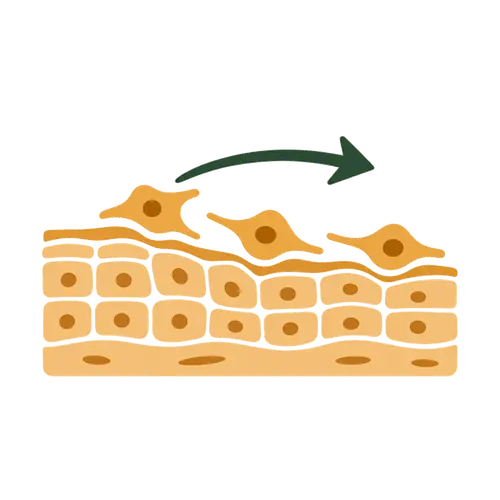
Laboratory skin models are also relevant in research on conifer resins. One research direction has examined the effect of conifer exudates on keratinocyte migration, meaning the movement of skin cells that are important in epidermal repair.
This type of finding is scientifically interesting because it connects a resinous material with a biological process in a cellular model. However, it remains a laboratory model, not clinical evidence that pine resin accelerates skin healing in humans.
The accurate interpretation is therefore that certain conifer resin materials show interesting effects in skin-cell models and deserve further research.
Abietic acid and skin-healing research
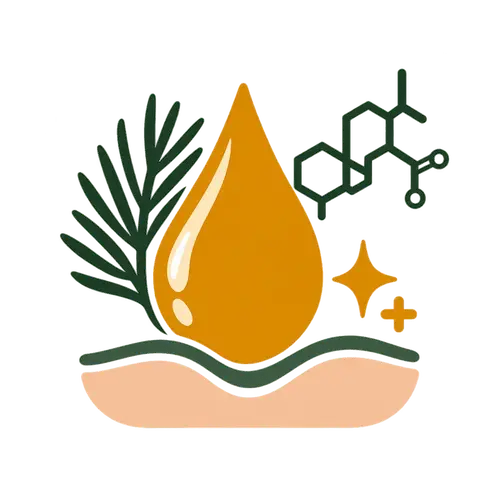
Abietic acid is one of the important resin acids associated with the non-volatile fraction of conifer resins. In a study using abietic acid isolated from pine resin, researchers examined its effect on angiogenesis in a HUVEC cell model and on skin healing in a mouse model.
This is much more specific than a general claim that pine resin has been “researched”. The limitation is important: the study examined an isolated compound, not whole fresh pine resin, and part of the research was performed in mice, not in a clinical study in humans.
This supports the view that individual resin acids are biologically interesting. It does not show that every pine resin has the same effect in humans.
Dehydroabietic acid and inflammatory signalling models
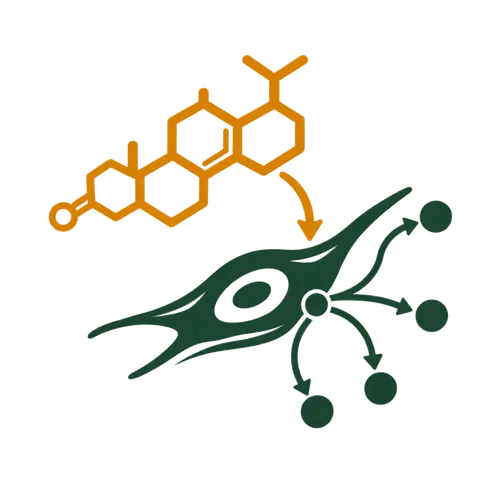
Another compound studied in this context is dehydroabietic acid, an oxidised derivative of resin acids. It has been studied in relation to signalling pathways in human adult dermal fibroblasts, including models involving TNF-α, FOXO1 and TGF-β1/Smad signalling.
Such research is important for understanding possible mechanisms, but it is mechanistic. This means it helps explain what may happen at the level of cells and signalling pathways, but it does not by itself prove a therapeutic effect of whole pine resin.
The fairest interpretation is therefore that resin acids and their derivatives are a research-relevant group of compounds within conifer resins.
What can we conclude from the research?
Available studies show that pine resin and related resin acids are not only historically interesting materials, but also serious subjects of chemical, cellular and preclinical research.
At the same time, the levels of evidence are not the same. Chemical analysis shows what a material contains. A cellular model shows what may happen under controlled laboratory conditions. An animal model is closer to biological reality, but it is still not the same as clinical evidence in humans.
The most accurate conclusion is therefore: pine resin and its non-volatile resin fraction are scientifically interesting, but results from individual compounds or models should not be directly generalised to whole resin or to treatment in humans.
Safety and precautions with pine resin
Natural origin does not mean that every pine resin is suitable for every use. Raw resin is a variable natural material: it may contain more volatile aromatic compounds, more non-volatile resin constituents, bark particles, oxidised substances or other environmental impurities.
It is therefore important to distinguish between general knowledge about resin, traditional records, laboratory research and the actual use of a prepared product. An informational page about pine resin is not an instruction to apply raw resin directly to the skin or to use it as a home remedy.
Possible skin sensitivity
Resinous materials may cause irritation or hypersensitivity reactions in some people, especially in those with sensitive skin, known allergies to resins, fragrances or essential oils, or with frequent or prolonged exposure.
If marked redness, itching, burning, blistering or worsening of the skin occurs after contact with resin, it is sensible to stop contact and, if needed, consult a healthcare professional.
Raw resin and prepared products are not the same
Raw pine resin, aged resin material, the non-volatile resin fraction, the volatile fraction and a prepared final product are not the same thing. They differ in composition, purity, preparation, intended use and safety profile.
Findings about one form of resin material should therefore not be automatically transferred to another form. The same applies to research on individual resin acids: findings from an isolated compound cannot be directly equated with the behaviour of whole natural resin.
When is extra caution needed?
- in people with known allergies or sensitive skin,
- in children, pregnancy and breastfeeding,
- on larger skin injuries, wounds, burns or signs of infection,
- near the eyes, mucous membranes or airways,
- with internal use or ingestion of raw resin.
In more serious problems, rapidly worsening symptoms, fever, pus, spreading redness or severe pain, professional assessment is needed. Resin and traditional preparations should not replace appropriate healthcare.
Frequently asked questions about pine resin
Is pine resin the same as spruce resin?
No. Pine resin and spruce resin are related conifer resins, but they are not the same material. They differ in tree origin, natural composition, the balance between volatile and non-volatile compounds and accompanying substances. You can read more on the page spruce resin.
What does the non-volatile fraction of pine resin mean?
The non-volatile fraction of pine resin is the thicker and more persistent part of the resin material, which remains important after volatile aromatic constituents have decreased. Resin acids and related non-volatile compounds play an important role in this fraction.
Is turpentine the same as pine resin?
No. Turpentine is mainly associated with the volatile aromatic part of pine resin, not with the whole resin. Fresh pine resin contains both a volatile fraction and a non-volatile resin fraction, so it should not be equated only with turpentine.
Why is pine resin not always the same in composition?
Because it is a natural material. The composition of pine resin depends on the pine species, resin age, the place of exudation, environmental conditions, exposure to air and whether the material is fresh, aged or otherwise changed resin.
What does research say about pine resin?
Research mainly examines chemical composition, resin acids, related conifer resins and laboratory or preclinical models. These data are scientifically relevant, but they cannot be directly generalised to every pine resin or to use in humans.
Can raw pine resin be applied directly to the skin?
An informational page about pine resin is not an instruction to use raw resin on the skin. Raw resin is a variable natural material and may cause irritation or hypersensitivity in some people. Skin problems, wounds, infections or stronger reactions require professional assessment.