
The conversation took place on 14.12.2020 live via Skype on Ljubljana TV.
Matic Konc was interviewed by the hosts Maša Tiselj and Rok Škrlep. During the show, the internet connection was occasionally unstable because it was overloaded by the remote schooling of three children on Zoom.
Transcription of the conversation:
Maša: Our guest, Matic Konc, may sometimes have bad luck, but it has brought him good fortune in life. Having resin in your life can be a problem, but spruce resin is a blessing, as its healing properties have been known for thousands of years. The ancient Greek physician Hippocrates, the father of scientific medicine, already wrote about its use in healing. Native Americans also knew it well, chewing pine resin for sore throats and various digestive and oral problems. From them, the American John B. Curtis got the idea to produce the first commercial chewing gum. Here too, pine resin has long been used in folk medicine for many ailments. Today we will talk about spruce resin treatment with biomedical engineer Matic Konc, director and owner of the company Smrekovit from Ljubljana, which also handles resin harvesting and production. Matic, welcome to our program.
Matic: Hello.
Rok: Greetings. Maša mentioned that you are also involved in resin harvesting at Smrekovit. I am particularly interested in what this harvesting looks like. So do you actually go into the forest with pots and start collecting, or is it done in a different way?
Matic: We collect resin in a way that does not harm the trees, choosing places where spruces have already been damaged by logging, falling rocks, or similar factors. However, the process of spruce regeneration is very slow, so we only go to the same place where we have already collected resin again after 10 years.
We collect resin in a way that does not damage the trees, in places where spruce trees have already been damaged by logging, falling rocks and similar factors.
Rok: How much resin do you get from one tree?
Matic: It varies a lot. Some trees produce several kilograms of resin, while others yield only a few grams. This is usually dry resin that has been on the tree for a long time, so the amount differs greatly. Most spruces don’t have any resin at all.
Maša: Why do trees produce resin in the first place? What is its function on the tree itself?
Matic: The main function of resin in a tree is to heal damaged bark. When the trunk is wounded, resin covers the injury and protects the tree from microorganisms such as fungi and bacteria, and also from insects.
Rok: Matic, as a point of interest, I wanted to mention that amber, a semi-precious stone, is also made from the petrified resin of conifers, isn't it?
Matic: Amber is fossilised conifer resin that polymerised over millions of years into a hard substance. It is valuable in archaeology because it often preserved ancient insects that are now studied. What fascinates me most is resin’s natural preservative power: in a mosquito trapped in amber for 40 million years, scientists can still observe cells and even cellular structures such as mitochondria under a microscope.
In a mosquito that has been trapped in amber (fossilised resin) for 40,000,000 years, scientists can still observe cellular structures such as mitochondria under a microscope.
Rok: Indeed, resin is an extremely interesting substance. But why is it used in practice? What is its purpose and for what purpose do your customers use your products?
Matic: Resin, whether spruce or pine, which are very similar in composition, can heal almost any type of inflammation—whether caused by mechanical injury, heat, cold or microbes. It is also antifungal and antibacterial. Exactly how it works is still not fully understood. Resin contains more than 80 organic compounds, and its effect is likely due to their combined action. Scientists have studied its effects, particularly on wound healing (notably Finnish researchers), and Russian scientists have shown that it can stimulate the local immune response, especially by activating neutrophils through the water-soluble fraction of the resin. This stimulation, however, may also explain why 3–4% of people develop an allergy to spruce resin.
Resin is made up of more than 80 organic compounds, and its effect is most likely due to the synergistic effect of several of these compounds.
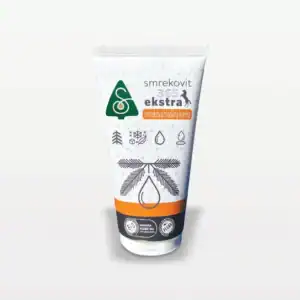
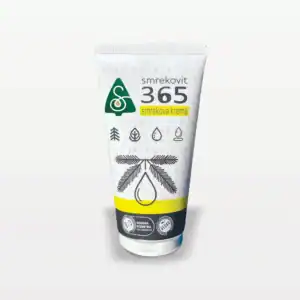
As far as the use of our products is concerned, most people use them for degenerative conditions such as joint pain, back pain, sciatica or, for example, a thorn in the heel, which is what people have the most problems with anyway. The results come quickly: within 14 days users notice clear improvements, usually 70 to 80 percent when the product is used correctly, though not complete recovery. Things like sciatica, for example, take a little longer. For these problems we recommend our creams Smrekovit 365 and Smrekovit 365 Extra.
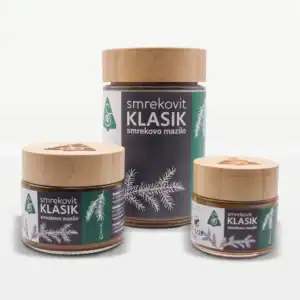
Smrekovit Klasik is very effective in the treatment of wounds.
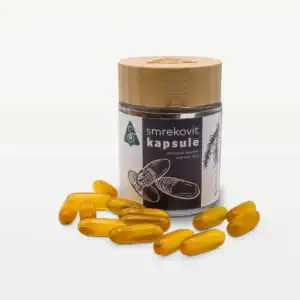
For stomach and intestinal problems, we have Smrekovit capsules, which also give fast results. Within a few days, the symptoms are significantly better (gastritis, stomach sores, etc.).
According to the Russian scientists, resin is most likely to affect inflammation by stimulating the local immune response,
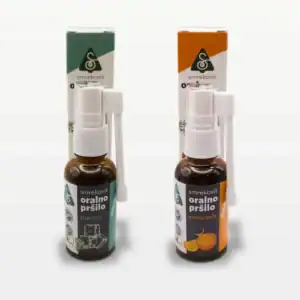
For sore throats, inflamed gums and mouth aphthae, Smrekovit is an oral spray, which also gives results in one to two days.
I have to say that this kind of efficiency gives me a boost to my work, because practically all the feedback we get is good. Very rarely do we get any negative feedback.
-

Smrekovit 365 Ekstra – spruce cream with a cooling effect
14,00 € -
Smrekovit 365 spruce resin cream
14,00 € -
Smrekovit Capsules 50+ (food supplement)
10,00 € -
Smrekovit Klasik spruce resin ointment
Price range: 6,00 € through 35,00 € -
Smrekovit oral spray
10,00 €
Maša: Another interesting fact is that the first chewing gum, made in 1848, was based on resin. What did they add to it to create chewing gum?
Matic: Yes, that’s right. In 1848, American businessman John B. Curtis got the idea from Native Americans. As you mentioned, they often chewed resin, which inspired him to create something commercial (in America everything has to be turned into a product). He mixed the resin with beeswax, sprinkled it with sugar and that's how the first chewing gum was created. Such a combination can be chewed very nicely.
You can also try chewing pure resin in nature, but you need to find the right kind: not too hard, not too soft, but soft enough with a cloudy texture. At first, you slowly move it around the oral cavity on the tips of your teeth, and when it reacts with the saliva, it forms a mixture that can be chewed like chewing gum.
John B. Curtis went a step further and made the stuff more workable by mixing it with beeswax, and later made several versions by adding different flavourings, and it is said that even kerosene was added for softness.
You can also try chewing pure resin in nature, but you need to find the right kind: not too hard, not too soft, but soft enough with a cloudy texture.
Rok: Matic, have you ever tried chewing resin? I have the feeling that it would stick to my teeth. Is that true, or is it actually easy to remove it from the teeth afterwards?
Matic: Of course, I have tried many times. You need to start gradually: first on the tips of your teeth, and only when it mixes with saliva can it be chewed. If you bite into it too quickly, it will stick to your teeth and be difficult to remove.
Maša: That is to say, carefully and in the right way. But your company has a long history. Your father started with pine resin products. Can you tell us more about the beginnings of the company, who were the first customers?
Matic: It all began in 1990, so this year marks 30 years of our resin products. The story started with my father’s own health problems. From a young age he suffered from back pain and sciatica, and was even exempted from military service in the JNA. He was treated by Mrs. Prežla from Lesce in Gorenjska, who made a black, sticky resin preparation and applied it to his lower back after slightly scratching the skin. The treatment helped him greatly and introduced him to resin. In 1989 he was inspired to create a more user-friendly product and that same year produced the first spruce ointment on a burner in front of his garage. When a neighbor with hip pain tried it, word spread quickly—first among friends and acquaintances, and then more widely—and within a year the ointment was known across Yugoslavia. In 1990 he started his own business and left his job as a physical education teacher. That was the beginning. I have been part of it practically since childhood, and I officially took over the company ten years ago.
In 1989, my father Ivo Konc was inspired and made the first spruce ointment on a burner in front of the garage.
Maša: And while you mentioned that resin is useful for treating spinal problems (your father had similar problems), I hear you have developed a special manipulative therapy specifically for treating spinal problems. Can you tell us about it?
Matic: The method was developed by my father. He knew functional anatomy from sports and studies, and then, under the influence of a well-known manipulative therapy practitioner, Ahchin from Domžale, he developed his own method. It is a non-aggressive manipulation of the spine, but it is very effective for spinal problems and accompanying pain along the nerves (upper limb pain, sciatica, etc.). My father passed on the knowledge of the method to me and to Roman Perk (former Junior Nordic Combined World Champion), but I don't think anyone is doing it at the moment because of the epidemiological picture.
Rok: How do you process and package the resin? I have seen that in the intermediate stage, the resin is also in a liquid state.
Matic: Yes, resin is a very difficult material to handle because it is sticky. We have developed procedures to make working with it as simple as possible. Of course, when we collect the resin, it is mixed with bark and other impurities from nature, which we purify in the course of the production process, but I would not, of course, disclose the details of the processes themselves. ????
Rok: Finally, Matic, can you tell us where your products can be obtained at all, do you have a website where it is possible to order, and how is it these days?
Matic: These days, business is almost normal because we sell mostly online, by telephone order and in pharmacies and specialist shops. We supply practically all pharmacies and specialty shops through Chemopharmacy and LL Wholesale. Even in these times everything is normally stocked.
Maša: Thank you Matic for taking the time to equip us with information about resin and we have learned that if resin sticks to us we need to manipulate it so that it sticks to us in our favour.
Matic: Thank you very much for the invitation, and may the resin stick with you—in the best way. ????