
The interview was originally published in Glas občine Naklo, December 2024.
Although Ivo Konc was not born in Naklo, everyone considers him a true a true local of Naklo, since his family moved here when he was still a cheerful and mischievous little boy who was always up to something. From an early age he faced serious health problems that put both him and his mother through many trials. Even in adulthood fate did not spare him, and this was partly what led to the creation of the healing spruce ointment, which today helps many people ease various health problems.
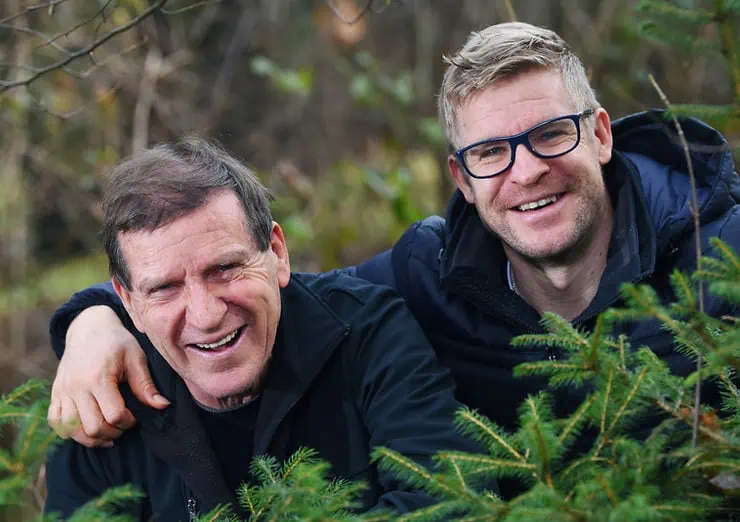
Ivo Konc - Childhood and Troubles
In Naklo and the wider area you are known mainly as the inventor of spruce ointment, but your career started in a very different way, didn't it?
Yes, it is true.
Can you tell us a little about your childhood, which I know was not easy.
It was the time after the war (1948) when I was sent out into the world, a time of scarcity, uncertainty and new hope, a time without cars, radio and television, when we knew how to enjoy the little things. At the age of two months, I developed boils all over my body (except on my face) as a result of blood sepsis. Two months of treatment brought no improvement, and when I was taken to hospital the factory doctor told my mother that I would surely die there. He gave her iodine for the fresh boils and ichthyol for the mature, purulent ones. Within three weeks I had recovered. Older people still remember that ichthyol was then called “that black gum” and was made from the resin of sunken Siberian conifers.
In 1953 we came to our house in Naklo, where a new world opened up for me. The whole village and its surroundings were ours, from Želin to Sava. The harsh winters brought a new ordeal. As we children were out in the snow all day and in the evenings the ice candles were hanging from us, I came down with acute rheumatic fever. I could not get on my feet for more than a week. I had knee pain all my youth. I had many childhood illnesses: measles, mumps, rubella and chickenpox - they seemed fun because we were not allowed to go to school.
I contracted tick-borne meningitis when I was 10 years old. Doctors punctured my spinal canal twice to examine my cerebrospinal fluid. Since then my head and spine have never felt the same. The first summer after the illness I suffered such a severe sunstroke that I could only leave the house after sunset for the entire summer.
When I was 12, we used to collect pine cones to reforest the Karst. When I was climbing on the young pines after them, the top broke off and I fell from about four metres onto my back. I couldn't speak for two days, and to this day I still like to get stuck for words.
The same year I hit my shin on a rock and the wound refused to heal, it festered and after two months the bone started to rot. Medicine was powerless. I went to Dr. Fajdiga (private practice), he gave me his ointment which smelled of pitch. Within three weeks the wound was healed.
After finishing eighth grade, while we youngsters were demolishing Kramar’s house, I jumped from a beam in the attic into the hay, where sharp wooden splinters pierced deep into my foot. The next day, despite a high fever, I sat for the entrance exam for grammar school and passed. That marked the end of my childhood.
Youth, studies and the coaching profession
How was your growing up?
It was a turbulent period. I wasn't the best as a student, but I was a good footballer and ski jumper. I jumped for Triglav in Kranj and made it to the top of the national team. I had three concussions. My increasingly critical attitude towards the society of the time brought me severe internal struggles.I fell into a dark period that would today be called depression. I became apathetic, unable to read, study or even continue ski jumping. In the second semester of my final year of grammar school, I was completely adrift. By the autumn I had somehow recovered and successfully finished high school. Among my new classmates was my current wife, with whom I have been together for 55 years. And I was back on the ski jumping hill again and tore my anterior cruciate knee ligaments. I recovered without medical treatment and managed to complete the first year at the Faculty of Sport in just half a year. I finally stopped jumping.
What made you want to study sport?
Studying sport was the logical choice, as I was convinced that I was called to a coaching career. I was already working with young people as a student, and I was very enthusiastic about doing this work for a pittance. At school I was employed as a physical education teacher, and I worked as a coach for Triglav and later Križ (today SSK Tržič). At that time I built the first 50-metre plastic ski jump with my boys (aged 14 to 18), and in Križ I repeated this feat with the younger ones by building a 25-metre ski jump. In Kranj, I won a shoe as a prize. At this time, I also started to experience unbearable pain in parts of my spine. I worked as a professional coach only in the 79/80 season in Kranj, from where I fled.
Has your professional life always been about sport and young people?
No. After 1989, when my son Anže died in a car accident, in my second life, my life was turned upside down, and a new mission began — one that I believed was pleasing to God. For a while I was still drawn to the old ways, but more and more I felt that I wanted to and could help people. My time as a teacher and coach was coming to an end.
Learning always goes both ways. What have young people unwittingly taught you?
Young people taught me that nothing can be achieved by force. If they feel you love them, they will follow you of their own accord.
The invention of spruce ointment
And where did the story of the spruce ointment come from?
The story is interesting. It started at school. I was playing basketball with my pupils, and when the ball bounced, Iztok Čop and I each hit the ball from our side. I sprained my finger. I knew the effects of pine resin because the old Prežla in Lesce used it as a cure. In my injury, this resin was difficult to use, so I tried to make something myself that would not be black and sticky. I heard a voice: "Go and get the resin, add this and that, boil it, strain it ...
On the way home, I was approached by a neighbour, a seamstress, whose knees were very sore. "Ivo, will you give me some when it's ready?" "I will," I replied, keeping my word. Within 14 days, her walking became light and flexible. The word got around and after less than a year, without offering or advertising the ointment, I was selling it in my home, in herbal pharmacies and sending it by post all over Slovenia and the former Yugoslavia. It took me a year and a half to earn more money from the ointment than a teacher, stay at home, open a sole proprietorship, and I have been on the market for 34 years without a cent invested in advertising. If that is not a miracle?
-

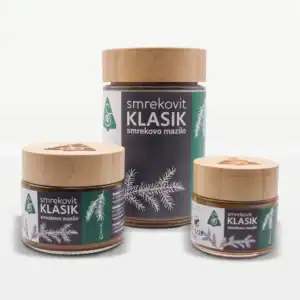
Smrekovit Klasik spruce resin ointment
Price range: 6,00 € through 35,00 €
How did you know that you could solve your problems with spruce ointment? Did you know it from before?
I was looking for all possible solutions to my back problems, as medicine offered me nothing but painkillers and a knife. It was so bad that the Faculty of Medicine exempted me from all practical exams when I was already a graduate. Even the army orthopaedic surgeon gave me a green booklet without a second thought, with the inscription: Unfit for service in peacetime. In Kranj, the orthopaedic surgeon promised me a wheelchair before the age of 30 if I didn't have the operation. I didn't go! And I didn't go to the doctors any more. One of the many helpers was a black sticky resinous mixture, dissolved and smeared on fabric, made by Aunt Prežla in Lesce. And I found help in the resin again, just as I did then with the blow to the leg and the treatment of the tura.
I suppose you also needed some knowledge of biology and chemistry to create it. How did you approach the business side of things?
My knowledge of biology and chemistry was the same as in high school, i.e. low. A glimpse of how to make an ointment appeared as a gift from God at the time of the greatest grief over my son's death and refocused my thoughts.
All beginnings are always difficult. Did you know right away that this ointment would be so successful? How did the idea develop?
Everything happened spontaneously; at first I only wanted to help myself. I never intended to turn it into a business.
But it's not just about the ointment. How else have you helped (and still do) people who turn to you with their problems?
In 1993, I was asked to be a therapist for the football players from Naklan, who played in the 1st Slovenian League. I started to perform manipulations with them for the placement of intervertebral discs. It worked. Since then, thousands of people have come to me for help. I have helped many well-known athletes to return to competition, most of all the jumpers Peterka, Petr and Domen Prevc, Kranjc, Hrgota, Jelar, the gymnast Petkovšek, the track and field athletes Brita Bilac and Jolanda Čeplak, the cyclists Tadej Valjavec and Andrej Hauptman, the rowers Čop and Mujkic, and many others. Just last year, even Noriaki Kasai came to me for help.
Did you have time for any other activities, perhaps a hobby, while working and working with the ointment?
My work is also my hobby. Every day I find time to walk (preferably in the woods) or read. Working with people makes me feel fulfilled and happy.
Are you one of the lucky ones who have been able to pass on your business to your children, in your case your son Matic? Did you have to encourage him to do so, or did he simply become so attracted to the cause that he took up your mission?
He always said he was going to take over the craft. When the time came, I warned him to think carefully about whether he would be happy doing this job. And now he does it with joy, heart and knowledge.
Have you experienced anything in these years that has particularly influenced you?
All that I have written about has had a profound impact on me. At the age of 48, God the Father opened my heart to seek God's love. I invited Jesus and Mary into our family and suddenly everything was different - more beautiful, better, everything made sense, even suffering and death.
You still go into the forest regularly, often with your wife. What draws you to nature, what does nature mean to you?
The forest is my life. It fills me with awe, and when I look at creation, my spirit is lifted toward the Creator.
What is your life motto, thought or guiding principle that has helped you through all the storms, good and bad?
God's commandments are our signposts for life, imprinted on our soul, consciousness and subconscious. That is why we know when we are doing the right thing and when we are doing the wrong thing. If we keep them, follow God's will, do good, we are a joy to God and to people, and after death we come into God's safe embrace.
What are your plans for the future?
The future always surprises us because it never turns out as we expect. That is why I do not make plans. As Jesus said, each day has enough of its own burden. I leave the future to Him, knowing from the past that through God’s grace and providence even the worst things have turned into good.